
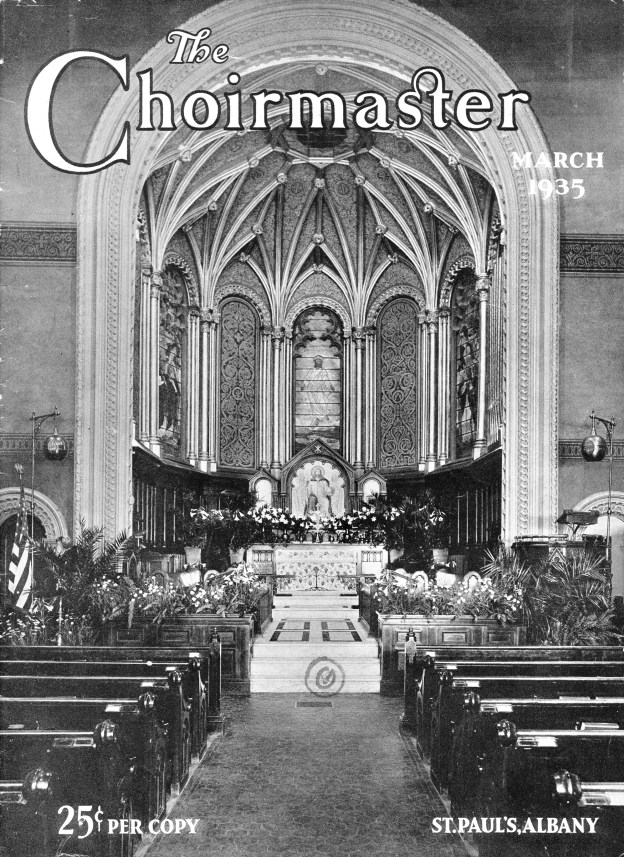
Yesterday, Steven Rosenberry shared a wonderful find: a copy of The Choirmaster featuring an article in which Thomas Handel Frederick Candlyn (St. Paul’s organist and choirmaster 1915-1943) describes his professional life up to 1935.
There are details here not available from any other source, and all in Candlyn’s words, as told to the magazine’s editor. Candlyn reports having “composed a fair amount of music since 1919,” but the attached list shows how modest he was being, with 85 compositions in 16 years, 2 of which he was in military service!
The magazine cover is a fine photograph of St. Paul’s nave and chancel, and inside is a professional portrait of Candlyn, “Choirmaster – Conductor – Composer.”

T. F. H. Candlyn about 1935 (The Choirmaster, March 1935)
Once a Choirboy – Now Famous as Organist and Composer
As told to your editor
I was born in a small village in the County of Cheshire, England, December 17, 1892 and have never since been able to overcome an antipathy to any rural surroundings. At about the age of seven became a choirboy in the Parish Church, where my father was organist and choirmaster and later played the organ for full rehearsals. (Must have been about nine when I first started to play). After my voice broke, my studies, musical and otherwise, continued, and in due time I matriculated as a student in music at the University of Durham, receiving a Bachelor of Music degree in 1911. Was appointed sub-organist of Doncaster Parish Church, my superior being Wilfrid Sanderson, the well-known composer of songs. Dr. E. Miller, the composer or arranger of the hymn tune “Rockingham” was organist of this Church from 1756 to 1807.
Sometime in the early part of 1914 I visited the United States and was impressed by the many opportunities for a Church musician, particularly for one accustomed to boy choir work. I returned to England, and on the advice of the late Dr. J. C. Bridge of Chester Cathedral, made plans to leave my native country. Meanwhile, war broke out, but as the only son of a widow I was exempt from military service. I therefore settled in the United States and in May 1915 was appointed organist and choir-master of St. Paul’s Church, Albany, N. Y. Here I had the good fortune to have the Rev. Roelif H. Brooks as my Rector. Shall never forget his wonderful personality and the encouragement he gave me all the time he was there. (Dr. Noble is very fortunate in having him as Rector of St. Thomas’ Church).
Later I did some post-graduate work at the State College, Albany, forsaking musical studies for philosophy, history, and Greek. When the United States entered the war, I soon found myself in a training camp and eventually became quite proficient in the use of such lethal weapons as bombs and bayonets. My division arrived in France in July 1918, one of my companions on the transport being Lee Pattison, well-known pianist. Albert Stoessel also was a member of the same division. It was thought that my professional training might be useful in keeping up morale, so much of my time was taken up in arranging concerts and playing for Church Services throughout the divisional area. As most of my playing was done on decrepit pianos of uncertain age, and an intractable reed organ, I doubt whether morale was improved to any extent. Three days before the Armistice, the division was broken up for use as replacements if necessary, but the war ended as I was bound for the front.
1 arrived in New York on the U. S. Seattle on Easter Sunday, 1919, and a week later was again in harness. I recommenced my studies at the State College and became a member of the faculty in 1920. For four years I worked with Dr. H. W. Thompson in the Department of Music. On Dr. Thompson’s return to the English Department I was appointed head. My colleagues and the Board of Regents seemed to think I was worthy of further honours, so the College conferred on me a doctor’s degree in 1927. As the College had only once before given a degree to a member of the faculty, I felt that the status of music as a subject had greatly advanced in College circles.
My present work at College consists of teaching the appreciation of music, harmony, etc., and the direction of a mixed chorus and operatic society. In addition I manage a series of concerts and recitals given under College auspices. For the last three years the Albany Oratorio Society has been under my direction. At St. Paul’s Church I have a boy choir which gives me a great amount of pleasure. There is no Church work that is so interesting and so satisfying as the training of a boy choir.
I have composed a fair amount of music since 1919. I had an amusing experience with “O come, O come Emmanuel”. This anthem was written in about thirty minutes and sent to the H. W. Gray Co. It had no luck and was duly returned to me.
Seeing an announcement regarding the Clemson Prize Anthem, I mailed “O come Emmanuel”, and sometime later was greatly pleased to receive word that it was judged worthy of the award. By the terms of the A. G. O. agreement, Mr. Gray had to publish the anthem and pay me well! Since that time, I have been lucky enough to win the Strawbridge & Clothier prize for a cantata, the N. A. Ο. prize for an organ sonata, and the Philadelphia Sesquicentennial prize for a suite.
The men who have influenced me most in my Church work are the late Dr. J. C. Bridge, Sir Edward C. Bairstow, and Dr. T. Tertius Noble. Before the latter came to the United States, I attended many services at York Minster. The masterly treatment of the organ and the impeccable style of Dr. Noble’s service-playing made a deep and lasting impression on me. St. Thomas’ is indeed fortunate in regard to both Rector and Organist.

T. F. H. Candlyn Compositions 1919-1935 (The Choirmaster, March 1935)
 Grain, Once Scattered