Author Archives: Paul Nance

Dr. Candlyn’s Early Career, in His Own Words


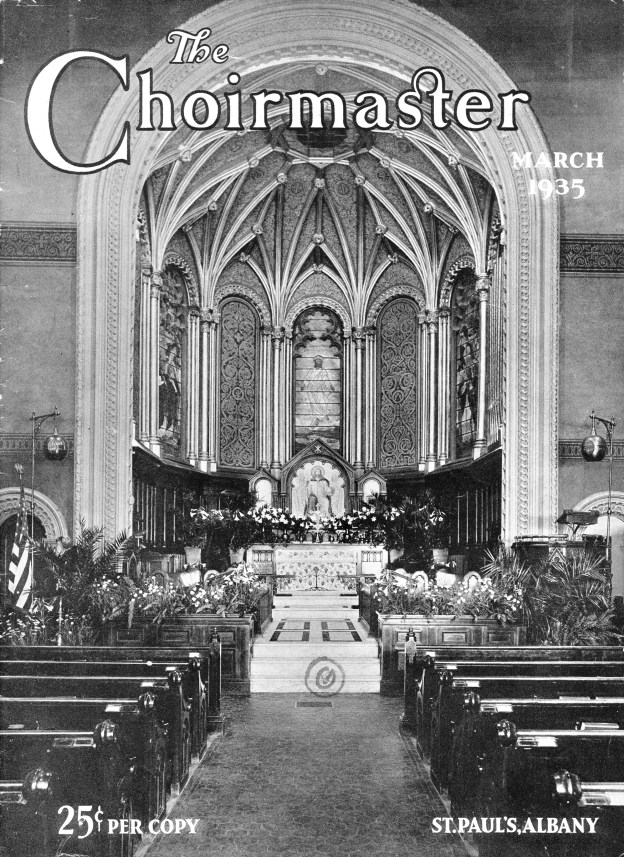
Yesterday, Steven Rosenberry shared a wonderful find: a copy of The Choirmaster featuring an article in which Thomas Handel Frederick Candlyn (St. Paul’s organist and choirmaster 1915-1943) describes his professional life up to 1935.

There are details here not available from any other source, and all in Candlyn’s words, as told to the magazine’s editor. Candlyn reports having “composed a fair amount of music since 1919,” but the attached list shows how modest he was being, with 85 compositions in 16 years, 2 of which he was in military service!

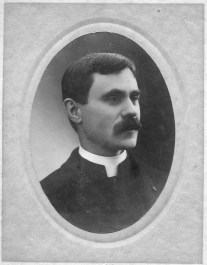
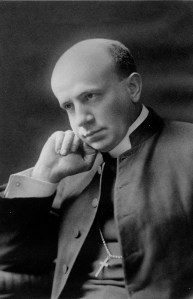
The magazine cover is a fine photograph of St. Paul’s nave and chancel, and inside is a professional portrait of Candlyn, “Choirmaster – Conductor – Composer.”

T. F. H. Candlyn about 1935 (The Choirmaster, March 1935)

Once a Choirboy – Now Famous as Organist and Composer

As told to your editor

I was born in a small village in the County of Cheshire, England, December 17, 1892 and have never since been able to overcome an antipathy to any rural surroundings. At about the age of seven became a choirboy in the Parish Church, where my father was organist and choirmaster and later played the organ for full rehearsals. (Must have been about nine when I first started to play). After my voice broke, my studies, musical and otherwise, continued, and in due time I matriculated as a student in music at the University of Durham, receiving a Bachelor of Music degree in 1911. Was appointed sub-organist of Doncaster Parish Church, my superior being Wilfrid Sanderson, the well-known composer of songs. Dr. E. Miller, the composer or arranger of the hymn tune “Rockingham” was organist of this Church from 1756 to 1807.

Sometime in the early part of 1914 I visited the United States and was impressed by the many opportunities for a Church musician, particularly for one accustomed to boy choir work. I returned to England, and on the advice of the late Dr. J. C. Bridge of Chester Cathedral, made plans to leave my native country. Meanwhile, war broke out, but as the only son of a widow I was exempt from military service. I therefore settled in the United States and in May 1915 was appointed organist and choir-master of St. Paul’s Church, Albany, N. Y. Here I had the good fortune to have the Rev. Roelif H. Brooks as my Rector. Shall never forget his wonderful personality and the encouragement he gave me all the time he was there. (Dr. Noble is very fortunate in having him as Rector of St. Thomas’ Church).

Later I did some post-graduate work at the State College, Albany, forsaking musical studies for philosophy, history, and Greek. When the United States entered the war, I soon found myself in a training camp and eventually became quite proficient in the use of such lethal weapons as bombs and bayonets. My division arrived in France in July 1918, one of my companions on the transport being Lee Pattison, well-known pianist. Albert Stoessel also was a member of the same division. It was thought that my professional training might be useful in keeping up morale, so much of my time was taken up in arranging concerts and playing for Church Services throughout the divisional area. As most of my playing was done on decrepit pianos of uncertain age, and an intractable reed organ, I doubt whether morale was improved to any extent. Three days before the Armistice, the division was broken up for use as replacements if necessary, but the war ended as I was bound for the front.

1 arrived in New York on the U. S. Seattle on Easter Sunday, 1919, and a week later was again in harness. I recommenced my studies at the State College and became a member of the faculty in 1920. For four years I worked with Dr. H. W. Thompson in the Department of Music. On Dr. Thompson’s return to the English Department I was appointed head. My colleagues and the Board of Regents seemed to think I was worthy of further honours, so the College conferred on me a doctor’s degree in 1927. As the College had only once before given a degree to a member of the faculty, I felt that the status of music as a subject had greatly advanced in College circles.

My present work at College consists of teaching the appreciation of music, harmony, etc., and the direction of a mixed chorus and operatic society. In addition I manage a series of concerts and recitals given under College auspices. For the last three years the Albany Oratorio Society has been under my direction. At St. Paul’s Church I have a boy choir which gives me a great amount of pleasure. There is no Church work that is so interesting and so satisfying as the training of a boy choir.

I have composed a fair amount of music since 1919. I had an amusing experience with “O come, O come Emmanuel”. This anthem was written in about thirty minutes and sent to the H. W. Gray Co. It had no luck and was duly returned to me.

Seeing an announcement regarding the Clemson Prize Anthem, I mailed “O come Emmanuel”, and sometime later was greatly pleased to receive word that it was judged worthy of the award. By the terms of the A. G. O. agreement, Mr. Gray had to publish the anthem and pay me well! Since that time, I have been lucky enough to win the Strawbridge & Clothier prize for a cantata, the N. A. Ο. prize for an organ sonata, and the Philadelphia Sesquicentennial prize for a suite.

The men who have influenced me most in my Church work are the late Dr. J. C. Bridge, Sir Edward C. Bairstow, and Dr. T. Tertius Noble. Before the latter came to the United States, I attended many services at York Minster. The masterly treatment of the organ and the impeccable style of Dr. Noble’s service-playing made a deep and lasting impression on me. St. Thomas’ is indeed fortunate in regard to both Rector and Organist.

T. F. H. Candlyn Compositions 1919-1935 (The Choirmaster, March 1935)
 

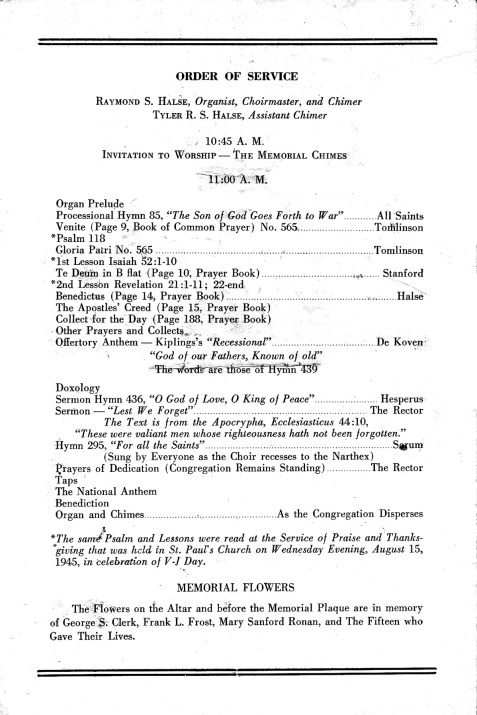
Dedication of the War Memorial Chimes

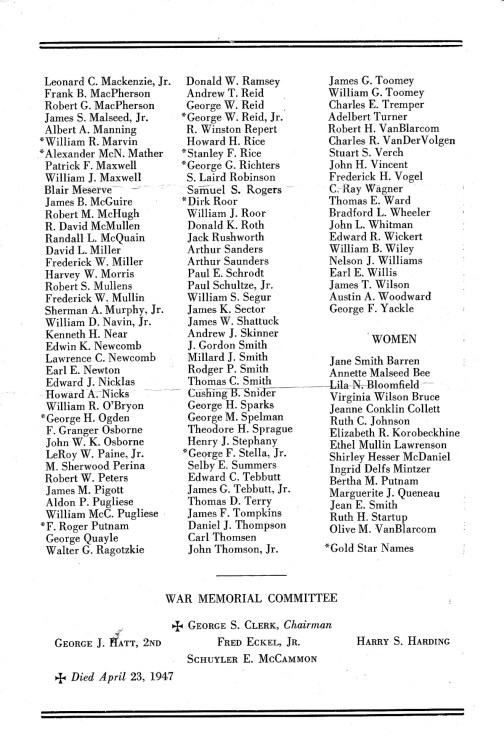
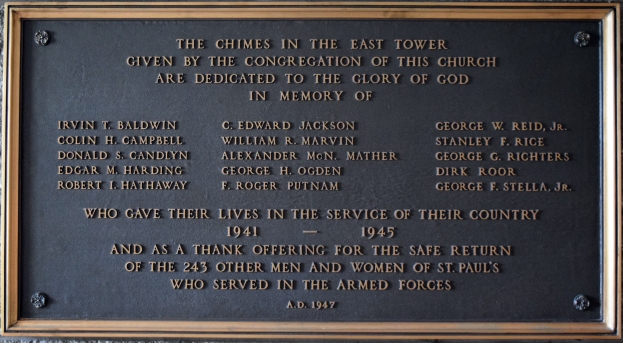
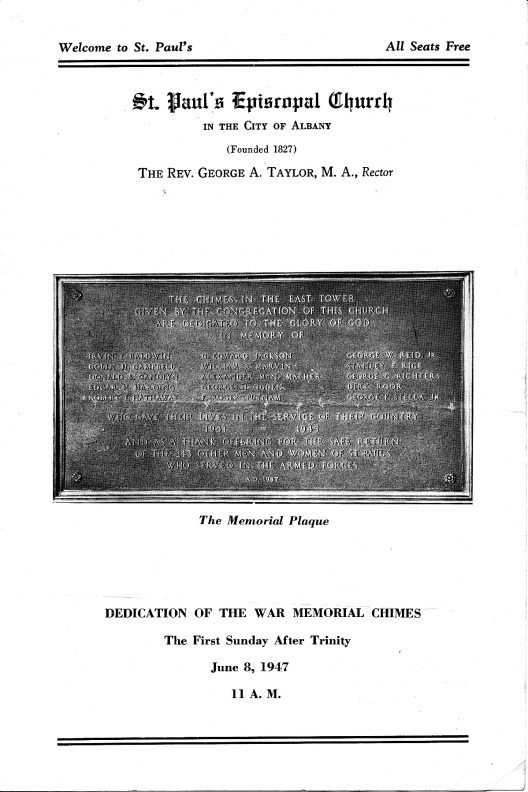
A few years ago, I posted a brief piece on the dedication of the war memorial chimes in June 1947. Now, thanks to a donation to the parish archives, we have a copy of the bulletin for that event.

Appropriately, today is Veterans Day, because the service bulletin lists all 258 of the St. Paul’s parishioners who served in World War II.

Dedication of the War Memorial Chimes, page 1

Dedication of the War Memorial Chimes, page 2


Dedication of the War Memorial Chimes, page 3

Dedication of the War Memorial Chimes, page 4

The Neemes Memorial Lectern

When St. Paul’s was forced to move from our long-time home on Lancaster Street, the wardens and vestry had a difficult decision to make. Of the many memorial objects in the century-old building, how many could be incorporated into the “new modernistic St. Paul’s”[1] on Hackett Boulevard? As a Times Union reporter framed the issue, “the congregation was faced with deciding how to retain this heritage tastefully in the contemporary style building.”[2]

Plans were made early on to include ten of the memorial windows into the new narthex.  Our only Tiffany window found a place in the vesting room and two brass tablets were installed in the new building. But most of the remaining memorial objects were either left with the building to be auctioned by the State or buried beneath the new altar.

Neemes memorial lectern

But there is one other memorial hidden in plain sight in the Hackett Boulevard building. I’m speaking of the small lectern in the narthex, holding the guest register. A brass plaque names the three sisters in whose memory it was given:

Sarah Neemes (1831-1904)

Phebe Neemes Washburn (1842-1910)

Elizabeth Neemes Husted (1843 – 1909)

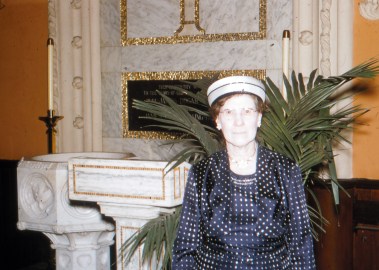
The lectern was dedicated in January 1911 and placed in the baptistry of the Lancaster Street church. With this addition, the baptistry was entirely decorated in marble with glass mosaic, all the pieces designed and built by J. and R. Lamb Studios. In addition to the lectern, it consisted of a marble platform with the decorated wall behind it,[3] a tablet in memory of John and Rosanna Clemishire,[4] and an image of the Christ Child.[5] The only photograph I can locate was taken about 1958, showing an unidentified woman. You can just see the top of the font and the lectern and a bit of the wall behind the platform.

Lancaster Street Baptistry, about 1958

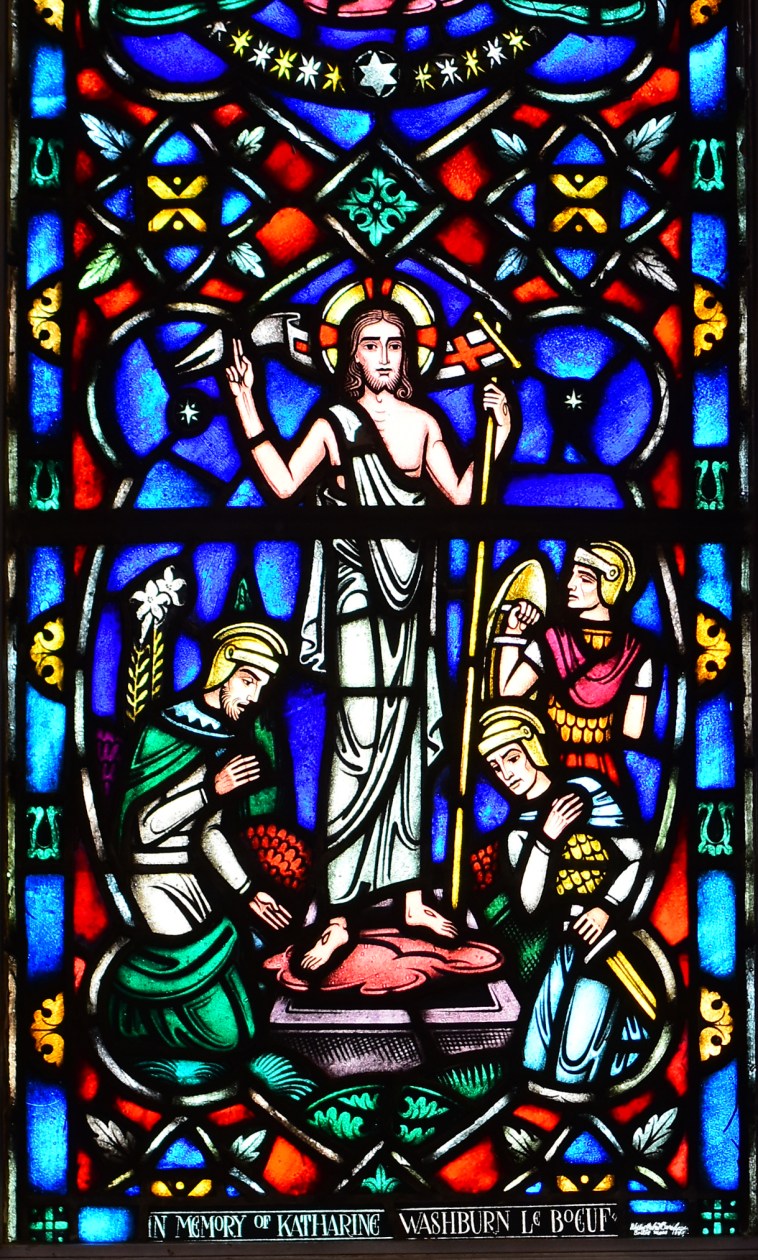
The lectern was donated by Phebe Neemes Washburn’s daughters, Katherine Washburn Le Boeuf and Elizabeth Washburn McKown. You may recognize those names. Two windows in our chapel were given in memory of the daughters.

“The Resurrection,” window in memory of Katherine Washburn Le Bouef

Katherine Washburn (1872-1943) married Randall J. Le Boeuf, a long-time St. Paul’s vestryman and warden. She donated the chapel’s rose window to his memory in 1942.

“The Last Supper,” window in memory of Elizabeth Washburn McKown

Elizabeth Washburn (1871-1948) married William J. McKown. This window was purchased with a bequest to St. Paul’s in her will.

[1] “Episcopal Church Consecrated: Modernistic St. Paul’s Replaces Mall Site Edifice,” Times Union Jun 1966 (precise date not available).

[2] “The New St. Paul’s Ready Next Week,” Times Union 2 Apr 1966.

[3] “Interest is Increasing at St. Paul’s,” The Argus 1 Apr 1907, page 3. 1912 Year Book: “Erected in memory of James Bogart Laing, for many years a vestryman of Saint James’ Church, Brooklyn, and as a thank- offering for the Baptism of James Bogart Laing Huntington, whose baptism took place in Saint Paul’s, 1906.”

[4] 1912 Year Book: “erected to the memory of John and Rosanna Clemishire by their children. Mr. Clemishire was a vestryman and one of the firm of builders which constructed the present edifice.”

[5] 1912 Year Book: “In memory of William C. Bouck Murray and Bessie Sanford Murray, children of Dr. and Mrs. William H. Murray, the donors.” A recent record of this item is a 2012 auction sale. https://www.cowanauctions.com/lot/ecclesiastical-mosaic-set-in-marble-105407 last accessed 12 Jan 2023.

The Church of St. John the Evangelist, Rockland County

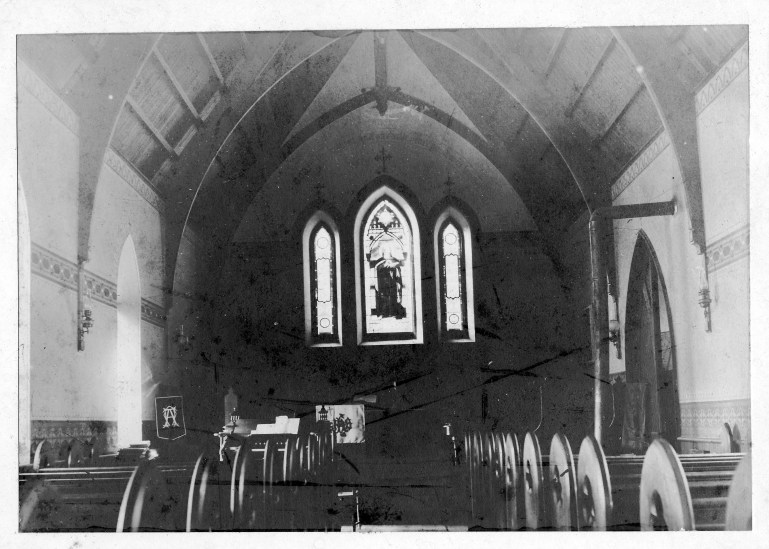
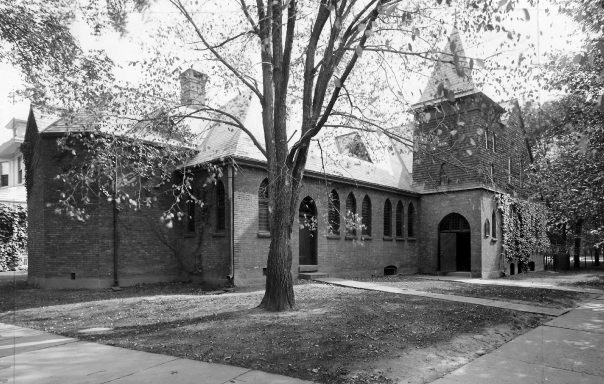
Among the items in St. Paul’s archives are three identically-matted old photographs of a church building unlike any associated with our parish. The first, showing the nave and chancel of the church, is unlabeled.

Nave, St. John the Evangelist, Rockland County, New York

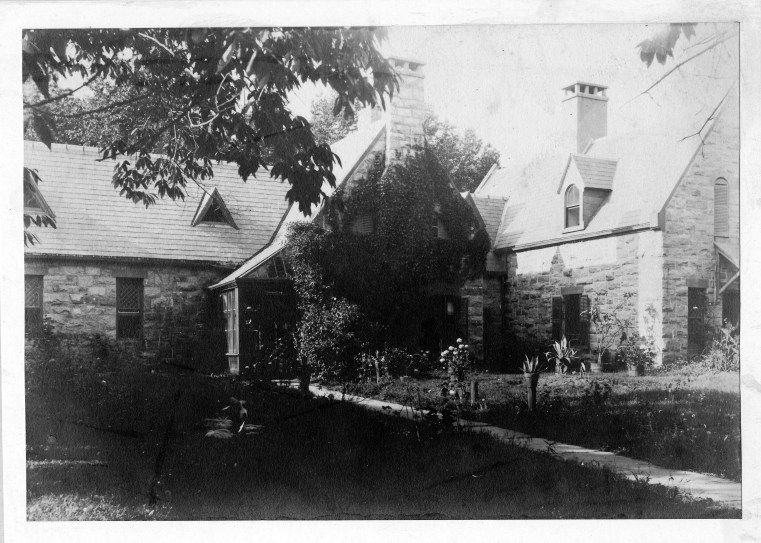
The second, showing the exterior of a church building, has a pencil notation on the back: “St. John the Evangelist, St. John’s, Rockland Co., N.Y.”

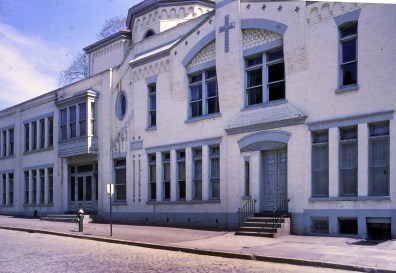
Exterior of St. John the Evangelist, Rockland County, New York

The third shows two people standing in front of the same building: a woman in a long dress, and a man in a clerical collar. The penciled notation reads: “Mrs. Ada B. Carey, Rev. Mr. Merrick, St. John’s, Rockland Co., N.Y.”

Ada B Carey and Augustus Warren Merrick, pictured outside St. John the Evangelist, Rockland County, New York

What is this church? There is now no Church of St. John the Evangelist in Rockland County. Nor is there a hamlet or village there named St. John’s. Mrs. Cary’s name provides the clue. She was an Episcopal missionary to the remote mountainous areas in Rockland County between about 1878 and 1915.

The Episcopal mission in Rockland County started in the mid-1860s, when the Rev. Ebenezer Gay, Jr. began caring for orphans in the Town of Haverstraw. By late in that decade, he had established an orphanage there named the House of Good Shepherd. In 1871, Mr. Gay purchased 64.5 acres in Tomkins Cove. The House of the Good Shepherd grew quickly, caring for local children and offering summer retreats for children from New York City.[1]

Ebenezer Gay’s ministry also expanded into the remote Ramapo Mountains west of Haverstraw. In 1878, he was joined by Ada B. Carey[2], who initially offered summer Sunday School classes. She quickly saw the need for additional social services. The area was very remote, with poor soil. The primary paying jobs available were making baskets and cutting wood for the brick industry in Haverstraw. Poverty and poor health were endemic, and there were limited educational opportunities.[3] Bishop Horatio Potter appointed her “visitor and reader to the people” and Mrs. Carey moved to the area, offering what services she could.

St. John's Mission, Rockland County, New York (The Sun, 18 Jan 1891, page 26)

Mrs. Carey’s efforts came to the attention of Margaret Furniss Zimmerman, a wealthy widow in New York City. Mrs. Zimmerman provided financial support, and in 1880 offered to build a church and school building for the mission. The cornerstone of the Church of St. John the Evangelist, a memorial to Mrs. Zimmerman’s husband John E. Zimmerman, was laid on June 23, 1880, and the church and school were completed later that year.[4]

Under Mrs. Carey’s direction, and with Mrs. Zimmerman’s continuing financial support, the mission made significant changes in the remote area. Ada Carey traveled daily throughout the region, “walking and driving over the bleak mountains, visiting homes, winning people to the church, and relieving sickness, hunger, cold and suffering wherever found.” The residential school offered education to both local boys and youth from New York City. To improve connections with the larger world, she also petitioned for a post office, and served as postmaster from 1883 until 1905.[5]

Ada B. Carey (The World, 2 Jun 1899, page 2)

Mrs. Carey seems to have operated independently from Mr. Gay after 1880. In 1891, a reporter for the New York Sun newspaper researched claims made in Mr. Gay’s fundraising, which described the “basket-makers” of Rockland County as “’semi-savage people,’ in danger of perishing of cold and hunger.”[6] The Sun reporter quotes Mrs. Carey’s vigorous response at length:

Well, I do hope that before you leave the mountains you will go to the homes of the people and see for yourself. Half savage, indeed! I assure you the basket makers and woodmen of our mountains are better educated than the inhabitants of most thinly populated localities. Within a radius of two miles of this mission there are two schools besides this one, and there are many other schools. Everybody can read and write, and cipher, at least, and many are pretty well educated. We get newspapers out here and people keep tolerably well informed about what is going on in the world and the country. I hope you’ll talk to everybody you meet and find out for yourself what a well-spoken, intelligent people we are here. Things are very different now from ten years ago, you know. Mr. Gay describes the basket makers of twenty years ago as those of to-day…

Of course, there are shiftless and lazy people here, as everywhere, and they, with the sick and unfortunate, are pitiably poor. But Mrs. Zimmerman don’t let anybody suffer for lack of food or clothing. We attend to that, and there is no need of Mr. Gay troubling himself…

There is another statement that has been made in these articles that I do not think Mr. Gay should permit. He was not the first to bring the Gospel to the mountain people. He did lots of good, no doubt, in those days of many years ago when the people really were ignorant and poverty stricken, but it’s wrong to say he first brought them the Gospel. They had their own Methodist churches through this country many years before Mr. Gay’s time.[7]

As to the other person in our photographs, Augustus Warren Merrick had a much shorter connection with the mission. He was rector of St. John’s from about 1895 until 1899.[8]

After Mrs. Zimmerman’s death, the church and school continued to be supported by a fund she established. At some point before 1935, the endowment was only able to support the rector’s salary, and the school closed.[9] The church, now known as St. John’s Church in the Wilderness, still stands in the Ramapo Mountains and services are held there every Sunday. The church and its grounds are now the only private property within Harriman State Park.

So now we know what this little church was and who the people in the photograph are. But one mystery remains. How did these photographs come to be in St. Paul’s records? The little church in Rockland County and St. Paul’s were then and are still today in different dioceses. And I’ve been unable to find any connection between the parishes. One possibility is that St. Paul’s was involved in fundraising for St. John’s. Albany newspapers in the 1880s and 1890s carried articles about the sad plight of Rockland County basket-weavers and about efforts to raise money for Mr. Gay’s programs.[10] St. Paul’s was active in supporting missions (both foreign and domestic) in this period, and it possible that the Rockland County mission was one of the causes supported.

[1] “A Home in the Country Tomkins Cove, New York: The Fresh Air Association House of St. John the Divine Historic and Archaeological District,” http://www.palinc.gladworksinprogress.com/sites/default/files/publications/Fresh%20Air%20Site%20Public%20Outreach%20Booklet.pdf last accessed 22 Dec 2022.

[2] According to the 1900 census, Ada Bessie Carey was born in July 1847 on the Isle of Guernsey, Channel Islands. She emigrated to the United States in the same year that she began working in Rockland County. Mrs. Carey returned to the United Kingdom in 1914. A window in her memory was installed in the church in 1935.

[3] “Dedicate Memorial at Chapel in Wilderness,” Rockville Leader 25 Apr 1935, page 1.

[4] “Rosenheim – Church of St. John the Evangelist,” The Churchman 3 Jul 1880, page 7.

[5] “Among the Basket Makers: A Primitive Community Only Fifty Miles from the Metropolis,” The Sun 18 Jan 1891, page 26.

[6] “Among the Basket Makers: A Primitive Community Only Fifty Miles from the Metropolis,” The Sun 18 Jan 1891, page 26. See also the descriptions of the residents in Albany newspapers, cited in endnote 10.

[7] “Among the Basket Makers: A Primitive Community Only Fifty Miles from the Metropolis,” The Sun 18 Jan 1891, page 26.

[8] A. Warren Merrick was born in Ireland in 1859 and ordained in the Church of Ireland. He came to the United States in 1894, licensed by the Bishop of New York, but still under the authority of the Bishop of Dublin. After leaving St. John the Evangelist, he served a parish in Ellenville, Ulster County, and then churches in the Diocese of Long Island. He moved to England in 1912 and died in London in 1933.

[9] “Dedicate Memorial at Chapel in Wilderness”

[10] See, for example, “Where Gaunt Poverty Lingers: Terrible Destitution of the Basket Makers of Rockland County:  An Albany Lady’s Appeal for Help for the Naked and Starving,” Albany Evening Journal 29 Dec 1885; “The Basket-Makers: A Singular Community in Need of Aid,” Albany Evening Times 26 Feb 1886; “Miss Murray’s Mission: Among the Basket Makers of Rockland County,” Albany Evening Times, 7 Dec 1886; “A Chance for the Charitable,” Argus 30 Apr 1893. Melvina F. Murray seems to have been the driving force behind these efforts. She traveled to Rockland County to investigate conditions and organized several fund-raising events.

Laying the Cornerstone for St. Paul’s Chapel of St. Andrew

Today we join our brothers and sisters at St. Andrew’s Church in celebrating the 125th anniversary of the laying of the cornerstone for their first building. The service commenced at 4:00 in the afternoon of July 19, 1897, with the reciting of versicles, collects and prayers, as well as singing of two hymns and Psalm 132. In the absence of St. Paul’s organist, George Edgar Oliver, the music was conducted by Frederick W. Mills, who had until recently been organist of Trinity Church, Albany.


Freeborn Garrettson Jewett, Jr.

St. Paul’s rector, Freeborn G. Jewett, Jr., laid the cornerstone, using a silver trowel specially made for the occasion. Five years earlier, Jewett (then St. Paul’s curate) had organized the Chapel of St. Andrew, St. Paul’s third chapel in this city.

The cornerstone, marked only with the cross of St. Andrew and the year, stills exists. It is embedded in the wall of St. Andrew’s parish house, on the site of the original chapel building.


Newspaper accounts of the event list the many clergy who attended, arriving in three horse-drawn carriages.

      • Thomas White, rector of Church of the Epiphany, Rensselaer
      • William F. Bielby, rector of Church of the Messiah, Rensselaer
      • F. St. George McLean, rector of Trinity Church, Albany (and former St. Paul’s curate)
      • Robert Dent Silliman, rector of Grace Church. Albany
      • Paul Birdsall, curate at St. Peter’s, Albany
      • Dr. Walton W. Battershall, rector of St. Peter’s, Albany
      • Freeborn G. Jewett, rector of St. Paul’s Albany
      • Archdeacon Frederick Schroeder Sill, rector of St. John’s, Cohoes
      • Dr. Edward Wilcox Babcock, rector of Holy Cross Church, Troy
      • Eaton W. Maxcy, rector of Christ Church, Troy
      • James Alnutt Smith, curate at St. Paul’s, Troy
      • Dr. James Caird, rector of Church of the Ascension, Troy
      • Canon Thomas B. Fulcher. canon precentor of All Saints Cathedral, Albany
      • Dr. Leonard Wood Richardson, professor of Greek and Latin at the Albany Normal College and priest associate at St. Peter’s, Albany

St. Paul’s Chapel of St. Andrew

Construction of the chapel building was completed over the next four months, and the building was consecrated on St. Andrew’s Day, 1897. With the continued hard work of the chapel congregation, and the continued support of St. Paul’s, St. Andrew’s was to become an independent parish less than two years later, on May 15, 1899.

Groundbreaking for St. Paul’s Chapel of St. Andrew

125 years ago today, on the morning of June 14, 1897, St. Paul’s rector broke ground for St. Paul’s Chapel of St. Andrew on the corner of Western Avenue and Main Street. Our brothers and sisters at St. Andrew’s Church, the direct descendant of that chapel, will be celebrating that event, as well as the anniversary of the building’s consecration in November this year. I wanted to take the occasion to tell something of the back story, telling how St. Andrew’s came to be.

Freeborn Garrettson Jewett, Jr.

The story begins 6 years earlier in 1891, when St. Paul’s curate, Freeborn G. Jewett, proposed organizing a chapel for St. Paul’s in Albany’s Pine Hills neighborhood. The first meetings took place in July 1892 in rooms belonging to the West End Savings and Loan Association on the south side of Madison Avenue just west of Ontario Street. St. Paul’s chapter of the Brotherhood of Saint Andrew was tasked with supporting the new chapel, which thus took their name. Later that year, in November 1892, the chapel moved to a former school building on Ontario Street, near the southeast corner of Hamilton Street. By early 1893, both Morning Prayer and Communion were regularly celebrated.

1892 Sanborn Map showing former schoolhouse, the first home of the Chapel of St. Andrew

George Lynde Richardson

The chapel building on Ontario Street was soon a busy place, with a Sunday School, a reading room, a room for boys’ activities and a sewing room. St. Andrew’s Chapel also participated with aid organizations to distribute food to the needy in the area. At this point, Jewett had been elected rector of St. Paul’s, and he delegated oversight to his curate, George Lynde Richardson. St. Paul’s curates who later served as minister-in-charge of St. Andrew’s were John Hale Griffith and Frederick St. George McLean.

John Hull Griffith

The Ontario Street building was hardly ideal, and planning soon began for a permanent building for the Chapel. In November 1896, St. Paul’s purchased lots on the southeast corner of Western Avenue and Main Street. Over that winter, contractors Gick & Sayles were retained, with construction due to begin the next spring.

Frederick St George McLean

And so it came to pass on that June afternoon in 1897, that the Rev. Mr. Jewett turned the first shovelful of soil, starting construction of St. Paul’s Chapel of St. Andrew. In the next few months, I’ll bring the story forward, first to the consecration of the building, and then to St. Andrew’s establishment as a separate parish in 1899.

Mrs. Kells Retires

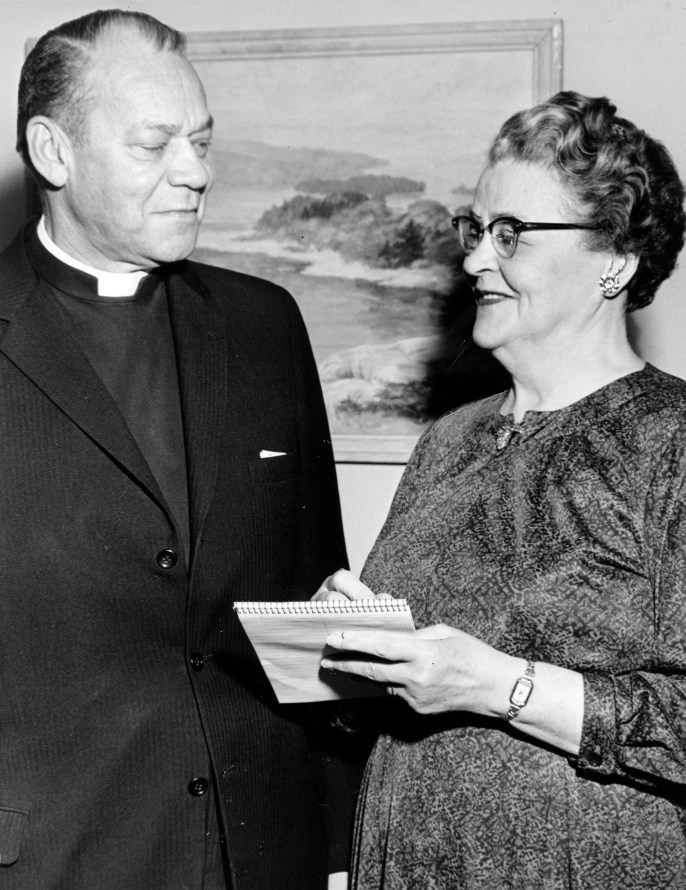
Nelson F Park and Josephine Kells (Albany Times Union, 30 Dec 1961)

A new contribution to St. Paul’s archives arrived in today’s mail: a newspaper photograph originally published in December 1961, showing St. Paul’s rector, Nelson F. Parke and the parish’s long-time secretary, Mrs. Josephine Kells.

The occasion was Mrs. Kells’ retirement after 35 years. The accompanying article lists all the rectors with whom she had served: Arthur Raymond McKinstry (1927-1931), George A. Taylor (1932 – 1948), Oliver D. Carberry (1948 – 1954), F. Graham Luckenbill (1954 – 1958) and Nelson F. Parke (1959 – 1962).

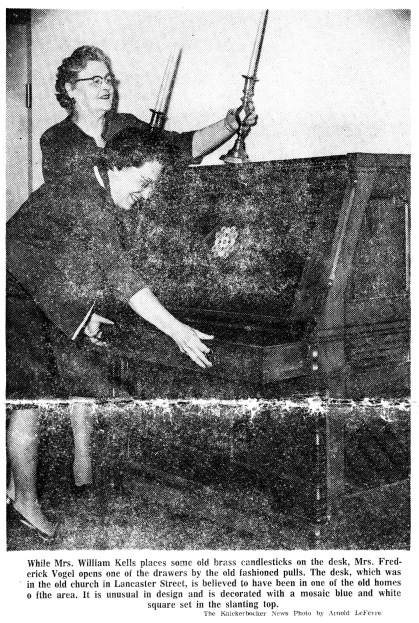
Josephine MacLean MacKenzie was born in Nova Scotia in in 1896, and must have come to St. Paul’s in about 1927. She was married to William Edward Kells at St. Paul’s in 1939. Mrs. Kells was an active member of this parish for 40 years. Here she is a few years after her retirement, helping to arrange the furniture in the Blue Room of St. Paul’s new building on Hackett Boulevard.

Knickerbocker News 18 May 1966

The Times Union quotes Father Parke’s assessment of Mrs. Kells’ place at St. Paul’s:

Mrs. Kells stands for so many things in the parish that are good and productive and helpful that she will be long remembered as a pillar of strength. The major part of her adult life has been spent in this office — she has stood by in feasts and famines, in years of plenty and lean years… She has been efficient, trustworthy and always ready with a sympathetic ear to hear both the joys and sorrows of a long, long line of parishioners in the course of 35 years. She is beloved by all the people of St. Paul’s.

“O Thou the Central Orb”

For today’s post, I turn from our usual concentration on the 195 year history of St. Paul’s Church or Congregation in the City of Albany to a more current topic. Last Sunday, St. Paul’s choir sang one of our favorite anthems, Charles Wood’s “O Thou the Central Orb.” Singing this widely-loved anthem again revived my curiosity about the origin of its vivid but somewhat ambiguous text.

Wood took the words for his anthem from those written as an alternative to the original text of an Orlando Gibbons work.

[verse] O Thou, the central orb of righteous love,
Pure beam of the most High, eternal Light
Of this our wintry world, Thy radiance bright
Awakes new joy in faith, hope soars above.

[full choir] Come, quickly come, and let thy glory shine,
Gilding our darksome heaven with rays Divine.

[verse] Thy saints with holy lustre round Thee move,
As stars about thy throne, set in the height
Of God’s ordaining counsel, as Thy sight
Gives measured grace to each, Thy power to prove.

[full choir] Come, quickly come, and let thy glory shine,
Gilding our darksome heaven with rays Divine.

[verse] Let Thy bright beams disperse the gloom of sin,
Our nature all shall feel eternal day
In fellowship with thee, transforming day
To souls erewhile unclean, now pure within.

[full choir] Come, quickly come, and let thy glory shine,
Gilding our darksome heaven with rays Divine. Amen.

Published in Ouseley’s edition of Gibbons’ works, “O Thou the Central Orb” is subtitled “An Advent Anthem. The words adapted by the Revd. H.R. Bramley.”[i] But what was Henry Ramsden Bramley adapting? Most sources assume that it was one of his own compositions, but no one has identified such a source in his other published works.

It is only thanks to Google Books that I happened upon what I believe is Bramley’s source, in a little-known compilation of religious verse, Lyra Mystica, edited by 19th century divine Orby Shipley.[ii] “O Oriens” is the fifth of seven sonnets (attributed by Shipley to Richard Meux Benson) paraphrasing the antiphons for the last week of Advent, also known as the O Antiphons. The sonnets are tied together by the structure of the concluding six lines (the sestet of the sonnet form): the first and fourth lines of all seven sestets start with “Come quickly! Come!” representing the Latin veni beginning the last line of each of the O Antiphons.

“O Oriens” by Richard Meux Benson

Bramley has skillfully incorporated the repeated pleading “Come!” from the antiphons into a chorus repeated by the full choir after each solo verse. The overall effect is quite effective, replicating the sense of Advent expectation.

Seeing Benson’s original may provide a solution to one oddity about Bramley’s adaptation. The sense of the last quatrain is not at all clear, and it seems very odd to have rhymed the word “day” with itself.[iii] Could “transforming day” have been a printer’s error for “transforming ray”? This would correct the rhyming problem and would seem to be more in line with the work’s theme.

[i] Frederick A. Gore Ouseley, A Collection of the Sacred Compositions of Orlando Gibbons (London: Nevello, Ewer and Co., 1873), 136-141. The original text was “O all true faithful hearts,” described as “A thanksgiving for the king’s rapid recovery from a great dangerous sickness.” https://www.google.com/books/edition/A_Collection_of_the_Sacred_Compositions/jyZJAQAAMAAJ

[ii] Orby Shipley, Lyra Mystica: Hymns and Verses on Sacred Subjects, Ancient and Modern (London: Longman, Green, Longman, Roberts, and Green, 1865), 176. https://www.google.com/books/edition/Lyra_Mystica/XLFcAAAAcAAJ?gbpv=1

[iii] For a discussion of some other solutions to these problems, see the discussion in ChoralWiki: “Talk:O Thou, the central orb (Charles Wood)” https://www.cpdl.org/wiki/index.php/Talk:O_Thou,_the_central_orb_(Charles_Wood) Last accessed 16 Feb 2022.

Now Announcing: A Book Social!

Card announcing a Book Social in November 1906

Today I’d like to share another find from the church archives: a small card, advertising a Book Social to be held in our Parish House in November 1906.

I’d never heard of a Book Social, but I’ve found that that around the turn of the century, they were a common way of attracting book donations for a library. As the announcement explains, the “admission fee will be a book suitable for the library of the Sunday School.”

In some cases, book socials were designed to create a new library, but that was not the case here. St. Paul’s had had a Sunday School library for many years. We know, for instance, that the former librarian, Ira Porter, Jr. had served for an impressive 45 years.

In 1906, St. Paul’s Sunday School had been a thriving part of its outreach for most of the church’s 79 years. In 1907, the Year Book reported attendance of 225, plus another 39 on the “cradle roll.” There were 26 teachers and 7 officers, including two librarians.

The Social was sponsored by the St. Paul’s Guild, a group “composed of young people of the parish” which had only been organized that year. In 1907, the Guild listed 36 members, most between the ages of 18 and 25. The month after the Book Social, the St. Paul’s Guild also sponsored a Christmas entertainment for the Sunday School.

Unfortunately, we don’t know any details about the entertainment the Guild provided. The tableau would have consisted of a classical or religious scene, depicted by costumed performers. Might the music have been provided by organist Robert H. Moore, who was also pianist for the Sunday School?

We do know the event’s location: the Parish House, which at that time was the rooms on Jay Street that had been donated by Van Antwerp in 1883. You can see the exterior in these two photos, the first from 1920, the second from 1964, just before the Parish House (and church) were demolished.

St. Paul’s Jay Street Parish House, 1920

St. Paul’s Church Jay Street Facade May 1964


It is likely that this event was one of the many new projects initiated by St. Paul’s energetic young rector, Roelif Hasbrouck Brooks, then in his first year at the parish. In a sermon that fall, Brooks urged the congregation “to repair and beautify their church by memorial gifts.” Completion of those enhancements was still years in the future, as was a renewal of parish social programs.

Roelif Hasbrouck Brooks

But one change initiated by Brooks had already been accomplished. Two months before this Book Social, St. Paul’s chorus of men and women with four soloists had been replaced by a choir of men and boys.

St. Paul’s Choir, during the rectorship of Arthur R. McKinstry (1927-1931)


Albany’s Butterfly Station

Not Erynnis brizo, but a related species, E. martialis, the Mottled Duskywing, photographed in the Albany Pine Bush, August 2021

The vestry portraits in St. Paul’s archives make dull browsing.  Vestrymen in the 19th century tend to look alike: serious middle-aged businessmen who we imagine had few interests in life other than their businesses and their families. But among those formal portraits there is one who stands out in three dimensions, with a passion for nature that suggests a person we would really like to know more about. That man is William Washington Hill, St. Paul’s vestryman and a noted collector of butterflies and moths. A few years ago, I wrote about Hill and his business partner (and fellow St. Paul’s vestryman) John Woodward, promising to say more about Hill’s passion for lepidoptery. With the publication of an article in spring 2020 about Hill’s collecting in the Adirondacks,[1] it is time to fulfill that promise, with particular focus on his work in the Albany Pine Bush.

William Washington Hill (1833-1888)

William Washington Hill’s natural history pursuits began with fishing, a life-long avocation. This developed into a hobby of collecting plant specimens, and later into an enthusiasm for insect collecting. Hill’s interest specifically in moths and butterflies may have been spurred by a display at the Albany Institute in October 1874. For several years, local businessman Otto Meske had been collecting lepidoptera in the Albany Pine Bush, and on this occasion he displayed over 3,000 specimens, many of them collected in the city of Albany or in the nearby Pine Bush. At the opening of the exhibit, State Entomologist Joseph A. Lintner delivered a lecture, describing Meske’s efforts and praising the care with which the specimens were prepared, identified and labeled.

Lintner had accompanied Meske on many of these collecting trips, and described a particularly telling incident.

I cannot forbear from earnestly commending the zeal displayed by Mr. Meske in the prosecution of his favorite pursuit. It bears with it its own reward, in the keen enjoyment which it affords him. On one occasion, when we were passing a day together in that almost unequalled entomological collecting ground, Center Station, midway between Albany and Schenectady, on the pine barrens, where an abundant insect fauna would not be looked for, and had met with eminent success in the capture of an unusual number of rare, beautiful and new forms, culminating in my friend’s netting a perfect specimen of Sesia gracilis[2], he turned to me, trembling with emotion and his face glowing with enthusiasm, exclaiming : “What is making money compared with this !”[3]

Meske’s enthusiasm and Lintner’s praise must have captivated Hill. Here was another Albany businessman who had found a challenging and exciting avocation. Hill soon joined Meske and Lintner in their collecting expeditions, both in the city and the Pine Bush. And this trio became a quartet when they were joined by Albany physician James Spencer Bailey[4].

Hill continued to fish every summer in the Adirondacks, that passion now supplemented by collecting moths and butterflies.[5] During the rest of the year, Hill was busy here in the Albany area, initially in and around the city, but then in the Pine Bush with Bailey, Lintner and Meske. The quartet “made excursions in the vicinity of Albany and finally Centre was hit upon, as an extraordinarily productive locality and here collecting was carried on with such vim and persistency that the place became known as ‘Butterfly station.’ Enormous quantities of ‘sugar’ were prepared and used, and thousands of moths paid the penalty.”[6]

Our best information about these jaunts comes from Dr. Bailey, who wrote:

Center is situated on the line of the New York Central Railroad, mid-way between Albany and Schenectady. The road in reaching this point traverses a distance of eight miles from Albany, and attains an elevation of 315 feet above tide-water.

During the warm months there are two daily trains stopping at this station, going east and west, and are so arranged as to give the scientist the advantage of the first half of the day on the ground. The place itself is not in the least attractive, consisting of but a few dwellings erected for the accommodation of the Railroad employes [sic].

It is among the pine barrens and seemingly unfertile and inhospitable soil where is found so much to interest and instruct the student, for here he can commune undisturbed with nature, and at each step find his pathway strewn with objects of interest. Center has a world-wide reputation botanically and entomologically. The collecting ground is embraced in a tract of one thousand acres, which civilization has never disturbed, but has allowed to remain in its primitive condition. It is now owned by a community of Shakers, living in close proximity.

The entomological tract is situated on the south side of the Railroad, and lies on both sides of the road leading to Sloans, any great divergence from which will not prove successful to the collector. It is unnecessary to traverse this road more than one mile, which brings you near to Mount Brizo, which is a bold projecting sand mound rising abruptly nearly to the height of 100 feet above the surrounding country on the east and gradually sloping to the west.[7]

These place name require some clarification, even for those who know the area well. The whistle-stop at “Butterfly Station” is now known as  Karner[8], and the road of which Bailey speaks would have taken the collectors a mile or so to the west-southwest. [9]

Detail of a 1895 atlas, showing roads between Centre Station at Karner and Sloan’s (the hamlet of Guilderland)

The identity of the dune near which they collected is a bit more difficult to determine.  It has been suggested that that it is the one on the northwest corner of Old State Road and New Karner Road[10], now much reduced in size by sand mining. “Mount Brizo” is a name that I’ve never found outside this account, and I think it is likely that it was invented by Bailey and the others in reference to a species they collected there, Erynnis brizo.[11]

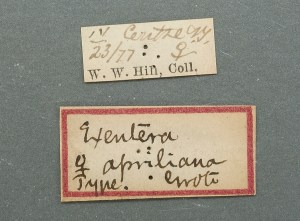
A label from the W.W. Hill Collection (credit: National Museum of Natural History, Smithsonian Institution)

While he was not formally trained, Hill was quite disciplined, labeling each specimen with the date and location in which he had found it. Following his death in 1888, Hill’s children donated his carefully preserved collection of 10,000 specimens representing more than 3,000 species to the New York State Museum. A catalog of the collection published in the Museum’s Bulletin lauded his significant contributions to the field of entomology.[12]

Hill’s collection is still intact, forming a part of the New York State Museum’s holdings. Between 1917 and 1921, his collection (along with those of Bailey, Lintner, Meske and Erastus Corning) was on display at the Museum and the Albany Institute during “Butterfly Week.” A 1921 article promised “Butterflies In All Colors of Rainbow,” and described in detail the “annual event eagerly anticipated in Albany.”[13]

[1] Edward Pitts, “Butterfly Effect: the lasting impact of hobbiest W. W. Hill,” Adirondack Life, May-June 2020, 57, 59, 61. Some of this material (and a reproduction of St. Paul’s portrait of Hill) has since been published in Pitts’ book, Beaver River Country: An Adirondack History (Syracuse: Syracuse University Press, 2022).

[2] The Slender Clearwing, now called Hemaris gracilis.

[3] J.A. Lintner, “Mr. Otto Meske’s Collection of Lepidoptera,” Transactions of the Albany Institute, volume VIII (Albany: J. Munsell, 1876), 218. Lintner read this paper at a meeting of the Institute on 20 Oct 1874.

[4] “Dr. James S. Bailey,” Albany Morning Express 2 Jul 1883; “James Spencer Bailey,” Papilio, volume 3, number 7 (Sep 1883), 166-167; “Dr. James S. Bailey,” Report of the Ontario Entomological Society for the Year 1883 (Toronto: C. Blackett Robinson, 1884), 82; “Biographical Sketch of Dr. James S. Bailey, of Albany, N.Y.” Transactions of the Medical Society of the State of New York for the Year 1884 (Syracuse: by the Society, 1884), 388-391.

[5] Pitts, 59.

[6] J[ohn] B[ernhardt] Smith, “William W. Hill,” Entomologica Americana, volume 3, number 12 (March, 1888), 235-236. Quoted in full in “List of the William W. Hill Collection of Lepidoptera,” Appendix A in 23d Report of the State Entomologist on Injurious and Other Insects of the State of New York 1907, Museum Bulletin 124 (Albany: University of the State of New York, 1908), 61-63.

[7] James S. Bailey, “Center, N.Y., Entomologically Considered,” The Canadian Entomologist, volume IX, number 6 (June 1877), 115-116.

[8] The station was located on what is now the grounds of Green Trucking Supply, on Railroad Avenue Extension, in Colonie, New York.

[9] “Sloan’s” is now known as Guilderland, near the corner of Western Avenue and Foundry Road. Originally named Hamilton or Hamiltonville, in the 19th century this was the site of a glass works, and briefly, an iron foundry. By the 1870s, it was informally known as Sloan’s, for the hotel kept there by Henry Sloan.

[10] Robert Dirig and John F. Cryan, “The Karner Blue Project: January 1973 to December 1976,” Atala, volume 4, numbers 1-2, 1976, 22-26.

[11] The Sleepy Duskywing. In 1877, Bailey reported collecting the species at Centre, referring to it as both Nisoniades brizo and Thanaos brizo. Those names have since been subsumed under Erynnis brizo. “Brizo” is Greek for to nod or slumber.

[12] “List of the William W. Hill Collection of Lepidoptera,” Appendix A in 23d Report of the State Entomologist on Injurious and Other Insects of the State of New York 1907, Museum Bulletin 124 (Albany: University of the State of New York, 1908), 61-117.

[13] “Butterflies In All Colors of Rainbow,” Times Union 2 Mar 1921.