The Oil Painting of St. Paul’s Lancaster Street Church

Painting of Lancaster Street Building signed “J. Lyons”

Thanks to our energetic building and grounds committee, the Blue Room has been freshly painted, and for the first time in years is actually blue! With that done, the oil painting of St. Paul’s home on Lancaster Street has been hung once more, so this seems a good time to share what we know about it.

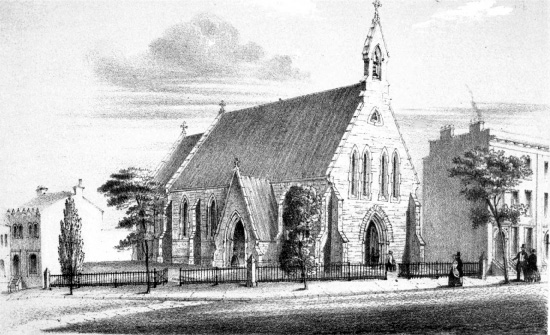
The view is of the church in winter, with many of the houses surrounding it on the south side of Lancaster between Hawk and Swan Streets also visible. It is particularly nice that we can see a bit of the rectory  to the right of the church. As I’ve mentioned before, we have only one good photograph of that structure.

St. Paul’s Church and Rectory


We can date the scene very precisely. You will notice that the church’s brick, originally buff-colored, has been painted white. This painting was done in the summer of 1960, in an effort to help spruce up the declining neighborhood. That gives us the earliest date for the view.

Father Parke supervises painting [Times Union 9 Jul 1960]


The latest possible date is sometime before spring 1964, by which time all the buildings to the west of the church (including the recotry) had been demolished. We can say then, with certainty, that the artist shows the church as it looked between 1960 and late 1963 or early 1964.

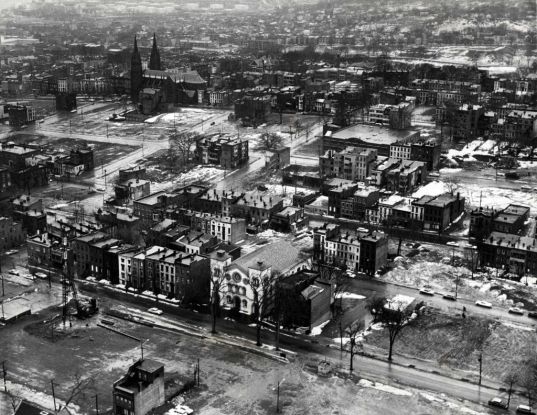
St. Paul’s Church and Rectory, 1963 or 1964 (photo credit: Times-Union Archive)

St. Paul’s Church after demolition of Rectory, 1963 or 1964 (photo credit: Times-Union Archive)

We also know who donated the painting. According to an article in the Knickerbocker News for May 18, 1966, it was the gift of Dr. Susan Seabury Smith, then associate professor of Library Science at the State University of New York at Albany (now University at Albany), and director of curriculum and library services for Columbia High School in East Greenbush.

But who was the artist? The painting is clearly signed “J Lyons,” but there is no other identification. The 1966 Knickerbocker News article says only that the painting was “by an artist named Lyon.” I’ve looked in period newspapers for a Capital Region artist named Lyons, but found nothing so far. One possible direction for the search would be to colleagues or friends of the donor, Dr. Smith. I noticed that the chair of the art department at Columbia High School  in East Greenbush was Lawrence Lyons. His wife’s name was June. Is it possible that June Lyons was the artist?


The Rev. Mr. Kip suffers Mr. DeWitt’s “unmeasured abuse”

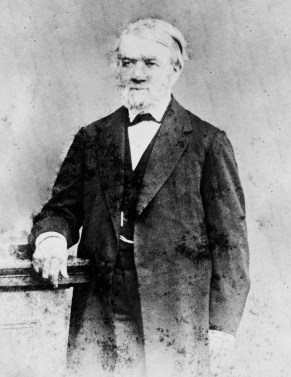
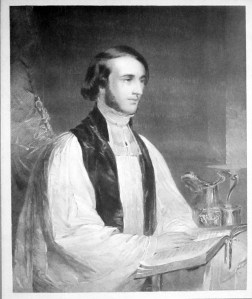
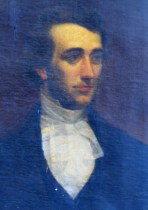
William Ingraham Kip (portrait attributed to Asa Weston Twitchell)

In earlier posts, we have described how in 1847 St. Paul’s rector, William Ingraham Kip, proposed building two mission chapels, and how those plans failed. Our senior warden, William H. DeWitt, then offered to fund the construction of a chapel of ease for St. Paul’s, to be known as the Chapel of the Holy Innocents, and located in Albany’s North End. As the building was being constructed, DeWitt changed course, resigned as St. Paul’s senior warden and formed Holy Innocents as a separate parish. When it came time to consecrate the new building, Kip (along with the rectors of Albany’s Grace Church and Trinity Church) formally protested the consecration, and the ceremony proceeded only when certain changes were made to the church deed and Kip withdrew his protest.

A letter, held in the archives of the Diocese of Maryland, has now added substantially to our understanding of the grounds of the protest, the resolution of the dispute, and the matter’s aftermath. Kip wrote it on August 6, 1851 and addressed it to Bishop William Rollinson Whittingham, who had ruled on the protest and conducted the consecration. Kip explains his protest and the reasons that he withdrew it. More important, he describes the ill will that was continuing between him and DeWitt a year after Holy Innocent’s consecration. And he asks the bishop, whom he in later years would refer to as an “old friend,”[i] a very large favor.

William Henry DeWitt

In the letter, Kip reminds Bishop Whittingham of the two points of his protest concerning DeWitt’s deed of conveyance, in which he perpetually leased the building and grounds to the church corporation. These points were DeWitt’s assertion of:

  • a right of unlimited nomination of the church’s rector “enabling him to force a Rector on them [the people of Holy Innocents]”
  • the descent of the right of nomination to William and Ann DeWitt’s heirs forever

Kip then describes the resolution to the protest, in which DeWitt’s deed of gift was substantially changed by:

  • restricting DeWitt’s right of nomination, by providing that DeWitt could only nominate the same person three times[ii]
  • eliminating the descent of the right of nomination, so that it would end with the DeWitts’ deaths[iii]
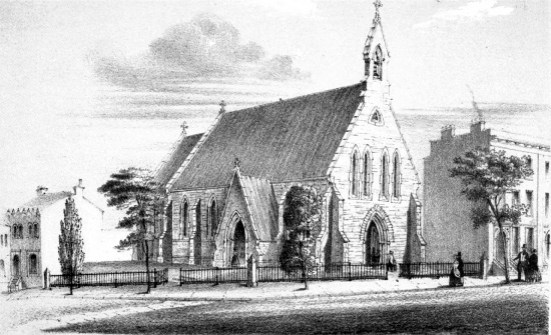
Holy Innocents

Given the long history of Kip and DeWitt’s relationship, we could guess that that this was a very personal dispute. They had worked together at St. Paul’s from 1837 until 1850. These were difficult years for St. Paul’s, and Kip and DeWitt as rector and senior warden, respectively, for that entire period worked together closely. It was through their collaboration that the parish recovered from bankruptcy and achieved financial stability. During the early, lean years, DeWitt was also St. Paul’s major financial contributor.

For his part, Kip was disappointed by the loss of the chapel and angry at provisions he saw as contrary to church law. He had proposed a mission chapel, as an outreach for a growing and thriving St. Paul’s and as an important work in furthering the mission of the church in the city of Albany. But Kip’s concern for proper ecclesiastical polity was also a factor. Shortly after the new church’s consecration, Kip’s vestry wrote him their “approbation of your proceedings in the matter of the consecration of the ‘Church of the Holy Innocents.’” In words that echoed Kip’s intentions in raising the protest:

All depend upon our clergy in keeping a watchful eye over the Church, allowing no innovations, nor dangerous precedents, rigidly adhering to its laws and in exactly observing its old landmarks. In all these things we feel we can say that you have done your duty and that you enjoy our highest regard and confidence.[iv]

DeWitt, for his part, was frustrated in his expectation of control over a chapel for which he had paid every expense, and promised to support forever. DeWitt must have felt that, having paid for the cost of both real estate and the building itself, he had the right to make it his own family church, after the model of Troy’s Church of the Holy Cross, which had been fully funded by Mary Warren and her family in 1844.
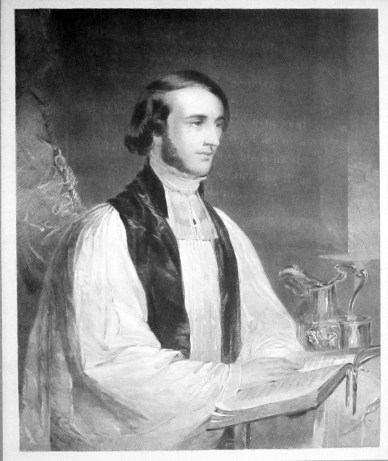
Wm. Ingraham Kip at St. Paul’s altar (from an 1847 portrait by William Tolman Carlton)

We have suspected, then, for some time that there must have been hard feelings, but did not learn until we saw this letter how the dispute had played out in the months and years after Holy Innocent’s consecration. We do not know DeWitt’s side, but Kip’s letter to Whittingham describes his view of this personal aspect of the dispute.

Kip describes how, over the year since the consecration, DeWitt has conducted a campaign of “unmeasured abuse” and “outrageous and long-continued slander.” Specifiically, Kip has heard of DeWitt “denouncing me to one of my vestry, as ‘an infamous, black, scoundrel’, (the proof being, my making that protest) & warning one of the families in my parish against me, as one whom they w[oul]d one day find out to be ‘a devil.” Kip also tells Whittingham that DeWitt has claimed that Whittingham had disapproved of Kip’s protest and that DeWitt “publicly denies that he was forced to yield anything , or that the deed has been in any way changed.” [v]

Kip’s purpose in writing was to ask Whittingham to confirm that DeWitt was wrong on all of these counts, by writing a letter affirming that the bishop had supported the protest and continued with the consecration only after two substantial changes to the deed. Kip asks that Whittingham put these in writing “in a letter of a single page” that he could show to those who believe DeWitt’s claims.

Finally, Kip asks Whittingham for his advice: would it be proper for Kip to present this matter to DeWitt’s rector, Sylvanus Reed, “demanding that he [DeWitt] be debarred from communion until he shall make proper reparation.” Kip does not mention the fact, but Whittingham may well have known that Kip was Sylvanus Reed’s mentor. Reed was the son of a St. Paul’s vestryman, had been brought up at St. Paul’s, and had been supported for ordination by Kip and St. Paul’s vestry. Whittingham would have known that a demand from Kip would certainly have been obeyed by the young Mr. Reed.
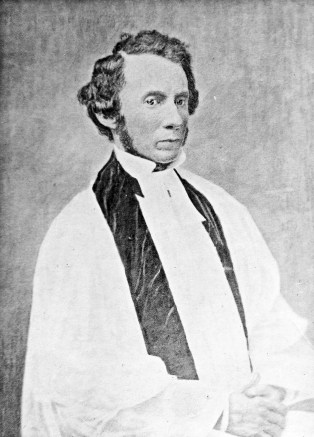
The Rev. Sylvanus Reed

Bishop Whittingham’s outgoing correspondence, sadly, has not survived. We will never know whether Kip asked Sylvanus Reed to withhold communion from William H. DeWitt. Nor do we know if Whittingham wrote the letter that Kip asked of him, and (if he did) how it might have affected Kip and DeWitt’s relationship.

If that outcome is unclear, it is more certain that failure of the mission chapel and DeWitt’s campaign of slander had an effect on William Ingraham Kip. Although he continued as rector of St. Paul’s for two additional years, his acceptance of election as missionary bishop of California may have been encouraged by the simmering conflict over the chapel of ease that never was.

In 1852, a year after this letter was written, Kip was thinking of moving on. That year, a friend suggested that Kip should express an interest in serving as rector of Trinity Church, San Francisco. Kip reported later:

The suggestion struck me favorably. I had been fifteen years in Albany, — had built up a large congregation, — and it seemed as if there was no room for progress or enlargement in the future. On the other hand, in San Francisco was a new field, — a rising empire, — and there was a freshness and enterprise in founding the Church in that region which rather fascinated my imagination.[vi]

And the controversy may have affected Whittingham view of Kip’s situation as well. As we have discussed before, he was the diocesan bishop of Maryland, acting here while the Diocese of New York had no bishop. Shortly after the discussion about the position in San Francisco, Kip was offered the rectorship in St. Peter’s Church, Baltimore, in Whittingham’s home diocese. Kip told his old friend Whittingham that he would not accept that call, but that he was tempted by the possibility of the position in San Francisco. Whittingham told him, “You must go to California, but not as a Presbyter! You must go out in another capacity.”[vii] It was the next year (1853), with backing from Whittingham and others, that Kip was elected missionary bishop of California, and left St. Paul’s Church.

[i] Wm. Ingraham Kip, The Early Days of My Episcopate (New York: Thomas Whittaker, 1892), 2, 7.

[ii] Another account describes the resolution differently: that DeWitt’s right of nomination would be “limited to three nominations and required to be exercised within a year from the occurrence of a vacancy.” [Joel Munsell, Annals of Albany, First Series, Volume X (Albany: Munsell & Rowland, 1859), 434]

[iii] The Albany Annals account describes this resolution differently as well: that the right to nominate would continue, but to William and Ann DeWitt’s issue, not their heirs. Since Mr. and Mrs. DeWitt then had no living issue, and were unlikely to have any more children (William was 51, and Ann 45), this would have had the same effect. [Joel Munsell, Annals of Albany. First Series, Volume X (Albany: Munsell & Rowland, 1859), 434]

[iv] Letter dated 20 Jul 1850 from the wardens and vestry of St. Paul’s Church to William Ingraham Kip. Held in St. Paul’s church archives.

[v] This may be what is referred to in a lengthy footnote to the Albany Annals account:

The ground of the opposition was, the nature of the reservations to the donors, and their heirs, and it was alleged that the deed of conveyance had been altered from the form in which it had been drawn up by Mr. J. C. Spencer, and assented to, as satisfactory, on the first opening of the church. The allegation was unfounded. The deed was made out in the office of J. V. L. Pruyn, Esq., and is a verbatim copy of the original draft made by Mr. J. C. Spencer, and admitted by him to contain nothing which could prevent the consecration. The Bishop received the protest; but on a conference with the donors, the right of nomination to the rectorship was limited (as by the release above), when he determined on proceeding.

[Joel Munsell, Annals of Albany, First Series, Volume X (Albany: Munsell & Rowland, 1859), 434-435]

[vi] Kip, Early Days, 1-2.

[vii] Kip, Early Days, 2.

Where was St. Paul’s Lancaster Street Building?

Where was St. Paul’s Lancaster Street building? Sounds almost as silly as asking “Who is buried in Grant’s tomb?”

The answer of course, was on the south side of Lancaster Street, halfway between Hawk and Swan. But the building (and 98 acres in the heart of Albany), was demolished in 1964 to make room for the South Mall. So let’s reframe the question: where, in what we now call the Empire State Plaza, was St. Paul’s building? Many think it was near where the Center for the Performing Arts (popularly known as “the Egg”) now sits, but we’ve known for some time that it must have been farther west, somewhere between Agency Buildings 3 and 4.

Thanks to the New York Public Library, we can now answer the question precisely and definitively. The NYPL web site has images of a detailed 1876 map of Albany showing the church’s location. And they recently added software that allows the user to lay the old map precisely over the current Google map of the same area. The result is below.

1876 Map of St. Paul’s neighborhood, with overlay of 2014 Google map

The darker portions of the image are from the Google map. You can clearly see the edge of the Plaza Concourse in blue near the bottom right corner; the large green rectangle is the park-like area on the Plaza’s northwest corner, between South Swan Street and Agency Building 4 (shown in dark gray). In the bottom left in orange is the South Mall Arterial and immediately above it is Agency Building 3, also in dark gray.

The older map appears in lighter shades of gray, showing the streets, lots and major buildings as they existed in 1876.  And yes, hovering  just off the north corner of Agency Building 3 is the ghostly  St. Paul’s, labeled simply “Church.”

St. Paul’s Church and Rectory

The Plaza’s Central Air Conditioning Plant and Transformer Vault lies beneath what was once an entire city block, the block on which St. Paul’s stood. As we’ve mentioned before, St. Paul’s hopes for staying in their building as part of  the South Mall  were dashed when the block was chosen for the cooling and heating facility. St. Paul’s rector, Nelson F. Parke, reported that at a meeting with St, Paul’s vestry in September 12, 1962, the State’s Assistant Commissioner of Housing

told us quite bluntly that plans for the South Mall in the block bounded by Lancaster, Hawk, Jay, and Swan Streets were such that the continued existence of the Church at its present location was entirely impossible, that the demolition of the Church was inevitable, that we would have only three years in our edifice before it was torn down, and that the possibility of our being able to relocated in the South Mall area was extremely remote.

But St. Paul’s was not to have even three years. In May 1964, the Commissioner of the Office of General Services wrote St. Paul’s new rector, J. Raymond McWilliam, to inform him that

Our present schedule calls for the completion of construction plans and specifications for the Central Air Conditioning Plant and Main Transformer Vault by July 1, 1964. They would then be advertised for bids calling for initiation of work by about mid-August. The site extends from Chestnut Street on the north to Jay Street on the south, and the area to be excavated includes the entire Church property.

This work will require the severing of underground utility lines (gas, water, sewer), the relocation of the underground telephone duct system, and the closing of Jay, Lancaster and Chestnut Streets. The extensive excavation (which at the site of the Church will average about 30 fee in depth) and the other construction activities will create such disturbance in the general area that even if it were possible to program the construction so as to delay the need for the Church property as long as possible, I believe the conditions would soon become disheartening to your congregation.

The commissioner ended the letter by asking that St. Paul’s vacate the building by the end of August 1964, almost a year earlier than had been promised. The last service in the Lancaster Street building was held July 26, 1964, and the building was demolished in October of that year.

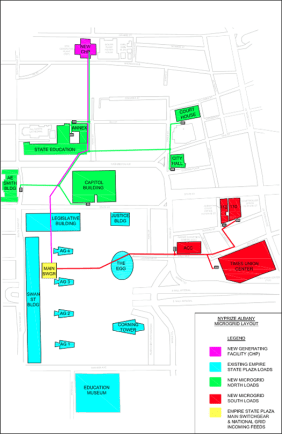
Diagram of proposed Empire State Plaza microgrid

St. Paul’s location has been in the news again lately, when it was announced that the main switchgear for the new heating and cooling system would be placed int the central air conditioning plant, precisely where St. Paul’s stood until its demolition in October 1964,

St. Paul’s Episcopal Church is demolished to make way the South Mall Oct. 19, 1964, in Albany, N.Y. Historic buildings and streets 1960s, Empire State Plaza. (Times Union archive)

Before Holy Innocents: an 1847 Proposal for Two Mission Chapels

We’ve told the story of how St. Paul’s rector, William Ingraham Kip, proposed a chapel of ease for the parish, and how the first steps towards forming the Chapel of the Holy Innocents were taken 1848. But we’ve recently seen a letter (held in the archives of the New-York Historical Society) written by Kip that provides additional information about an earlier proposal. It details plans which were quite different both from those discussed in 1848 and from the independent Church of the Holy Innocents as it was incorporated in 1850.

Holy Innocents

Kip’s letter, dated May 27, 1847, was addressed to Gulian Crommelin Verplanck, a vestryman of Trinity Church, Manhattan, the richest congregation in the Diocese of New York, which then included the state as far west as Utica. Trinity had provided financial aid to many struggling congregations across New York, including a $5,000 grant to St. Paul’s in 1833 that had kept the congregation afloat during a critical period.

William Ingraham Kip (portrait attributed to Asa Weston Twitchell)

Kip now asked for another grant of $5,000 from Trinity Church, but toward a wider mission. Kip’s goal was to establish not one but two mission churches in Albany, infusing “new Spirit with the entire Ch[urch] in Albany.” He saw need in the two fastest growing parts of the city: the north end “between Broadway and the canal” and in Arbor Hill, in the area just up the hill from the Ten Broeck Mansion. They would serve newcomers, mostly immigrants, many of whom had been members of the Church of England before emigrating. Kip describes the “immense mass of foreign destitution about us” and pleads “for thousands of the destitute, many of whom were Ch[urch] going people in England, but here feel that ‘no man careth for their souls.’”

Importantly, Kip did not ask that Trinity Church directly fund the two new churches. Rather, he proposed that the grant be designated to pay off half of St. Paul’s outstanding debt, reducing the interest the congregation would have to pay, and speeding the repayment of the principal. To justify this proposal, Kip reminds Verplanck of St. Paul’s recent history. Kip probably chose Verplanck because he would have already known some of this history, having lived in Albany from 1820 until 1823 as a State Assemblyman, and then again from 1838 until 1841 as a member of the State Senate.

St. Paul’s Ferry Street Building as it looked in the early 20th century

St. Paul’s financial problems had started with its founding in 1827, culminating in 1839 with the forced sale of the Ferry Street building and the move to Pearl Street. The church could have simply reincorporated and walked away from the debt arising from the construction of the Ferry Street building. Instead, they chose to honor those debts as they began what Kip describes as their “new enterprise” in the former Pearl Street Theatre. The congregation had grown significantly since then, and the parish was stronger than it had ever been. But St. Paul’s was still burdened by $10,000 in debt, and reluctant to start new ventures while holding that debt. Halving the debt, and substantially reducing the interest payments, would encourage the congregation to respond to the city’s needs.

South Pearl Street Church (credit: Albany Institute of History and Art)

Kip’s vision, then, was not of missions funded and supported from the outside, but of a vibrant St. Paul’s, no longer constrained by heavy debt, that would be allowed to create and support new outreach, to venture forth in mission. These new missions, he stressed, would be entirely St. Paul’s work, fully supported by the parish.

The request was an urgent one, particularly because the two areas with greatest growth also had very few churches. In 1847, there was one Roman Catholic church in the North End (St. Joseph’s, in its original home on the corner of North Pearl and Livingston Avenue) and a Methodist Chapel in Arbor Hill (Arbor Hill Methodist). And Kip points out that John McCloskey, who had been appointed Albany’s first Catholic bishop a week earlier, was likely to plan moves into both of these areas.

William Henry DeWitt

We do not have Verplanck’s response, but it must have been negative. Within the next year, Kip and his senior warden, William H. DeWitt, had begun plans to fund a single chapel of ease in the North End through subscriptions. Those plans also failed, and it was only through DeWitt’s donation of the land and the cost of construction that Holy Innocents came to be built.

This, then, is the back-story of Holy Innocents. The passion of this letter, and Kip’s vision of St. Paul’s mission work explain Kip’s disappointment and anger when DeWitt formed Holy Innocents as a separate parish. Kip had seen the mission chapel as a vital outreach that would both enliven St. Paul’s and enhance the church’s cause in the city. But DeWitt’s creation of a separate parish had not only ruined that plan: Holy Innocent’s deed provided that DeWitt and his heirs would have the right to nominate the church’s rector in perpetuity, even over objections from the congregation. DeWitt’s vision of his own private, family chapel was the very antithesis of Kip’s plan.

Kip (with the rectors of Albany’s Trinity Church and Grace Church) protested the consecration of Holy Innocents. The consecration had proceeded only when DeWitt agreed to change the objectionable terms in the church deed and Kip withdrew his protest. In our next post we will learn more about Holy Innocent’s after-story: how hard feelings between Kip and DeWitt lingered even after Kip withdrew his protest.

Wm. Ingraham Kip at St. Paul’s altar (from an 1847 portrait by William Tolman Carlton)


Albany and the New York Times

Would you be surprised to learn that the plan to create the New York Times was made here in the city of Albany? And that two of the three principals involved were then members of St. Paul’s vestry? Well, both statements are true, and here is the story.

Albany in 1848

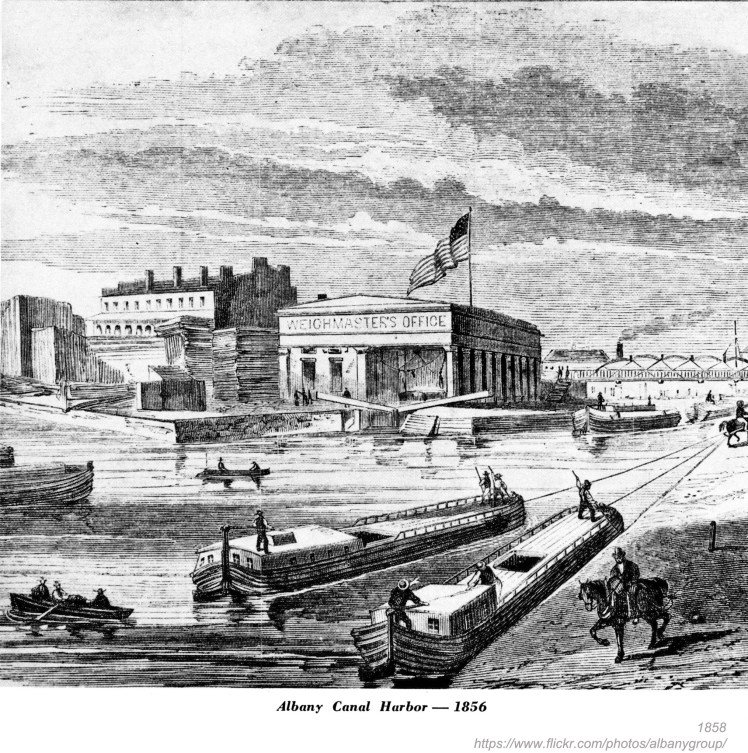
Albany Harbor in 1856 (credit: Albany Group Archive)

The Albany in which the plan for the New York Times was hatched was a bustling place, sitting at the crucial intersection of the Erie Canal and the Hudson River. Goods from the American Midwest flowed into Albany through the Erie, Champlain and Oswego canals, and were transferred at the canal basin for shipment to New York City. This flow supported large numbers of wholesale and retail businesses. According to the 1840 census, Albany had 53 commission house, 35 importing houses, 440 retail dry goods stores, 612 grocery and provision stores. And because those goods had to be paid for, there was also a busy financial connection between Albany and New York City, already then the financial center of the country. Albany’s population was also growing quickly: from 24,000 in 1830, the population had reached almost 34,000 by 1840 and would exceed 50,000 by 1850.

Albany Basin in the 1850s (credit: Albany Group Archive)

St. Paul’s vestry elected in 1848 was representative of this thriving business environment. The two wardens were businessmen with ties across the state and region: William H. DeWitt, a dealer in lumber, and John Tweddle, a malt and hops merchant. Both of these businesses involved major trade across the state and throughout the region, and an especially strong connection with New York City. Two of the vestrymen were also major businessmen. Four vestryman were involved in banking and finance; only two were professionals (one a doctor, the other an attorney).

Bank Note Brokers

Of the four vestrymen involved in banking and finance, two were bank note brokers. At that time, regional banks could issue paper currency. Currency issued by Albany banks was accepted at full value here, but only at a reduced value in New York City; the reverse was true for currency issued by New York City banks. Bank note brokers made their money by buying Albany bank notes at a discount in New York City and carrying them back to Albany where they were redeemed at full value; they could then purchase New York City bank notes at a discount in Albany, and redeem them at full value in New York City. One of our vestrymen reported routinely carrying $20,000 in cash on the steamboats between the cities in this operation.

These two bank note brokers, members of our vestry, were Edward B. Wesley and George Jones. Both were New Englanders, both born in 1811, who had come to Albany for business. And it is they who were instrumental in establishing the New York Times.

Edward Barton Wesley

Edward Barton Wesley

Born in Leicester, Massachusetts, Wesley came to New York City as a young man. He found employment with a steamboat line that ran between New York City and Albany and quickly learned that he could make extra money by speculating in goods (fish, butter, eggs, vegetables, “nearly everything in the market”) in the New York markets, and shipping them to Albany where he sold the produce for a profit. From this beginning, he moved into brokering bank notes. By 1845, he had set up a brokerage partnership in Albany with Norman S. Washburn. That same year, he was elected to St. Paul’s vestry for the first time.

George Jones

George Jones

Jones was born and raised in East Poultney, Vermont. As a teenager, he worked as a clerk and errand boy in a local grocery store. There Jones became friends with Horace Greeley, who was a printer’s apprentice in a newspaper operated by the owner of the grocery store. Like Wesley, Jones went to New York City as a young man. After other business experience, in 1841 he found employment with his friend Horace Greeley, working in the business office of Greeley’s New York Tribune. Here he met Greeley’s editorial assistant, Henry Jarvis Raymond, who was destined to become the third principal in the founding of the New York Times.

In 1842, George Jones moved to Albany, at first running the Albany News Depot, a news agency selling newspapers from New York City and other major cities of the United States and England, as well as magazines and books. In about 1847, he sold the News Depot, and started brokering bank notes, using a desk in the offices of Edward. B. Wesley. It was shortly after this that Jones was elected to St. Paul’s vestry for the first time. Jones had several personal connections to members of St. Paul’s: he also rented office space from Leonard Kip (a member of the church, and brother of William Ingraham Kip), and one of his closest friends was banker Edward E. Kendrick, our treasurer and a member of our vestry.

All Three in Albany in 1850

So, by January 1850, both Wesley and Jones were in Albany, working as bank note brokers in the same office, and serving on St. Paul’s vestry (they were both reelected in April 1850) and the vestry’s finance committee. Jones’ former colleague Henry J. Raymond was also in Albany, having recently arrived as a newly elected member of the New York State Assembly.

New York State Capitol, 1860 (credit: Albany Group Archive)

Jones and Raymond had discussed creating their own newspaper during their time together on the Tribune in 1841 – 1842, but nothing had come of these plans. Thurlow Weed, politically powerful owner of the Albany Evening Journal, had offered to sell his newspaper to Jones and Raymond in 1848; that offer fell through when one of Weed’s partners refused to sell his shares. Jones and Raymond again discussed the newspaper idea during the legislative session of 1850, but the time seems not to have been right.

Across the Icy Hudson in 1851

The plans only became concrete in early 1851, with Raymond again in Albany, in this legislative session having been elected Speaker of the House. There are two stories about how the discussions were renewed, and both involve a walk across the ice-covered Hudson River, from Albany to the Hudson River Railroad station in Rensselaer.

Across the Icy Hudson (1850)

According to one account, Jones and Raymond were walking across the Hudson to meet Raymond’s father’s train. “When half way over,” Raymond again suggested a new newspaper. Jones responded that he was doing well in his bank note business. Raymond pointed out that a bill was pending in the Assembly which would make the business far less profitable and suggested (jokingly, perhaps) that it would be in his interest to see that the bill passed, if it would encourage Jones to join in his venture.

According to the other account, it was Jones and Wesley who were crossing the Hudson in order to buy copies of the New York newspapers when Jones asked Wesley to join him in his plans with Raymond.

Founding of the New York Times

Whatever the sequence of events, the bill on bank note brokers did pass, and both Wesley and Jones joined Raymond. The original partnership was known as Raymond, Jones & Co., with Jones and Wesley each putting up $20,000 in cash to begin production. The company’s Articles of Incorporation were signed by Raymond, Jones and Wesley. The first issue of the new newspaper, then known as the New York Daily Times, was issued on September 18, 1851, with Henry J. Raymond as editor, and George Jones as business manager.

First edition New York Daily Times, 18 Sep 1851

Jones’ and Wesley’s later roles at the New York Times and St. Paul’s Church

When Jones resigned after only six weeks’ due to bad health, Edward B. Wesley became the Times business manager, and served in that role for most of the newspaper’s first ten years. At the end of his long life, he was angered that Jones was given more credit than he as a founder of the newspaper. Jones, he argued, may have had a larger role in the initial founding, but he (Raymond) was the one who built it up over a decade and ensured its survival.

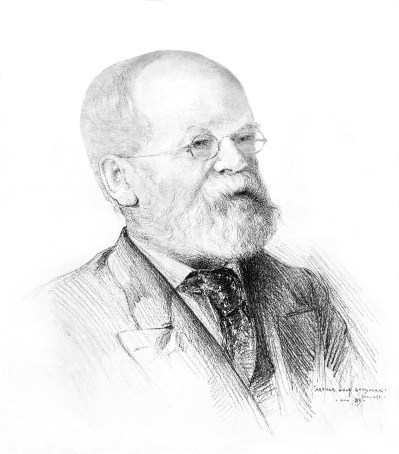
Edward B. Wesley was on St. Paul’s vestry for a total of seven years, from Easter 1845 until Easter 1852. He lived the rest of his life in New York City, and died there in 1906 at the age of 95, his obituary in the New York Times describing him as “The Dean of the Speculators.” He would be pleased to know that it also gave him full credit as a founder of the Times, as well as the Union Trust Company.
George Jones

After his resignation, George Jones was not involved with the newspaper for many years. When Raymond died suddenly in 1869, however, he returned to the Times and was its publisher for twenty years.

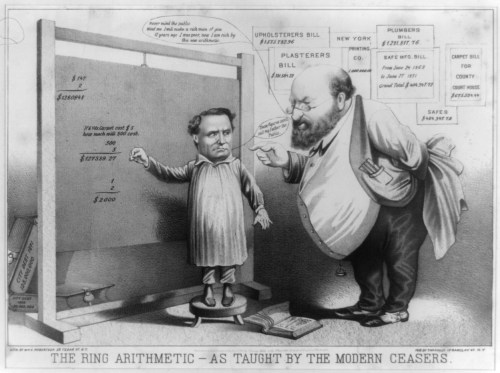
As long-time publisher of the New York Times, Jones deserves considerable credit for its success. In 1870 – 1871, he supported and encouraged the Times’ investigative journalism into the abuses of Tammany Hall. Jones refused a bribe of $5 million (the equivalent of well over $100 million today) by the city controller, Richard B. “Slippery Dick” Connolly, to stop the attacks.

Thomas Nast cartoon, showing Richard B. Connolly and William M. Tweed

George Jones was on St. Paul’s vestry for a total of eight years, from Easter 1848 until
Easter 1856. He also lived the rest of his life in New York City, and died there in 1891.

Conclusion

Although Wesley and Jones were not Albany natives, and lived here for less than twenty years, we can take pride in  the role our city played in bringing them together in business and in the vestry room of St. Paul’s Church. The next time you pick up a copy of the New York Times, remember the thriving business, financial and social connections between the city of Albany and New York City in the 1850s that brought the newspaper into being.


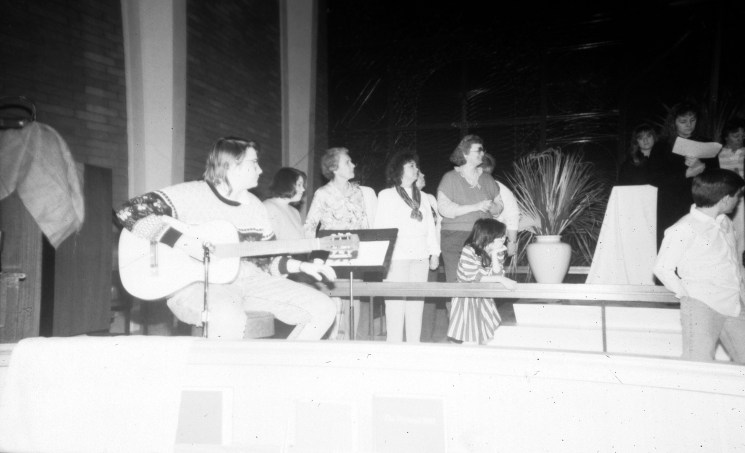
St. Paul’s Presents: “Fat, Fat Jehoshaphat”

Today we turn from St. Paul’s long history to an event that many of us remember well: the performance of “Fat, Fat Jehoshaphat” on April 8, 1990.

“Fat Fat Jehoshaphat” Program Cover

This “musical that teaches the the power of prayer” required the efforts of several dozen parishioners of all ages, as well as our choirmaster, Albert Melton, and the rector, Bruce Rodgers.

“Fat Fat Jehoshaphat” Rehearsal

Our first photograph shows a rehearsal, with the choir and their director, Jennifer Johnston, on the left side of the altar. Left to right, they are:

  • Jennifer Johnston (Choir Director, with guitar)
  • Beth Mahony
  • Kirk Hauser
  • Judy Condo
  • Grace Dennis
  • Sarah Feedore (in front)

To the right of the altar are:

  • Chris Kleinman (Page)
  • Happy McPartlin (Chief Priest)
  • Julie McPartlin (High Priest)
  • Jon Bugler (King’s Guard, in front with head turned)

“Fat, Fat Jehoshaphat” set construction

Here we see part of the stage crew building the set. They are:

  • Martha Eells Murphy
  • Andrew Murphy
  • Ann Jaquish

“Fat, Fat Jehoshaphat” Luncheon

And here is a photograph of the luncheon that followed the performance. On the left is Donna Williams, the only person we have been able to identify so far.

Finally, here is the complete cast listing for this performance.

“Fat, Fat Jehoshaphat” Cast List

“Fat, Fat Jehoshaphat” Cast List


Easter 1967

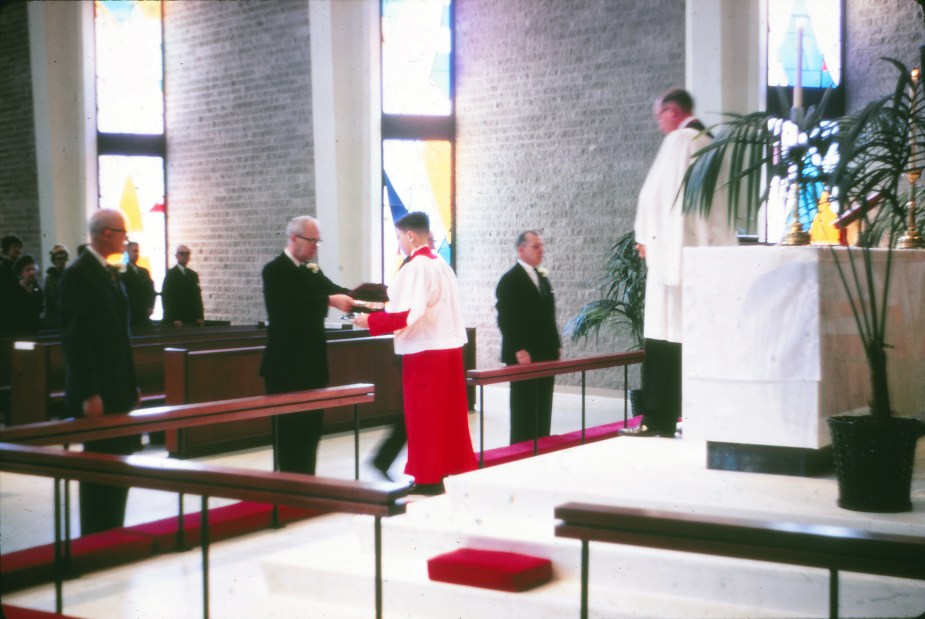
On this Easter morning we share two slides taken on Easter Sunday fifty years ago, March 26, 1967.

Easter Sunday 1967

Easter Sunday 1967


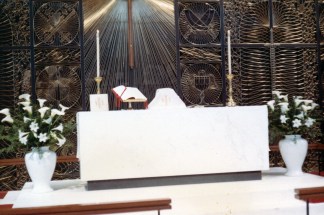
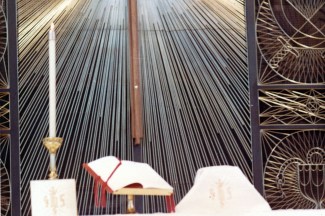
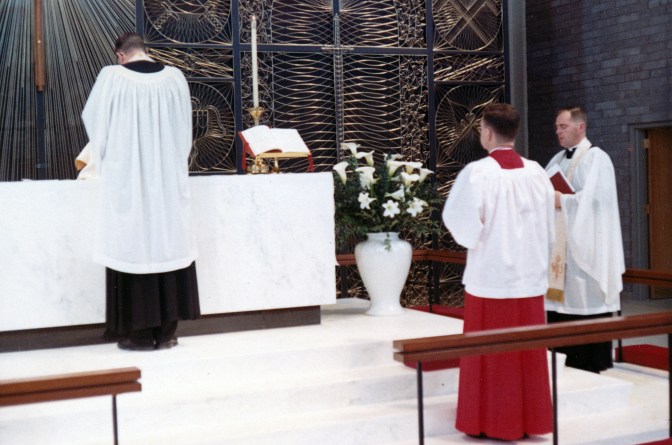
And here are four undated photographs, mostly likely from Easter, and possibly also from Easter Sunday 1967. The rector, J. Raymond McWilliam, is clearly visible. Does anyone recognize the server or the other priest?

Altar, possibly Easter 1967

Altar detail, possibly Easter 1967

Procession, possibly Easter 1967

Altar party, possibly Easter 1967


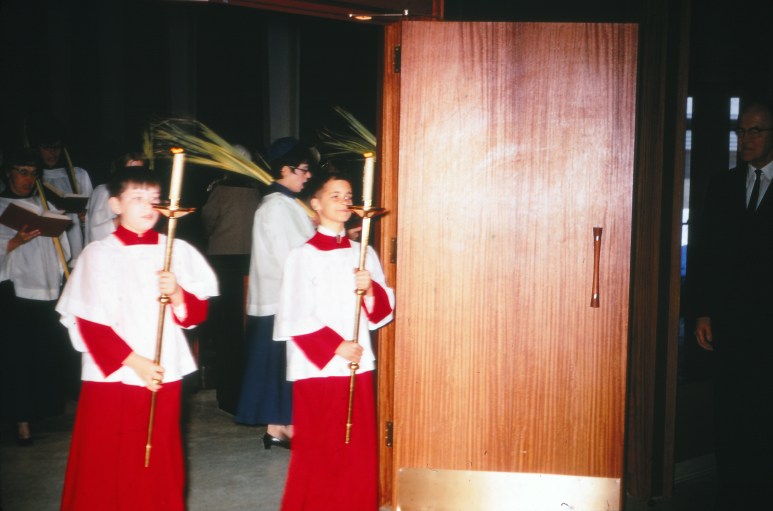
Palm Sunday 1967

Tomorrow is Palm Sunday, the first day of Holy Week. Today we share five slides taken fifty years ago, on Palm Sunday 1967, the congregation’s first Palm Sunday in the new building. The high altar had been consecrated on Maundy Thursday of the previous year.

The first slide shows the nave, at the beginning of the service.

Palm Sunday 1967

Then we see two servers at the rear of the nave preparing for the procession. Can anyone tell us who these two are, or identify the chorister just behind them?

Palm Sunday 1967

Next, we see the rector,  J. Raymond McWilliam, reading the gospel from the liturgical north end of the altar, as was then the custom.

Palm Sunday 1967

The final two slides show Father McWilliam receiving the offering. We have been able to identify only two others in these shots: of the men facing the altar, the two on the left are Herb Brown and Jim White. Can anyone identify others in the pictures?

Palm Sunday 1967

Palm Sunday 1967


The Albany Diocesan Choir Festival

A few weeks ago, St. Paul’s choir sang “Christ whose glory fills the skies,” one of the most popular works of T.Frederick H. Candlyn, our organist from 1915 until 1943.

T.F.H. Candlyn 25th Anniversary at St. Paul’s

As we finished singing the piece (one that we regularly perform with pleasure), I noticed the note on the last page: “Copyright 1942. Commissioned by the Eleventh Albany Diocesan Choir Festival, Albert F. Robinson, director,” and wondered (not for the first time) what the Festival was. Within the past ten years, the Cathedral of All Saints has hosted an Epiphany choir event, in which the choirs of Albany deanery parishes joined. Was the 1942 Festival similar to this more recent “Battle of the Choirs?” No one seemed to know, but the answer was to be found in newspapers of the time. And a very interesting story it was.

T. Frederick H. Candlyn at St. Paul’s organ.

The Albany Diocesan Choir Festival was begun in 1931 by J. William Jones, organist and choirmaster at All Saints Cathedral from 1929 until 1939. In the early years, these were small events, with just a few local choirs. But by the fourth annual Festival in 1935, with 22 choirs taking part, the festival had become a huge occasion, with (as a contemporary newspaper reported) “hundreds of voices” that was “attended each year by throngs.”

The 1935 festival was the culmination of a six-day “Festival Week of Music” at the Cathedral, including a concert of Candlyn’s compositions, sung by St. Paul’s choir and Candlyn’s chorus from the State College for Teachers. The week’s schedule was:

  • Monday: recital by the Cathedral choir featuring works of Palestrina
  • Tuesday: organ recital by Ernest White of Trinity Church, Lenox, Massachusetts
  • Wednesday: recital by Major John A. Warner piano, Earle Hummel violin
  • Thursday: concert of works of T. Frederick H. Candlyn
  • Friday: a chorus of American Guild of Organist choirs, conducted by Dr. Russell Carter. The  massed choir was composed of choirs from Reformed, Methodist, Presbyterian, Baptist congregations in Capital District.
  • Saturday: Fourth Annual Diocesan Choir Festival, conducted by J. William Jones. Part of this service was broadcast on radio station WGY.

Candlyn was again involved in the 1936 event as accompanist. That year also he was also president of the Albany Diocesan Choirmasters’ Association, which was very active in promoting and organizing the festivals, but also in sponsoring recitals, conferences and in commissioning choral works. The Association even published a newsletter, “The Chorister.”

Cover of “The Chorister,” May 1941

Candlyn was also accompanist in 1937, when twenty massed choirs sang his work “Thee we adore,” which he dedicated to the Festival choir.

St. Paul’s Choir, with T.F.H. Candlyn, 1937

By 1938, the Festival had “grown to be of national importance,” and had become the model for other festivals across the United States. That year, the Albany Diocesan Choirmasters’ Association conducted district festivals in each of the diocese’s deaneries, preparing the parish choirs for the diocesan event in Albany. The Ogdensburg event, for example, gathered 200 choristers from 14 choirs to St. John’s, Ogdensburg for rehearsals and for a choral service presided over by Bishop G. AShton Oldham.

George Ashton Oldham, Bishop of Albany

1938 was also the first year that the Albany Diocesan Choirmasters’ Association commissioned new works to be performed at the festival. The composers and their works were:

  • Healey Willan (1880 – 1968) of Church of St. Mary Magdalene, Toronto: “Before the ending of the day”
  • Everett Titcomb (1884 – 1968) of Church of St. John the Evangelist, Boston, Massachusetts: “Benedictus es, Domine”
  • Gardner C. Evans (1897 – 1951) of Church of Our Savior, Brookline, Massachusetts: “Thy kingdom come”

The Association arranged for publication of these works (as well as “Magnificat and Nun Dimittis” by Titcomb) by Carl Fischer, Inc., in Series I of The Albany Diocesan Choir Festival Series.

Healey Willan, “Before the Ending of the Day” cover obverse

In 1939, the Choir Festival was again part of “Festival of Music Week.” That year, the schedule was:

  • Monday: Albany Federal Orchestra (an organization supported by the Works Project Administration)
  • Tuesday: Liszt Choristers, Booker T. Washington Choral Society, Schenectady NYA Choir
  • Wednesday: chamber music recital, again with pianist Major John A. Warner, as well as a violinist, a horn player and four cellists.
  • Thursday: J. Stanley Lansing, Dean of the Eastern New York Chapter of the American Guild of Organists conducted a massed choir from nine area congregations
  • Friday: organ recital by Thomas Mathews of St. Martin-in-the-Fields, Philadelphia
  • Saturday: Albany Diocesan Festival, with 50 choirs, Mr. Jones conducting

William Jones, whose energy had moved the festival from small beginning into a project that “has spread throughout the length and breadth of the Diocese of Albany, with a fine organization of choirmasters and clergy as its sponsor and its own magazine which now has a national circulation” resigned from the Cathedral staff effective December 1, 1939, his tenth anniversary at the cathedral.

“Cathedral of All Saints” by Earle L. Kempton

Jones’ place as director of the Festival was taken by Albert F. Robinson, organist and choirmaster at Trinity Church, Potsdam. Albert F. Robinson oversaw the district festivals that year. We have a record of the Albany deanery festival, which drew 10 choirs to St. Andrew’s Church in Albany.

The 1941 Festival may have been the grandest of them all, with 50 choirs and 500 voices joined. Two new anthems were commissioned for the service:

  • Alfred Whitehead (1887 – 1974) of Christ Church Cathedral, Montreal: “Come Thou Almighty King”
  • Gardner C. Evans (1897 – 1951) of Church of Our Savior, Brookline, Massachusetts: “O Saving Victim”

These, along with the following piece (probably commissioned for the 1940 Festival) were published by the Diocesan Choirmasters’ Association in Series II of Fischer’s The Albany Diocesan Choir Festival Series:

  • Charles O’Neill (1882-1964), professor at the State Teachers’ College at Potsdam, New York (now the Crane School of Music): “I will extol Thee”

As mentioned above, Candlyn’s work “Christ whose glory fills the skies” was commissioned for the 1942 festival. It also was published in Series II of the Fischer series. With the war on, this was a smaller event, held in conjunction with the Diocesan convention “to aid in conservation necessitated for war measures.” We assume that this refers to gasoline rationing, which would have made it very difficult to transport 50 choirs for a separate event. This year was to be Candlyn’s last at the Festival: in 1943 he resigned from St. Paul’s to become organist and choirmaster at St. Thomas Church in Manhatttan.

Healey Willan, “Before the Ending of the Day” cover reverse

The Diocesan Choir Festivals for 1943 and 1944 were again held in conjunction with the diocesan convention. There seems to have been a break during the last years of World War II.

The first Festival after the war was in 1947, when 500 singers from all parts of the diocese were directed by Duncan Trotter Gillespie, of St. George’s, Schenectady, and accompanied by organ and a brass choir from Albany High School. In 1950, in a sign that the festival had returned to its former glory, the regional festivals were held once again: the Albany deanery met at St. Andrew’s, and other events were held in Cohoes, Staatsville, Morris and Ogdensburg.

1951 was a slightly smaller event, with 25 choirs attending, but scheduling the festival with the newly-organized Tulip Festival helped with attendance: the audience, we are told, filled the cathedral to overflowing.

All Saints Cathedral (credit: Albany Group Archive)

Starting in the 1954, when the Choir Festival was again held in conjunction with the Tulip Festival, the director was W. Judson Rand Jr., organist and choirmaster of St. Peter’s church, who had been the festival’s organist back in 1941. The Diocesan Choirmasters’ Association continued to organize the event, which attracted 200 singer in 1955.

The last reference to the Festival that I’ve been able to find is an advertisement from 1965. It is a pity that we have lost this element of diocesan life. With smaller congregations and smaller choirs in many Episcopal churches, it would be difficult to organize such a festival today. But think of the benefits of bringing together musicians from across the diocese to meet, to form friendships, and to join together in song.


The Geer Memorial Pulpit

Last year St. Paul’s Church celebrated its fiftieth year in the Hackett Boulevard building. Some parishioners have wondered why there are so few items from the previous church in this 1966 building. Today we discuss one item from the Lancaster Street Church that could not be incorporated into the new building, and how it came to be preserved and protected for future generations.

When St. Paul’s vestry met on September 12, 1962 with William F. Meyers, New York State’s Assistant Commissioner of Housing, he told them that they would have three years before the building was demolished. It was to be a far shorter time. Because St. Paul’s property (church, parish house and rectory) were in the area designated for the South Mall’s central air conditioning and main transformer vault, the demolition had to occur early in the mall’s construction. In May 1964 the vestry was told that they would have to vacate the building by the end of August of that year. After some negotiation, the congregation agreed to hold their last service in the building on July 26, 1964. That same day, ground was broken for the Hackett Boulevard building.

Architect’s rendering, Swann Street Building, South Mall

Father Nelson Parke had passionately argued for the value of the many memorials in the Lancaster Street building. And Grace Gunderson, a member of the Temporary State Commission on the Capital City (the organization that was planning the South Mall), had proposed “to save and move the sanctuary and memorial objects such as the stained glass windows, and build a new church around them.” The vestry had to quickly determine which objects from the Lancaster Street building could be moved to the Hackett Boulevard church.

J. and R. Lamb windows, Hackett Boulevard Narthex

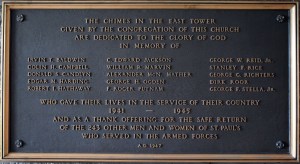
A dozen of the stained glass windows from the Lancaster Street building would be placed in the new church’s narthex. Room was also found for brass plaques honoring Harry Van Allen and those who lost their lives in World War II. Many items from the chapel could be used in the new building; many other memorials would be buried under the new altar.

Harry Van Allen Memorial Plaque

Memorial plaque for World War II Dead

The solution, however left a large number of other objects which could not be used in the new building. All of these objects were the property of New York State, which had taken the entire church by eminent domain on March 27, 1962. The State sold fifty-five lots of items at auction held in the last days of July 1964, including smaller stained glass windows, pews, paintings and doors. Lot number 44 “Pulpit – decorative sold oak” went to the Champlain Conference of the Wesleyan Methodist Church for $13.00.

Robert Geer

The pulpit had originally been donated in 1883 by Robert Geer, in memory of his two wives: Mary Sophie Gere (1837 – 1868) and Rhoda Kellogg Shed (1837 – 1882). Robert Geer was born in Ledyard, Connecticut in 1837. He worked as a druggist in Norwich, Connecticut, then in Syracuse, New York. In 1865, he moved to Albany, where he represented the Salt Company of Onondaga, in which his first wife’s family played a prominent role. In Albany, Robert Geer was also president of the Board of Trade and served as a bank director.

In 1883, six months after the death of his second wife, Robert Geer wrote a confidential letter to St. Paul’s vestry, explaining that during her last year Rhoda S. Geer had “several times expressed the wish that some one would place a new memorial pulpit in St. Paul’s Church.” Both women had been confirmed at St. Paul’s and were communicants of the congregation. Having consulted with the rector, J. Livingston Reese, Geer commissioned the pulpit in memory of his wives, and asked the vestry’s permission to place it in the church.

J. Livingston Reese

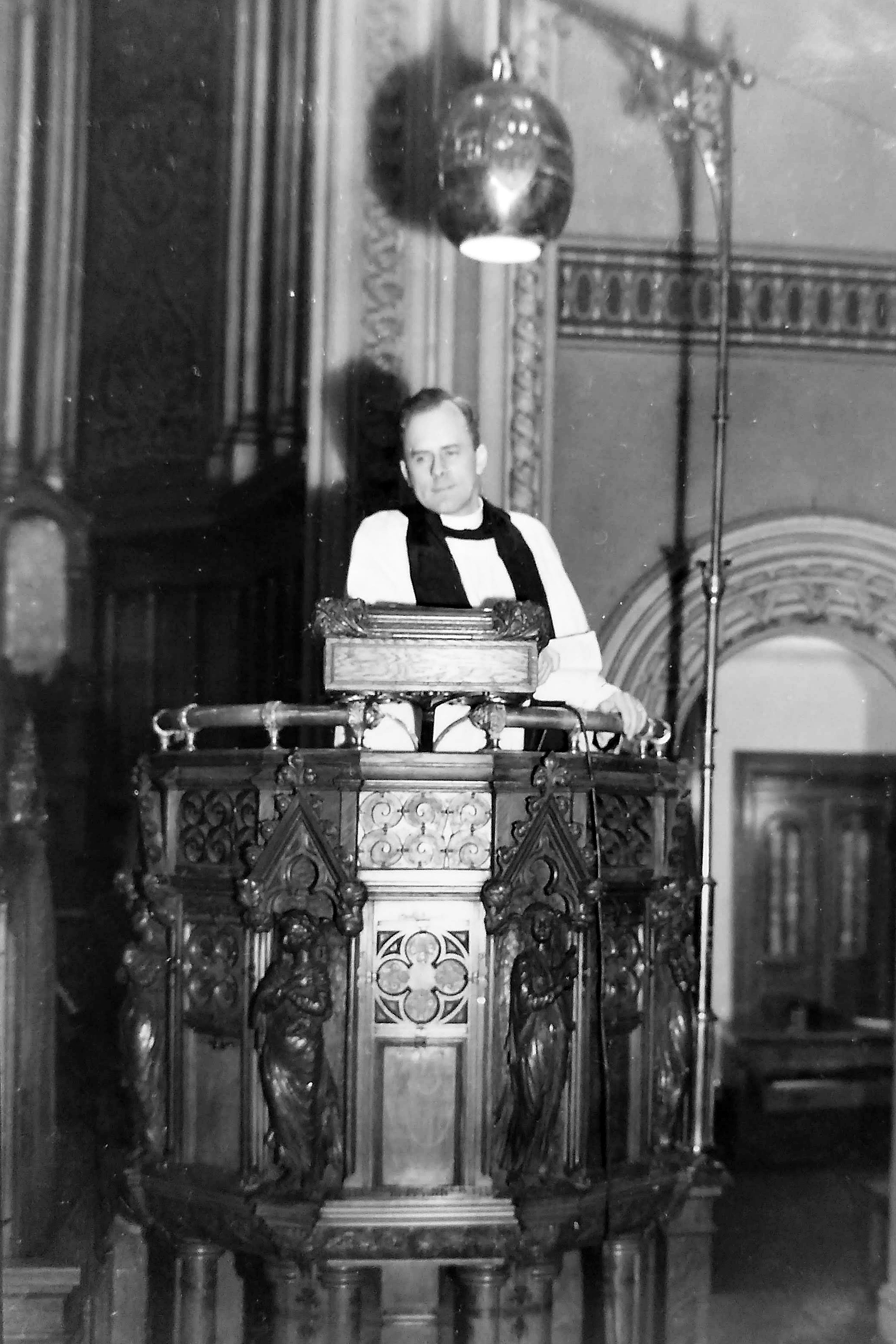
From church records, we know that work was designed by Robert W. Gibson, architect of All Saints’ Cathedral, and designer of the pulpit in St. Peter’s Church. The pulpit was executed by Annesley & Co., the Albany firm that also made the bishop’s throne at the Cathedral of All Saints.

The Geer memorial pulpit remained in place in the Lancaster Street building for the next 81 years, but its future in summer of 1964 was far from certain. If the pulpit was not claimed by the Wesleyan Methodists before demolition began, it would become the property of the demolition contractor, to be disposed of as the contractor saw fit.

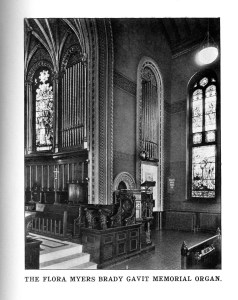
Flora Myers Brady Gavit Memorial Organ and Geer Memorial Pulpit

But two weeks following the sale, Hugh M. Flick, Associate Commissioner of State Department of Education (and State Historian) intervened. In an August 14, 1964 letter to General C.V.R. Schuyler, Commissioner of New York State Office of General Services, Frick wrote:

“…I have personally examined the carved wooden pulpit in St. Paul’s Episcopal Church on the Mall. This pulpit was carved by Camillo Kramer and is an unusually fine example of Albany handicrafts. Miss Camilla Kramer is still living and we will seek to glean from her reminiscences concerning her father and other woodcarvers in Albany.”

Flick formally requested that the pulpit be preserved, and transferred to the collection of the State Department of Education. General Schuyler responded positively the next day, and within the week, arrangements had been made to remove the pulpit from the church and place it in the Department of Education warehouse at 1260 Broadway. If it had not been for Hugh M. Flick’s intervention, the pulpit might have permanently left the city of Albany, or might even have been destroyed.

Geer Memorial Pulpit

It is certainly a impressive piece of furniture: almost seven feet from base to top of the lectern, and monumental in scale. But it must have been the angels that impressed Flick. Each figure is carved in fine detail, with very distinctive features, as though each were based upon a real individual. How did Flick recognize it as the work of Camillo Kramer? We have been unable to locate any further documentation from the State Education Department, though I have not yet checked Hugh M. Flick’s correspondence from this period. I have been unable to find other examples of Kramer’s work, but Flick was too careful a historian to make an attribution without some evidence.

Geer Memorial Pulpit: Angel with hands clasped

Camillo Kramer was born in Prussia in 1846, and emigrated to the United States about 1870, settling first in New York City. He must have trained as a wood carver in Germany, because that is the first occupation listed in city directories. Kramer came to Cohoes about 1877, working as a carver for a furniture manufacturer. He came to Albany in 1882, the year our pulpit was built. He does not appear in business listings for several years, and we assume that he was working for other firms, possibly including Annesley. He established a shop at 8 Green Street (on the corner of Beaver Street) in 1888. That first year he is listed as a wood carver, but by the next year he had switched to another line of business: bicycles. Kramer sold bicycles and tricycles in the Green Street shop from 1889 until 1891. By 1893 he was back to wood carving, the occupation he continued until his retirement in 1912.

Geer Memoiral Pulpit: Angel with crossed arms

Camillo Craver was not only a craftsman. Even as a young man in Cohoes he obtained a patent for a table, and over his lifetime was granted other patents for a velocipede, velocipede wheels, a pipe wrench, and a shoe fastener.

Geer Memorial Pulpit: Angel with harp

Geer Memorial Pulpit: Angel with cross

The pulpit remains in the State Museum collection. In October 2015, thanks to Department of Education staff, I was able to see the pulpit in their Rotterdam storage facility, and take the photographs that accompany this post. The pulpit was most recently displayed in the museum in the mid-1990s. We can hope that Flick’s promise of inclusion in new museum displays can continue to be fulfilled, and that it will be displayed regularly, as envisioned in Flick’s 1964 letter to General Schuyler:

“In the light of the historical interest of this unusual example of the work of an Albany artisan, I would like to most sincerely request that consideration be given to the preservation of this pulpit and that it be included in the historical collections of the State Education Department. It is anticipated that when the new museum rises on the Mall, exhibits such as this will add a good deal to the value of the exhibits.”

George A. Taylor, St. Paul’s rector, in the Geer memorial pulpit, Christmas 1941