Category Archives: Clergy

June 1966 — Consecration of “The New Modernistic St. Paul’s”

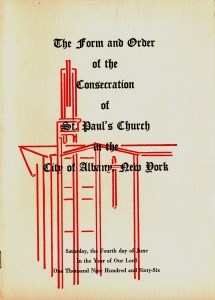
Consecration Bulletin 4 Jun 1966

Consecration Bulletin 4 Jun 1966

In posts over the past eighteen months, we’ve noted the progress in the construction of St. Paul’s new home on Hackett Boulevard, beginning with the groundbreaking in July 1964, following the stages of construction through 1965 and early 1966, and most recently the consecration of the high altar and the laying of the cornerstone. Today we celebrate the fiftieth anniversary of the building’s consecration on June 4, 1966.IMG_0012 v001

The preacher that day was Darwin Kirby, Jr., rector of St. George’s Church in Schenectady. Thanks to a Times-Union article describing the consecration of “the new modernistic St. Paul’s Church at 21 Hackett Boulevard,” we know some of the words he spoke that day, words that still resound half a century later. Kirby described the church as “the Bethel of Albany, its House of God, a meeting place of heaven and earth, Jacob’s ladder pitched there in Hackett Boulevard, in the midst of a great swirl of traffic and the hurrying life of a great capital.”

The Times-Union article continued:

Father Kirby paid tribute to the “vision and vigilance” of the people of St. Paul’s, saying “You and your distinguished rector are to be congratulated on what you have achieved.”

The new edifice replaces the former church in the South Mall.

Father Kirby warned that “splendidly-cared-for church buildings by themselves are not enough; that from the day of Pentecost until the day of Constantine, the Church owned not a single building it could call its own.Yet, he went on, “the church outlived, outfought and outdied a hostile, pagan Roman Empire.”

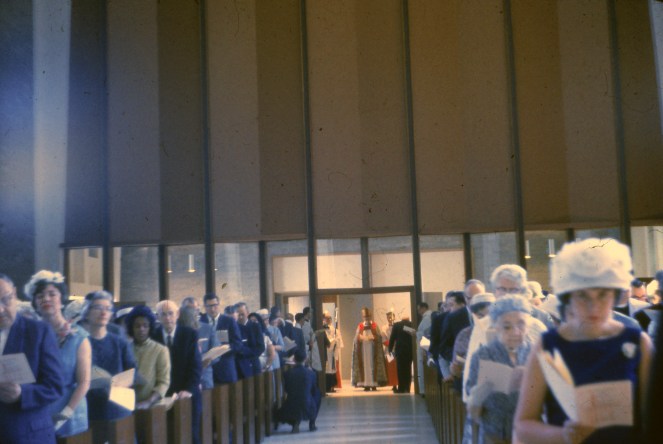
Presiding at the ceremony was Allen W. Brown, Bishop of the Diocese of Albany, with Suffragan Bishop Charles B. Persell, Jr. The Master of Ceremonies was Thomas T. Parke, curate of St. George’s Church, Schenectady and son of Nelson F. Parke, St. Paul’s rector from 1959 until 1962. Here we see Bishop Brown and the servers as the procession formed. The processional hmyns were Austria (“Glorious things of Thee are spoken,” and Regent Square (“Christ is made the sure foundation.”)
IMG_0001 v005

Following the prayer of consecration, Bishop Brown made a circuit of the church, praying at the font, the crossing, the midst, the pulpit, the crossing again, and the sanctuary. In the next photographs, we see the bishop at two of these stations.

The first photo shows Bishop Brown, with Father Parke holding the service book. In the background is St. Paul’s rector, J. Raymond McWilliam; the server with his back to the camera is Peter Eells.

Bishop Brown, with Father Thomas T. Parke 4 Jun 1966

Bishop Brown, with Father Thomas T. Parke 4 Jun 1966

The second photo shows Bishop Brown and Father Parke, with the same two servers.

Bishop Brown, with Father Thomas T. Parke 4 Jun 1966

Bishop Brown, with Father Thomas T. Parke 4 Jun 1966

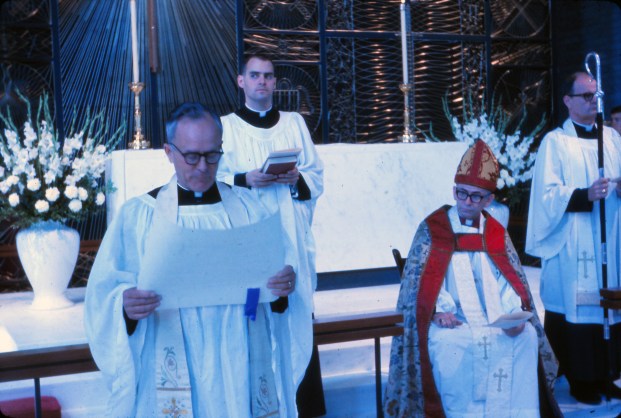
After the circuit of the church, the Sentence of Consecration was read by George A. Taylor, St. Paul’s rector from 1932 until 1948.
IMG_0006 v001

Following the celebration of the eucharist, the bishop preceded by Father McWilliam processed from the church as the congregation sang Vigiles et Sancti (“Ye watchers and ye holy ones”).

Procession, St. Paul's Consecration 4 Jun 1966

Procession, St. Paul’s Consecration 4 Jun 1966

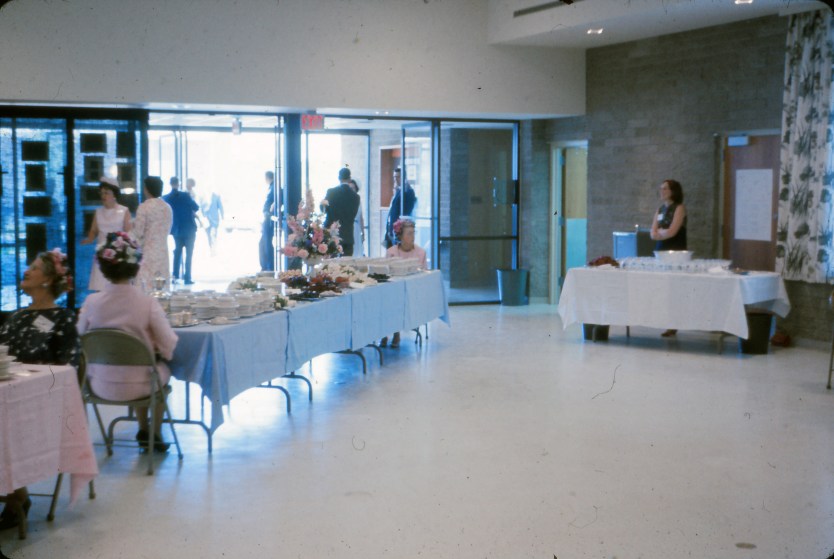
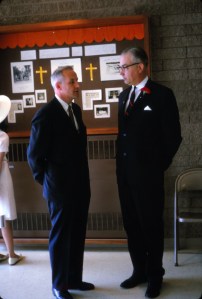
The reception after the service was the first to be held in the church hall, now known as McEwan Hall, in honor of William Starr McEwan, treasurer of the building committee. We see McEwan standing that day in the narthex with the building’s architect, Donald Stephens.
Reception 4 Jun 1966
Reception 4 Jun 1966

Donald Stephens (architect) and William S. McEwan (treasurer, building committee)

Donald Stephens (architect) and William S. McEwan (treasurer, building committee)

Finally, here are two photographs of clergy taken in the parking lot, probably immediately after the service.

Father George A. Taylor

Father George A. Taylor

Bishop Allen W. Brown and Father George A. Taylor
Bishop Allen W. Brown and Father George A. Taylor
Harry Van Allen, Missionary and Printer

As you enter the door to St. Paul’s chapel, if you glance to your right, you will notice a brass plaque, one of only two from the Lancaster Street building to be displayed in our present church home.

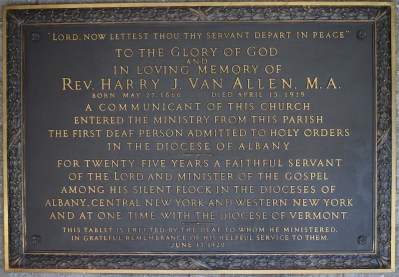
Harry Van Allen Memorial Plaque

Harry Van Allen Memorial Plaque

You may be touched, as I have been, by this memorial to the first deaf person ordained in this diocese, and one whose ministry, both lay and ordained, was connected with this parish.

When Harry Van Allen came to his first service at St. Paul’s in 1894, he had already accomplished much for a young man of twenty-eight. Deaf since the age of ten as a result of scarlet fever, Van Allen had first attended the school for the deaf in Oneida County, and then the institution now known as Gallaudet University. He had taught printing for three years at the Pennsylvania Institution for the Deaf and Dumb (where he also served as editor of their newspaper, Mt. Airy World), and had worked as a printer in several central New York cities. But Harry Van Allen had a vocation as well as a career. Since his days in Philadelphia, he had served as a lay reader in Episcopal churches, conducting Bible classes for the deaf. In 1894, he was appointed missionary to the deaf by the Albany diocese’s newly-organized Commission for Church Work Among Deaf-mutes, whose secretary was St. Paul’s rector, Freeborn G. Jewett.

Van Allen moved his young family from Johnstown to Albany, obtained a job at Riggs Publishing and Printing, and began an energetic round of visits to churches throughout the diocese, leading classes and conducting services. Just as important, in a period when deaf people were isolated, Van Allen’s services drew them together for mutual support and encouragement. Van Allen also provided practical assistance not otherwise available, including translating, counseling, and help in finding jobs.

To add to a schedule that few of us could maintain, Harry Van Allen also began to study theology and church history and applied to Bishop Doane as a candidate for ordination. The bishop at first rejected his application, but after discussions at the General Convention of 1895 decided to accept him as a postulant. Harry Van Allen was ordained deacon in 1898 (with the recommendation of St. Paul’s vestry) and priest in 1902.

Harry Van Allen (courtesy Gallaudet University Archives)

Through these years, Harry Van Allen was listed in the Albany City directory as “missionary and printer,” as he continued his printing job during the week and on Sundays traveled across the diocese. In 1900 he added the Central New York diocese to his responsibilities and shortly afterwards moved his family to Utica. In 1916 he also took on Western New York, extending his mission field from Albany to Buffalo and from Ogdensburg to Binghamton.

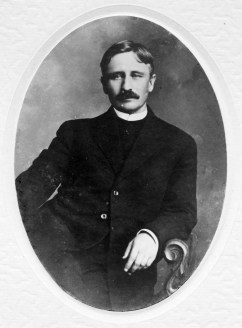
At a celebration of the twenty-fifth year of his missionary efforts held at St. Paul’s just a few months before his death, Harry Van Allen estimated that in those years he had traveled 150,000 miles and reached more than 1,500 deaf men and women. We see him in the final photograph as he must have often stood, overnight bag in hand, about to board another train or interurban car, heading off yet again to serve “the deaf to whom he ministered.”

Harry Van Allen (courtesy Gallaudet University Archives)

Harry Van Allen (courtesy Gallaudet University Archives)

Holy Innocents’ Day

Today, December 28, is Holy Innocents’ Day, and we are sharing a manuscript poem, found in St. Paul’s archives, that was written for this day by William Prall, our rector from 1902 until 1905.

William Prall

William Prall

Holy Innocents’ Day

Jesu, pure and undefiled,
Make me as a little child
Wash my soul from grief and sin
Keep me good and true within.

Only as a child may I
Hope to see Thee when I die.
As a child I long to be
Now and for eternity.

In the fullness of Thy grace
Turn upon me Thy dear face
Assuage the tears that I have shed;
Lay Thy hands upon my head.

Bless me as Thou once didst bless
The children that around Thee press’d;
In thy blessing I shall be
A child for all eternity.

1902
William Prall

William Prall was born 6 April 1853 in Paterson, New Jersey[1], a son of Edwin T. Prall and Rachel More Thomson.[2] He earned the A.M. and Ph.D. degrees at Heidelberg University in 1873 and the LL.B. at Columbia University in 1875 and then took up the practice of law in Paterson.[3] He served a term in the New Jersey State Assembly (1883-1884), during which he wrote and sponsored the state’s free public library statute.[4]

William Prall married Lilian Porter Clapp in 1881[5] and the couple had a daughter, also named Lilian. Mother and daughter died within a year of each other[6], in 1884 and 1885 respectively. Weeks after his daughter’s death, Prall was accepted as a candidate for the priesthood by Thomas A. Starkey, St. Paul’s former rector, and by then bishop of Northern New Jersey.[7]

Thomas A. Starkey

Thomas A. Starkey

Prall began study at the De Lancey Divinity School (associated with Hobart College, Geneva, New York) in the spring of 1886.[8] He was ordained a deacon in 1886 and priest in 1887, both ordinations by Bishop Starkey.[9]

Prall’s first assignment was as assistant to J. Livingston Reese at St. Paul’s, Albany, where he served from 1887 to 1889. He next served as rector of the Church of the Holy Comforter in South Orange, New Jersey (1889-1891) and St. John’s Church, Detroit Michigan (1891-1900).[10] In 1900 he chose to return to St. Paul’s Albany as rector, to the “intense surprise” of an anonymous New York Times columnist, who described St. Paul’s as “the very reverse of rich and marked by the signs of decrepitude sometimes incidental to advanced age”.[11] Prall was to stay at St. Paul’s from 1900 until his retirement in 1905.[12] In 1903, he briefly accepted the wardenship of St. Stephen’s College (now Bard College) in Annandale, New York, but changed his mind and returned to Albany after he and his wife “expressed dissatisfaction with the accommodations afforded”.[13]

William Prall was awarded an honorary Doctor of Sacred Theology degree by the De Lancey Divinity School in 1893.[14]

In 1897, during his stay in Detroit, Prall married Helen Ames Lothrop.[15] There is no evidence of children from that marriage.

Among William Prall’s publications are:

Books:
The State and the Church (New York: T. Whittaker, 1900)

Civic Christianity (New York: T. Whittaker, 1895)

Book Chapters:
“The Priest in the Organized Parish” Chapter VII (pages 92-110) of Edward Macomb Duff (ed.), The American Priest at Work: A Symposium of Papers (Milwaukee: The Young Churchman Co., 1900)

Books translated and edited:
Giovanni Visconti Venosta Memoirs of Youth: Things Seen and Unseen (Boston and New York, Houghton Mifflin Co., 1914)

Almira Strong Lothrop, The Court of Alexander III: Letters of Mrs. Lothrop (Philadelphia: The John C. Winston Company, 1910)

Published sermons and lectures
“Past, present and future; a sermon preached January 26th, 1902, in commemoration of the seventy-fifth anniversary of the founding of the parish of St. Paul’s, Albany, N.Y.”

“The Reformation and the Origin of the Church of the Huguenots: A Study” (New York: The Huguenot Society, 1924)

William Prall died 22 March 1933 at his home, 1130 Park Avenue in New York City.[16]

[1] Frederick S. Hills (ed.), New York State Men:Biographic Studies and Character Portraits (Albany: The Argus Company, 1910), page 186

[2] “Dr. William Prall Dies in 80th Year,” New York Times, 24 March 1933

[3] New York Times, 24 March 1933

[4] Hills, New York State Men, page 186

[5] New York Times, 24 March 1933

[6] The Churchman, 26 Sep 1885, page 343

[7] New York Times, 18 October 1885

[8] New York Times, 18 October 1885

[9] The National Cyclopaedia of American Biography (New York: James T. White & Company, 1897), Volume VII, page 113

[10] Frederic E. J. Lloyd (ed.), The American Church Clergy and Parish Directory for 1903 (Cleveland: Frederic E. J. Lloyd. 1903), page 208

[11] “Topics of the Times,” New York Times 21 Jan 1900

[12] Hills, New York State Men, page 186

[13] New York Times 23 September 1903

[14] Journal of the Fifty-sixth Annual Council of the Protestant Episcopal Church in the Diocese of Western New York 1893 (Buffalo: printed for the Council, 1893), page 54

[15] John W. Leonard (ed.), Who’s Who in America 1899-1900 (Chicago: A.N. Marquis & Company, c. 1899), Volume I, page 579

[16] New York Times, 24 March 1933

A Merry Greeting on Christmas Day!

On this Christmas morning, a greeting from the only carol written for St. Paul’s Church, Albany. “A Christmas Carol”  was “written for the children of St. Paul’s Church” in 1856 by George William Warren, our organist and choirmaster from 1848 until 1860 and sets verse by our rector, Thomas A. Starkey.

Thomas A. Starkey

Thomas A. Starkey

Geo. Wm. Warren's A Christmas Carol

Geo. Wm. Warren’s A Christmas Carol

Starkey’s words also appear on a song sheet published separately.

Christmas Carol Song Sheet (courtesy Library of Congress)

Christmas Carol Song Sheet (courtesy Library of Congress)

Thirty years later, the song was still sung in Albany. Huybertie Pruyn Hamlin, in her memoir An Albany Girlhood, refers to it as “our favorite carol” in the 1880’s. Writing fifty years later, she still recalled the frosted bells on the cover and the last line of the first verse: “to young and old, to sad and gay, a merry greeting on Christmas Day!”


The Lancaster Street Rectory

Church records no information about how housing was provided to St. Paul’s earliest rectors. Most of them seem to have rented or purchased houses in the neighborhood, although as late as 1869 J. Livingston Reese (rector from 1864 until 1891) was boarding at 67 Chapel Street, one third of a mile from the church. The first mention of plans for a rectory appears in our records in 1865, when the Sunday school donated $1,200 for purchase of the lot to the west of the church for that purpose from Miss Kate Wilson. This was an impressive amount of money, with an approximate current value of $18,000,  at a time when St. Paul’s had one of the largest Sunday Schools in the city, with almost 500 students and about 50 teachers. In 1867, funds for construction of the building were raised by a subscription and by the women of the parish.

There is some question about when the rectory was completed. Reese, Its first occupant, reported that he was first able to welcome guests there on New Year’s Day, 1870. But church historian Thomas H. C. Clemishire (whose father, John Clemishire was a carpentry contractor on the project) writes that contracts were let in June 1870. A January 1871 newspaper article says “A new rectory is already completed and occupied”, but adds information about what its dimensions and cost will be “when completed.” [Albany Evening Journal 28 Jan 1871] Perhaps it is best to say, as did Milton W. Hamilton in his 1977 history of the parish, that it “was built in 1870-71,” and that construction may have proceeded in stages.

Construction over a period of years would explain the building’s unusual design, which has been described as “post-Civil War eclectic, combining several stylistic trends of the period: French Second Empire, Venetian Gothic (arches with poly-chrome voussoirs), and maybe a bit of Italian Renaissance thrown in for good measure.”

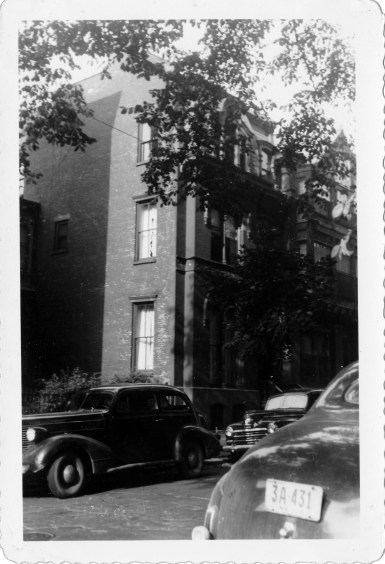
The  rectory was “sixty feet in length by twenty-four feet in width, and three stories in height.” [Albany Evening Journal 28 Jan 1871].  The best photograph we have was probably taken about 1900. The rectory (80 Lancaster) is immediately to the right of the church. The house on the far right (82 Lancaster) was built in 1884 as the home of Anna Van Allen Jenison and her husband  E. Darwin Jenison, Vice President of the Commerce Insurance Company. Known as “the Swiss Chateau,” it was a wedding gift from Anna’s parents, Mr. and Mrs. Garrett A. Van Allen, who were long-time members of St. Paul’s.

St. Paul's Church and Rectory

St. Paul’s Church and Rectory

I have been able to locate only three additional photographs of the Lancaster Street rectory. Then next two are snapshots that were taken in 1946 during an insurance appraisal.

Rectory 1946 002 v001

St. Paul’s Lancaster Street Rectory, 1946

Rectory 1946 001 v001

St. Paul’s Lancaster Street Rectory, 1946

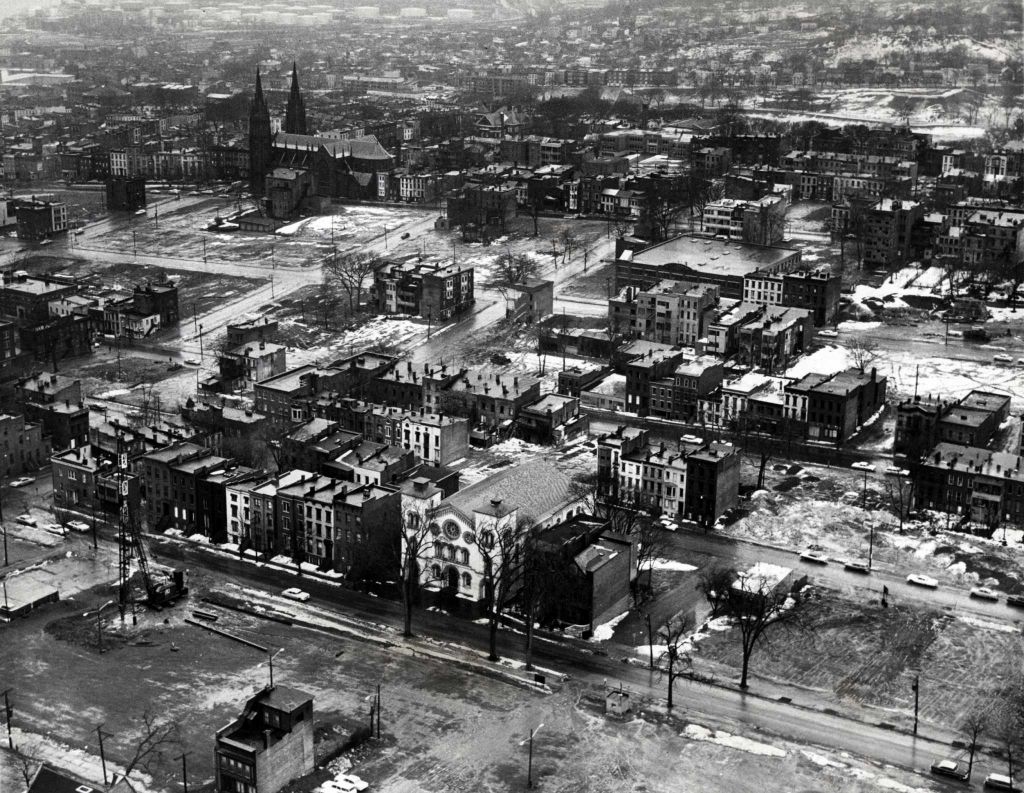
Sadly, the fourth photograph was also most likely the last, taken shortly before the church and rectory were demolished in October 1964 for construction of the South Mall.

St. Paul's Church and Rectory, 1963 or 1964 (photo credit: Times-Union Archive)

St. Paul’s Church and Rectory, 1963 or 1964 (photo credit: Times-Union Archive)

Much of the neighborhood was demolished by mid-1963, so this undated photo may have been taken during the winter of 1963 – 1964. The church stands out clearly in the foreground, because its reddish or buff-colored brickwork had been painted white in 1960.  The rectory still exists, but is difficult to see behind the bare trees.

William Ingraham Kip’s Leave of Absence

While St. Paul’s fourth rector, William Ingraham Kip, is certainly the best-known of our early clergy, his fame is principally due to his later service as the first missionary bishop — and subsequently first diocesan bishop — of California. But Kip deserves our respect and remembrance as well for his role in leading this congregation through an early financial crisis that we might not have survived.

Within months of Kip’s appointment as rector in 1838, it became apparent that the congregation was (in the words of a contemporary vestryman) “hopelessly wrecked.” Kip and a new group of lay leaders had no choice but to sell the Ferry Street church in order to pay creditors. It was their genius, however, to realize that if the church was to survive it could not stay in Albany’s South End. Under Kip, the Pearl Street Theater was purchased and renovated, relocating the congregation to what was then the center of Albany’s most upscale neighborhood. In that new location, with dynamic leadership, both ordained and lay, the congregation thrived.

Wm. Ingraham Kip at St. Paul's altar (from an 1847 portrait by William Tolman Carlton)

Wm. Ingraham Kip at St. Paul’s altar (from an 1847 portrait by William Tolman Carlton)

The years that followed this new beginning were busy and stressful ones. While major creditors had been satisfied by the sale of the church, for several more years others submitted claims for payment. Kip led through this difficult period, attracting many new parishioners with his dynamic preaching. During the winter of 1842-1843, he also gave a series of lectures that were to be published as Double Witness of the Church, one of the most popular and influential books of theology in the Episcopal Church in the mid-19th century, printed in 25 editions.

All this activity must have taken its toll. At a special meeting on September 30, 1844, the vestry was read a letter from Kip, announcing (as summarized in the vestry minutes) “his intention of leaving the city for the winter on a Tour to Europe for the purpose of improving his health as he has been advised by his Physician and Friends.”

The suddenness of this announcement may have surprised the vestry, but illness among clergy in this period was common. St. Paul’s, in particular, had far too much experience with illness among its clergy. Our second rector, William Linn Keese, came to Albany already in frail health, which was further worsened by his providing pastoral care for both St. Paul’s and St. Peter’s Church during the cholera epidemic of 1832. He was forced to resign in 1833, his health completely broken, and died three years later, at the age of 33. Kip’s immediate predecessor, Joseph H. Price, on his resignation had cited “the severity of the climate of Albany.” And Kip’s successor, Thomas Alfred Starkey, was on medical leave for the last six months of his term as rector.

The vestry approved a leave of absence for Kip of no more than one year and appointed Vandervoort Bruce as interim rector. They closed their meeting by approving this statement:

Therefore it is unanimously resolved that the good wishes and earnest prayers of the Vestry for the safety and preservation of our much esteemed Rector and his family accompany them on their contemplated voyage to Europe, and their Tour on that continent, and that under the blessing of Divine Providence they may return in safety, and that with a renovated constitution he will again resume among his congregation the exercise of his holy functions.

Kip and his family left Albany on October 2, and on October 8, 1844 sailed from New York City to Paris. On November 12, Kip addressed a pastoral letter from Paris to his flock, signed by “your absent yet affectionate rector.”

Cover, Kip Pastoral Letters to the Congregation of St. Paul's Church (1845)

Cover, Kip Pastoral Letters to the Congregation of St. Paul’s Church (1845)

By January 9, 1845, Kip was in Rome, where he wrote a second pastoral letter. He seems to have spent the majority of his leave in Rome. Both letters were later published for distribution in Albany.

Kip took almost the entire year’s leave granted by the vestry. He returned to Albany in August 1845, and preached his first sermon on September 7, 1845. The leave of absence proved fruitful intellectually. Before the year was out, he had published Christmas Holydays in Rome, and he later wrote The Catacombs of Rome, which used research that he had done on the trip.

The Rt. Rev. William Ingraham Kip

The Rt. Rev. William Ingraham Kip

Kip’s leave of absence seem to have succeeded in restoring his health; he served the rest of his term in Albany in apparent good health, resigning in 1853 when he was elected missionary bishop to California.


Thomas Gallaudet, “Apostle to the Deaf” at St. Paul’s

In The Proper for the Lesser Feasts and Fasts, today’s date, August 27, honors Thomas Gallaudet, known as the Apostle to the Deaf. Among saints so honored, he is the only one who was associated with St. Paul’s Church, and who sparked what has been called “one of the most peculiar and interesting agencies for good connected with St. Paul’s,” a ministry to the deaf that lasted for over one hundred years.

In the early nineteenth century there was no organized education for the deaf in the United States. In 1815, a Hartford, Connecticut businessman, seeking an education for his deaf daughter, paid Thomas Hopkins Gallaudet’s way to Europe to learn about advances there. When Gallaudet returned, he brought the source of what would become American Sign Language and French techniques for teaching the deaf and he was named principal of the Hartford School for the Deaf, the first school for the deaf in the United States.

But Thomas H. Gallaudet, for whom Gallaudet University is named, is not the person we remember today. It is, rather, his son, Thomas Gallaudet, an Episcopal clergyman who in 1852 established St. Anne’s Church to serve the deaf of New York City.

Thomas Gallaudet

Thomas Gallaudet

From that base Gallaudet reached out to other cities: first Philadelphia, then Baltimore, and, in 1860, Albany. Here, Gallaudet was welcomed by St. Paul’s new rector, William Rudder, who as an undergraduate in Hartford had known of the Deaf School.

Between 1860 and 1872, the Rev. Thomas Gallaudet or one of his associates traveled to Albany each month to conduct services for the deaf and to translate sermons at regular services into sign language. As this outreach expanded beyond the northeastern United States, Gallaudet formed the Church Mission for Deaf-Mutes, for which he served as General Manager for many years.

Albany Evening Journal 9 Mar 1861

Albany Evening Journal 9 Mar 1861

Preaching at St. Paul’s fiftieth anniversary in 1877, Gallaudet proudly described the Church Mission’s activities across the country, and reminisced about the years which St. Paul’s had extended a “helping and guarding hand” to the deaf of this part of the state.

As further support for the Church Mission, this congregation in 1872 called the Rev. Thomas Benjamin Berry as assistant to the rector and as priest-in-charge of St. Paul’s Mission Church on lower Madison Avenue.

Thomas Berry

Thomas Berry

Before his ordination, Berry had taught at schools for the deaf in England, New York and Maryland. Berry’s ministry at the Mission Chapel included monthly services and a Sunday School class for the deaf, and he also assisted Gallaudet in ministry throughout the state as an associate of the Church Mission.

Thomas Berry left St. Paul’s in 1874, continuing his work with the deaf in Wisconsin, South Dakota and central and western New York. But Berry’s departure was not the end of St. Paul’s ministry to the deaf. That ministry lasted until 1976, spanning more than half of the time that we have been a congregation.

Mrs. Hawley’s Legacy — the Deaconess and the Bishop

As the last of our posts about the legacy of Elizabeth Starr Hawley, we come to two more of her great-grandchildren, Gertrude Boucher Mosher, and Gouverneur Frank Mosher, younger siblings of J. Montgomery Mosher. They are unusual, because both brother and sister were ordained ministers of the church, and both served as missionaries. Gouverneur Frank is unique as the only person raised at St. Paul’s who became a bishop.

Gertrude Mosher was born in 1866; she was only 13 when her mother died, and 17 at her father’s death, when she assumed primary responsibilities for housekeeping and care of her two younger brothers. Gertrude was baptized at St. Paul’s in 1867 and confirmed here in 1881. “Gouv” was four years younger than Gertrude, and we are told that she was a parent figure to him. Gouv was also strongly influenced by his mother’s cousin, Sister Julia (born Julia Maria Janes, a granddaughter of Elizabeth Starr Hawley), a member of the Sisterhood of the Holy Child Jesus, who taught in St. Paul’s Sunday School.

Gouverneur attended school in Albany; after graduating from Union College, he decided to enter the ministry. Gertrude’s course through these years is harder to trace. We don’t know what schools she attended, but she must have been an enthusiastic reader. In 1888, she published a small pamphlet, “Spare Moments with Milton,” containing her favorite quotations from “Paradise Lost.”

"Spare Moments with Milton", Selected and Arranged by Gertrude B. Mosher

“Spare Moments with Milton”, Selected and
Arranged by Gertrude B. Mosher

In 1889, Gertrude sailed to Germany, “to continue her musical education.” She was in Germany until July 1891, when she returned to Albany. The next year, she was working as a governess.

Gouverneur, meanwhile, had entered Berkeley Divinity School, and while there decided that he was called to be a foreign missionary. Gertrude seems to have decided to join him, because she began study at the New York School for Deaconesses. In June 1896 Gouverneur was ordained a deacon, with the backing of St. Paul’s vestry. Later the same year, Gertrude was “set apart” as a deaconess.

On October 6, 1896, at a  service in the chapel of Church Missions House, in New York City, the congregation bade farewell to Gouverneur and Gertrude, “deacon and deaconess and brother and sister”. The next day they sailed for England, on their way to an assignment in China.

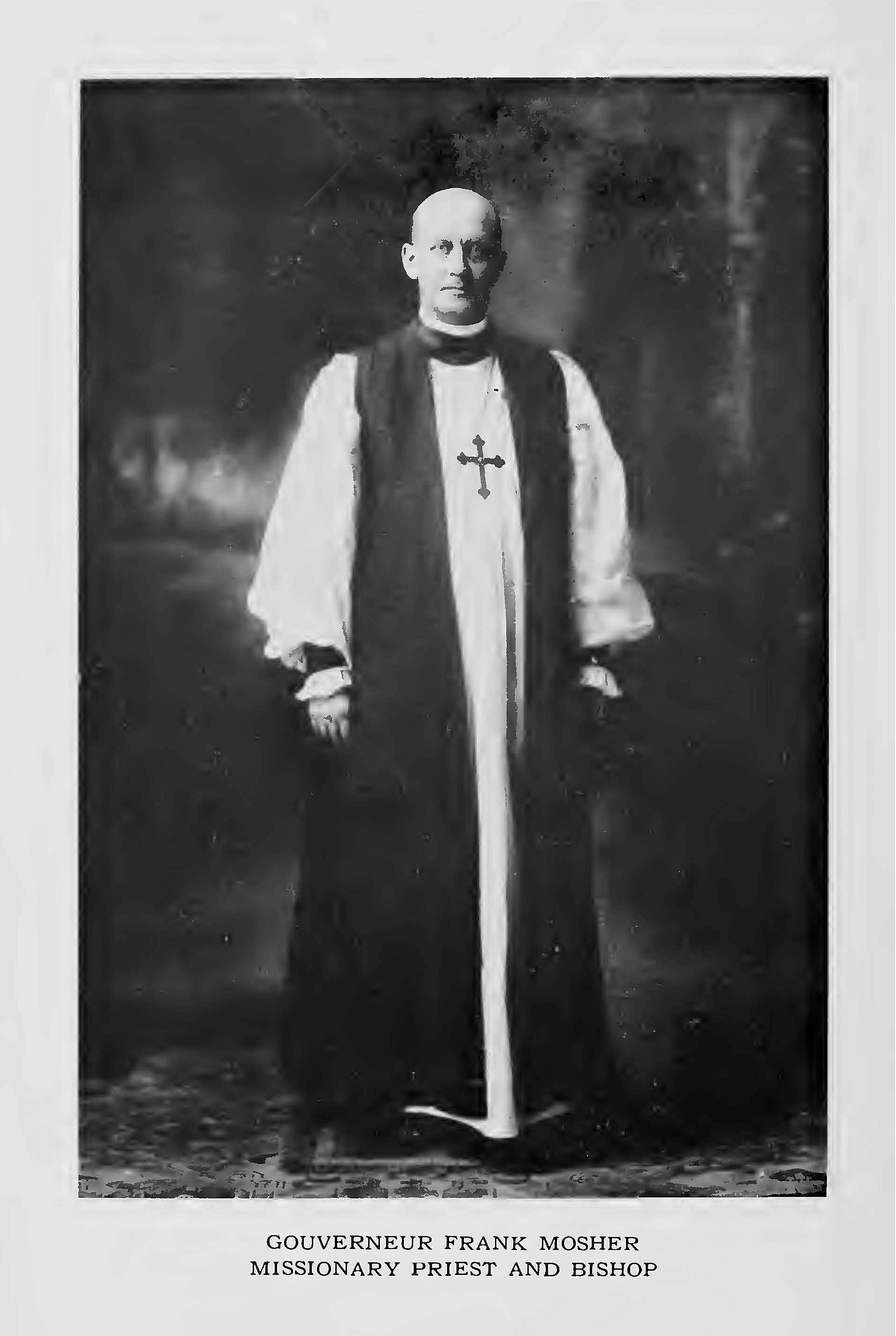
Gouverneur Frank Mosher

Gouverneur Frank Mosher

Gertrude worked in China from 1896 until 1900, when she returned to the United States and married the Rev. Franklin Knight in a ceremony conducted by St. Paul’s rector, William Prall. She and her husband had four children, and spent the rest of their lives in Massachusetts, Franklin’s home state. We have no further record of Gertrude’s activities, although it seems likely that she continued to contribute in other ways as well.

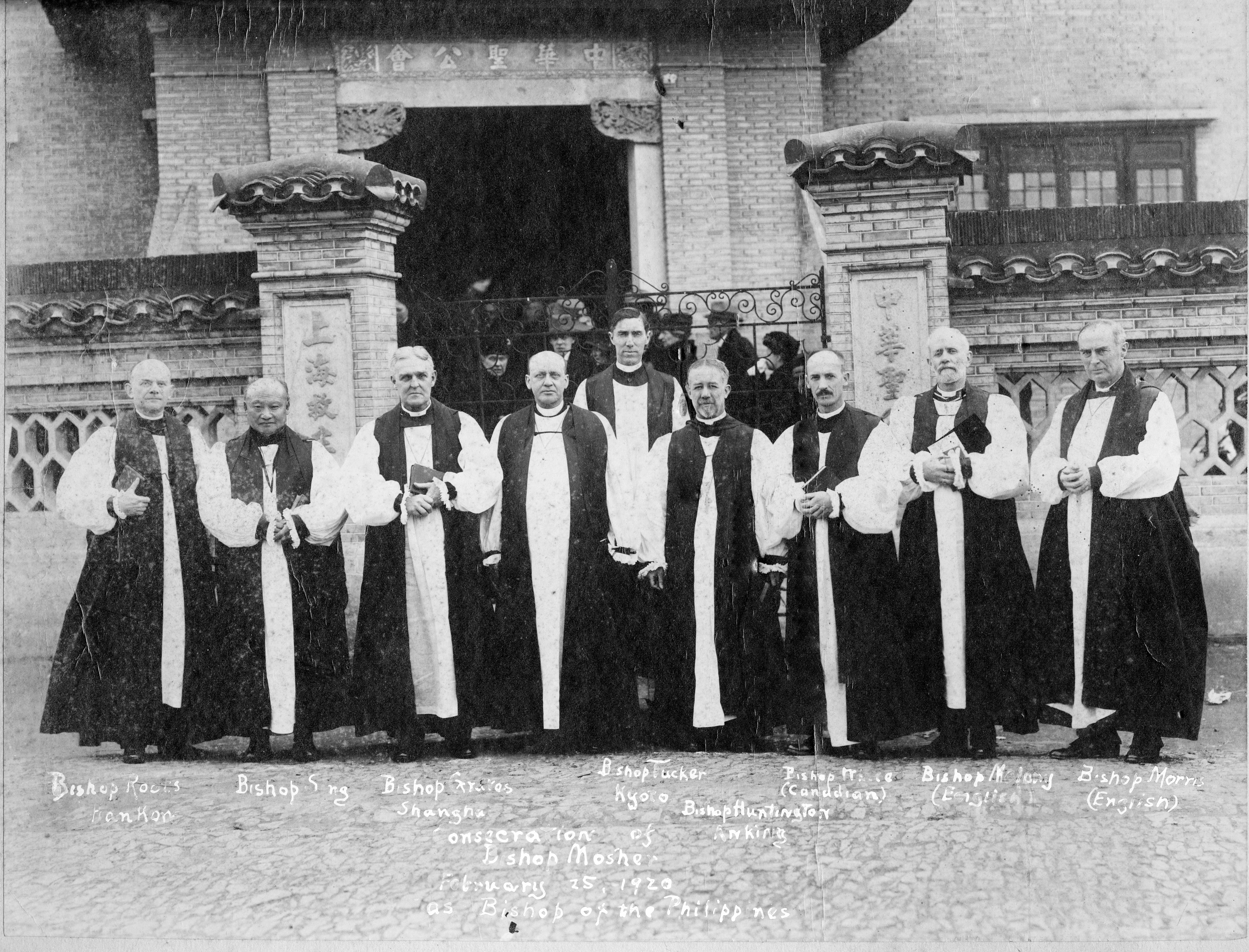
Gouverneur worked in China until 1919, when he was elect missionary bishop of the Philippines. He was consecrated in Shanghai on February 25, 1920.

Gouverneur Frank Mosher

Gouverneur Frank Mosher

The bishops who participated in Gouverneur Frank Mosher’s consecration as missionary bishop of the Philippines February 25, 1920 are listed below. Unless otherwise noted, they were bishops of the Episcopal Church in the United States. There is no record of a Church of England bishop named Morris in China, so we assume that the label on the man to the far right of the picture is an error.

Bishops at the consecration of Gouverneur Frank Mosher as Bishop of the Philippines

Bishops at the consecration of Gouverneur Frank Mosher as Bishop of the Philippines

Gouverneur Frank Mosher resigned as bishop in 1940 because of ill health,  and returned to the United States. He died in 1941.


January 29, 1947 — St. Paul’s Parish Aid Society

In a recent post, I mentioned the difficulty of tracing women’s involvement in St. Paul’s church in the earliest period. By the mid-twentieth century, women’s organizations are more often recognized. We are lucky to have these two snapshots taken during World War II, showing the women of  St. Paul’s Parish Aid Society sewing for the Red Cross. The photographs are unusual in including identification for each person. Do some of our current members remember any of these ladies?

Rector, assistant rector and two members of the Parish Aid Society. Note the parish photo gallery on the wall behind them, with portraits of some of the congregation’s wardens and vestrymen.  George Taylor was our rector from 1932 until 1948; Rollin S. Polk was curate from 1945 until 1947.  Pictured left to right are: Mrs. Wm. H. Verch (treasurer), the Rev. Rollin S. Polk (Assistant Minister), Mrs. George S. Jacobsen (worker), the Rev. George A. Taylor (Rector).
Parish Aid Society January 1947

Parish Aid Society January 1947


Women at work. Part of the photo gallery is also visible here; we can see the  section with portraits of major donors and men who had entered the ministry from St. Paul’s.  The large portrait at rear left is of Thomas A. Starkey, St. Paul’s rector from 1854 until 1858 and later bishop of Northern New Jersey. Gwenola Smith Jones (fourth from right) was the wife of Sydney T. Jones (senior warden from 1922 until 1943 or later) and mother-in-law of the rector. The women are (L-R): Mrs. Marion Larwood, Mrs. George Jacobsen, Mrs. Margaret Weaver, Mrs. Edward McCammon, Mrs. Fred Eckel, Jr., Mrs. William J. McKown, Mrs. W. Phinn, Mrs. Sydney T. Jones,  Mrs. Augustus Bender, Mrs. W.J. Fernette, Mrs. W.S. McDowell

Parish Aid Society Ladies January 1947

Parish Aid Society Ladies January 1947

The Font and Caroline Gallup Reed

St. Paul's Font

St. Paul’s Font

Of all the articles regularly used in our services, very few are more than a century old.  Two silver chalices and a paten dated 1839 are brought out for special occasions. But every time we gather, we see the font, reminding us of the long history of this congregation.

We do not know when we acquired this font, although already in the 1920’s we had had it “for many years.” Here is a snapshot from 1958, showing the font in the Lancaster Street church, in a baptistry of marble and mosaic, below a mural of “Christ Blessing a Child” and next to the marble  and mosaic lectern, now placed in the narthex of the Hackett Boulevard building.

Baptistry of St. Paul's Church, Lancaster Street

Baptistry of St. Paul’s Church, Lancaster Street

We do not know who made it. But we do know who arranged for its purchase, and therein lies a story.

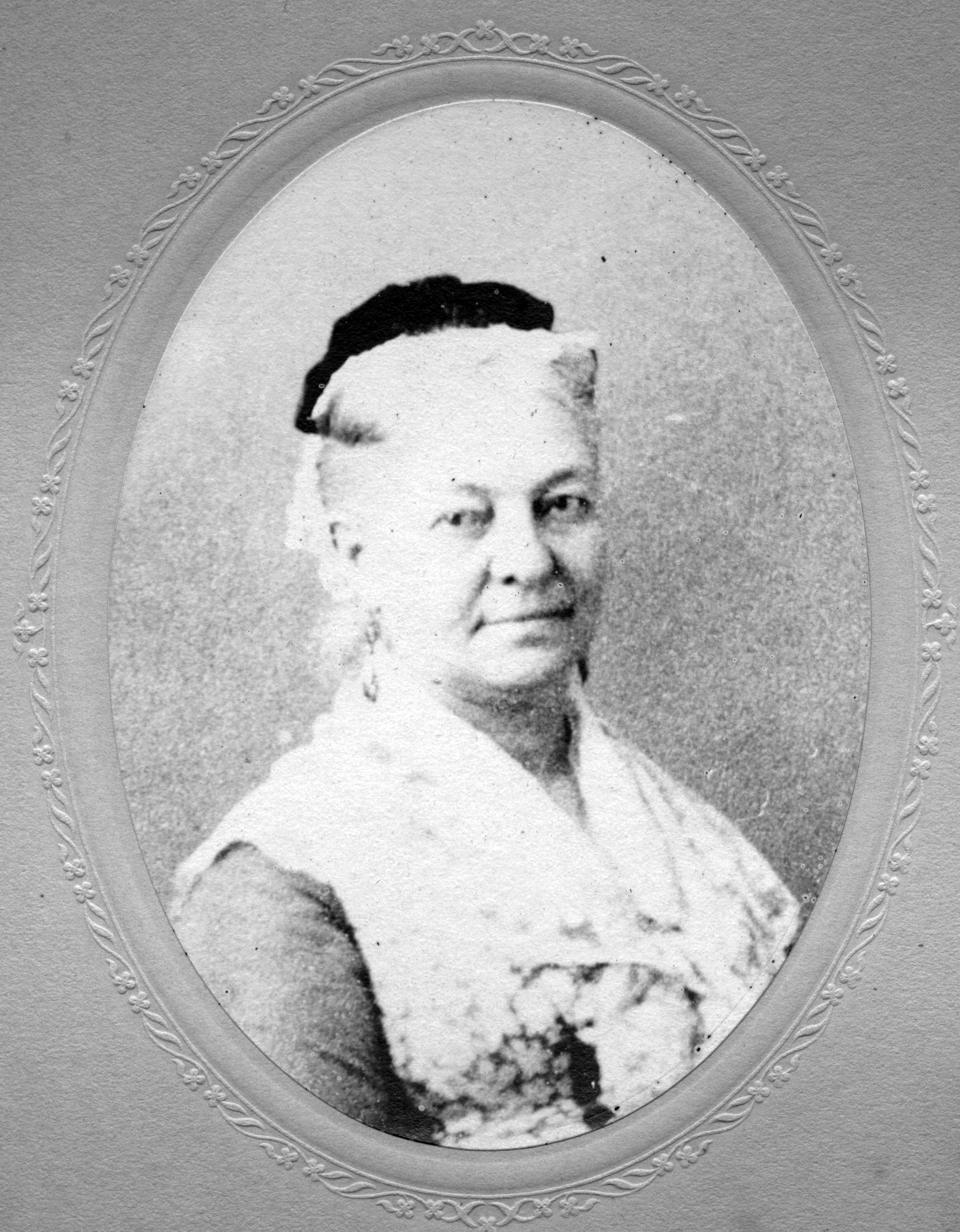
In the Lancaster Street church, St. Paul’s kept a gallery of photographs of important persons: warden and vestry, rectors,  curates and major donors. Among these latter, is a portrait of “Mrs. Sylvanus Reed, through whose efforts the font now in use was presented to the Parish.”

Caroline Gallup Reed

Caroline Gallup Reed

Caroline Gallup was born in Berne, Albany County, August 5, 1821. She moved to Albany with her family in 1832, when her father,

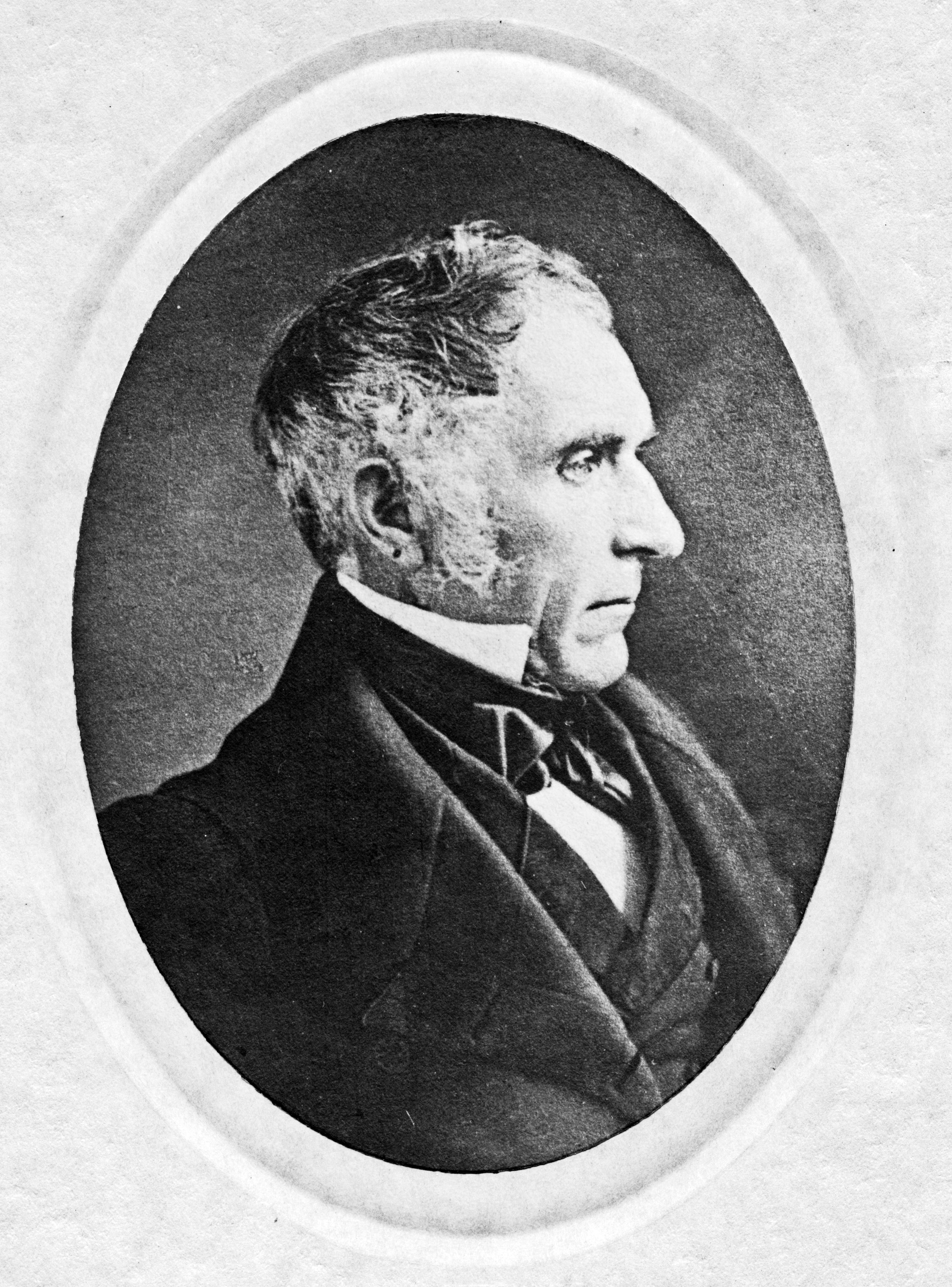
Albert Gallup

Albert Gallup

Albert Gallup, became Albany County sheriff, a position he held until 1835. In 1837, Albert Gallup was elected to the U.S. House of Representatives. The family’s association with St. Paul’s seems to have begun just after Albert Gallup’s single term ended in 1839. Caroline’s mother, Eunice Smith Gallup, became a communicant of St. Paul’s in 1840, and Albert Gallup began a three-year term as vestryman the same year.

Caroline’s early education was in St. Peter’s school, and the school run by the estimable Misses Carter, four “Irish ladies of culture and refinement” who were also St. Paul’s communicants. She then attended the Albany Female Academy, graduating in 1839.  Caroline became a communicant of St. Paul’s in 1841.

In 1851, Caroline was married at St. Paul’s to Sylvanus Reed in a service conducted by our rector, William Ingraham Kip. Sylvanus had also grown up in this parish. His father was Sylvester Reed, a St. Paul’s vestryman from 1839 until 1839.

Sylvester Reed

Sylvester Reed

Sylvanus had the distinction of being the first person from St. Paul’s to enter the ministry.

The Rev. Sylvanus Reed

The Rev. Sylvanus Reed

By the time of their marriage, he was rector of the newest Episcopal congregation in Albany, the Church of the Holy Innocents on North Pearl Street.

After their marriage, Sylvanus and Caroline lived in Albany for eleven years and all four of their children were born here. Two of these children may be of interest to you. Caroline’s son Sylvanus Albert Reed became an engineer, and designed the first modern metal airplane propeller. Caroline’s daughter Mary Geraldine was a well-known artist; she married Francois Millet, son of the painter Jean-François Millet. In 1862 Sylvanus accepted a position of minister at St. George’s Chapel, and the family moved to New York City.

Sylvanus’s health failed soon after the move, and in 1864 Caroline founded Mrs. Sylvanus Reed’s English, French and German Boarding and Day School for Young Ladies. Within a few years, it became on the of most prestigious schools for women in New York City, providing the daughters of the the city’s upper crust with a rigorous college-level education not then generally available to women in this country. The school attracted faculty of the highest caliber, and seems to have been particularly successful in providing employment to women, who found it difficult to find other academic appointments.

George William Warren

George William Warren

In another St. Paul’s connection, George William Warren, who had been our organist for twelve years between 1848 and 1860 (and likely the organist at Caroline and Sylvanus’s wedding),  taught choral singing and solfeggio, and gave private piano lessons at Mrs. Reed’s School.

Sylvanus died in 1870, but Carolyn continued as head of the school until 1890, and as a Visitor until 1894. when it became the School of the Sisters of the Church. Caroline Gallup Reed died in 1916.

Course of Study Collegiate Department 1883

Course of Study Collegiate Department 1883

We may never know  what efforts Caroline Gallup Reed exerted to bring this font, to St. Paul’s, but its presence in our nave serves as a reminder of our long history, and of our connection to an interesting family with an important role in women’s education.

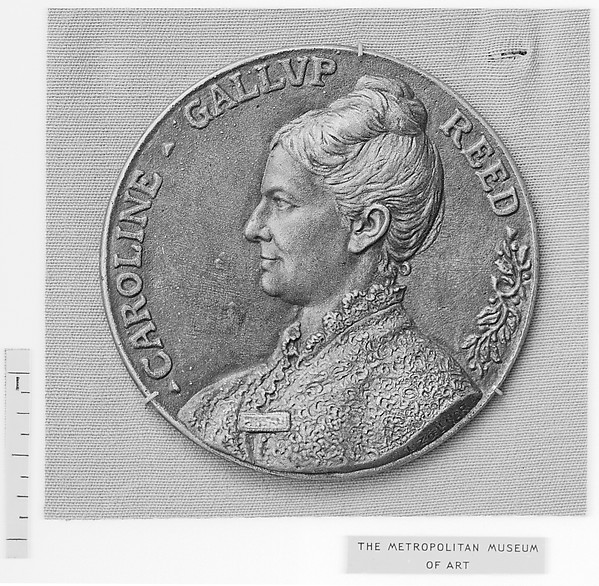
Medal Commemorating the 25th Anniversary of Mrs. Reed's School

Medal Commemorating the 25th Anniversary of Mrs. Reed’s School