Architect’s Model of the Hackett Boulevard Building

We have already seen two color slides of the architect’s model of the Hackett Boulevard church. Through the generosity of a former parishioner, we now have three additional photographs of the model as it was displayed to the congregation following Sunday services, probably in 1963.

In the first photograph we see Kenneth Eells, chairman of the building committee on the left, and the rector, Father J. Raymond McWilliam, on the right. Can anyone tell us who the two women in the middle are?

Architect's Model of the Hackett Boulevard building. Kenneth Eells (left) and J. Raymond McWilliam (right)

Architect’s Model of the Hackett Boulevard building. Kenneth Eells (left) and J. Raymond McWilliam (right)

Architect's Model of the Hackett Boulevard building

Architect’s Model of the Hackett Boulevard building

Architect's Model of the Hackett Boulevard building

Architect’s Model of the Hackett Boulevard building


“Te Deum laudamus”: The Nelson F. Parke Memorial Window

Te Deum laudamus, St. Paul's Chapel

Te Deum laudamus, St. Paul’s Chapel

Last month marked the fiftieth anniversary of the first Holy Communion service in the chapel on Hackett Boulevard. The chapel was designed to replicate a 1940s-era memorial chapel in the Lancaster Street church building, using the older building’s memorial windows and furniture. The new chapel even uses the communion rail from the main Lancaster Street chancel.

Chapel, Hackett Boulevard

Chapel, Hackett Boulevard

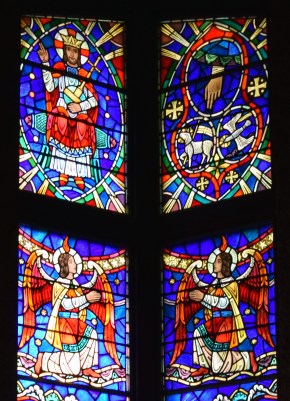
Only one new window was created for the new Hackett Boulevard chapel: the window named “Te Deum laudamus” behind the altar. It takes its name from the early Christian hymn of that name, and its donor describes it thus, mirroring the text of the hymn: “The group of figures includes saints, apostles, prophets, martyrs, and figures representing the Holy Church throughout all the world, all praising God.” The donor was William Starr McEwan, St. Paul’s vestryman, treasurer of the Hackett Boulevard building fund, and the McEwan for whom our parish hall is named. McEwan gave the window in memory of the Reverend Nelson Fremont Parke, St. Paul’s rector from July 1959 until his death in November 1962.

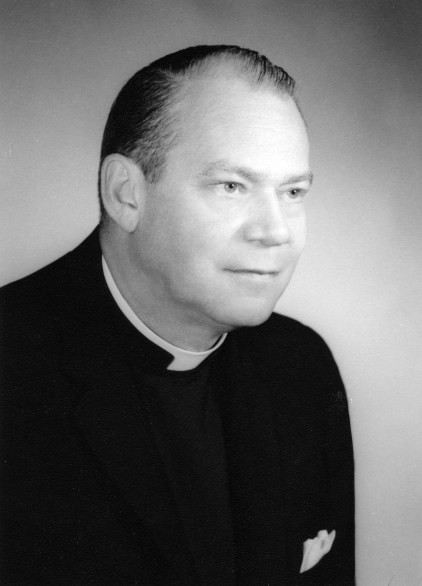
Nelson F. Parke (image courtesy Mrs. Nancy Grayson Knapp)

Nelson F. Parke (image courtesy Mrs. Nancy Grayson Knapp)

While Nelson Parke was rector here for only a little more than three years, his influence will long be felt, because it was his enthusiasm and leadership that held St. Paul’s family together in a difficult period, and and it was his powers of persuasion that convinced the State that St. Paul’s Lancaster Street building was of particular value.

St. Paul’s was not a strong parish in 1959. Changes in the neighborhood and flight to the suburbs had reduced the size of the congregation and its income, and since 1954 they had been unable to support a rector. Just a year before, the outlook was so grim that Bishop Frederick L. Barry advised the vestry that calling a new rector was “unthinkable,” and suggesting a choice between merging with another parish, or continuing as before, with a priest-in-charge, while considering other options.

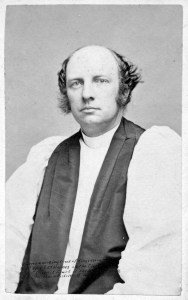
Bishop Frederick L. Barry

Bishop Frederick L. Barry

Father Parke supervises painting [Times Union 9 Jul 1960]

Father Parke supervises painting [Times Union 9 Jul 1960]

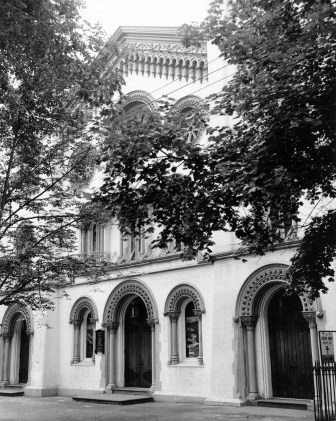
The vestry chose to call Father Parke. Nelson Parke brought energy to St. Paul’s. In 1960, they painted the buff brick of the church façade white, with gray trim, in an effort to brighten the down-at-the-heels neighborhood.

In January 1962, the Temporary State Commission for the Capital City, which was planning urban renewal for the Capital District recommended that “the focus of state government be returned to downtown Albany.” Two months later, on March 27, 1962 they announced that the State would take 98.5 acres of downtown Albany by eminent domain for the South Mall. St. Paul’s Church was in the middle of this “take area.”

St. Paul's, freshly painted, about 1962

St. Paul’s, freshly painted, about 1962

In early comments on the situation, Father Parke suggested that St. Paul’s might be spared. On two occasions in early spring 1962, he quoted the Commission’s chairman, Lt. Governor Malcolm Wilson, as saying that there was a possibility the church would be allowed to remain. Leaning on this slender hope (Wilson never publicly made such a statement), Parke pushed for the concept of St. Paul’s remaining in the South Mall. In a May 15 letter to Lt. Governor Wilson he wrote, “We can envisage this white church, appropriately floodlighted, surrounded by lawns and gardens looming large in the middle of the Complex, as a spiritual and aesthetic center in the midst of the new State Buildings.” Parke also encouraged the congregation to “work to keep up our property, maintain it to the best of our ability and press forward in our ministry to those who will find a spiritual home in old St. Paul’s.” Parke closed this letter with another argument, this one more light-hearted:

“We notice that the excellent Telephone Company is to be left in the Mall area. May we suggest, perhaps not too seriously, that if this admirable institution which provides for the communication of man to man is left – St. Paul’s might well be left to provide a system whereby man might communicate with his maker.”

Through the summer of 1962, the congregation waited hopefully for a response from the State. As Parke suggested, they continued to maintain and improve the building, including a major renovation to the church kitchen.

Te Deum laudamus: Christ the King and the Trinity

Te Deum laudamus: Christ the King and the Trinity

The State’s response was to come in a September 12 meeting with William F. Meyers, Assistant Commissioner of Housing. As related in a September 8, 1962 Knickerbocker News article, “Mr. Mayers [sic] said the talks would be merely fact-finding discussions to sound out the feelings of the two congregations. He said that at this point, as far as he knew, all buildings in the South Mall area were slated for demolition but, he added: ‘We will have a better insight into what may happen when the planners complete their work.’” In the same article, Father Parke continued to express hope for St. Paul’s Church-in-the-Green concept, suggesting that “its Romanesque architecture might ‘lend color, among the modern buildings in the South Mall.’”

But at the September 12 meeting, Meyers shut down all of St. Paul’s hopes for staying in the Lancaster Street building, and all but closed off the possibility of relocation within the South Mall area. As Parke summarized the meeting, Meyers

“told us quite bluntly that plans for the South Mall in the block bounded by Lancaster, Hawk, Jay, and Swan Streets were such that the continued existence of the Church at its present location was entirely impossible, that the demolition of the Church was inevitable, that we would have only three years in our edifice before it was torn down, and that the possibility of our being able to relocated in the South Mall area was extremely remote.”

The plans to which Meyers referred may be the placement of the Central Air Conditioning Plant and Main Transformer Vault between Chestnut and Jay streets, an area that included the church site. Once the planners made that decision, there was no hope for St. Paul’s to remain on Lancaster Street.

Te Deum Laudamus: Moses, Saints. Stephen, Peter, Paul, Catherine of Alexandria and Isaiah

Te Deum Laudamus: Moses, Saints. Stephen, Peter, Paul, Catherine of Alexandria and Isaiah

By early the next week, internal memos in the governor’s office show the level of anger and frustration from St. Paul’s warden and vestry. Governor Rockefeller’s administrative assistant suggested that Parke write directly to the governor. But that same week, within a few days after the meeting, Father Parke fell ill with pneumonia and was hospitalized at Saratoga Hospital. This fact was known by the Governor’s administrative assistant, who wrote in a memo to Lt. Governor Wilson that “Mr. Parke has been hospitalized recently but is now apparently picking up the cudgels again.”

Te Deum Laudamus: Augustine of Canterbury, Joan of Arc, Saint Chrysostom and Saint George

Te Deum Laudamus: Augustine of Canterbury, Joan of Arc, Saint Chrysostom and Saint George

On September 27, St. Paul’s church secretary, Nancy Knapp, was driven to Saratoga to take dictation from Father Parke. In his letter to Governor Rockefeller, Parke wrote:

“This then, Governor Rockefeller, is a prayerful plea to you that our Church be saved from demolition. We ask it because of its historic value as a building which will be 100 years old on next November 2 – because of its great beauty, particularly in more than 20 stained glass windows, not capable of replacement and not exceeded in magnificence in Albany – because we can offer a place of rest, meditation, and prayer to the thousands of State Workers of all denominations in the Mall (as Trinity Church does to those employed in the Wall Street Area) – and because, most importantly, with the passing of the Greek Orthodox and First Methodist Churches, ours then would be in the 98 acres of the South Mall the only House of God.”

That same evening, St. Paul’s vestry met in a special session, with Bishop Allen W. Brown as a guest. There were only two items on the agenda: arranging for substitute clergy during Mr. Parke’s absence, and determining a site for relocating St. Paul’s. At the conclusion of the meeting, “[t]he Vestry voted to go on record as in expression [sic] our intent of joining with the diocese in the purchase of the 4 acre site adjacent to the Good Samaritan Center for the purpose of construction and relocation of a new church for St. Paul’s Parish.”

It is apparent that Nelson Parke wanted to return to work. In an October 2 letter to the parish “from the rector’s temporary study (at Saratoga Hospital)” he wrote:

“My doctor has advised that I am coming along nicely with only rest stipulated before I am allowed to get back into harness. It is my understanding that our Wardens, Mr. Eckel and Mr. Foskett, have joined with my doctor to enforce this stipulation by having made arrangements for substitute priests for the next few weeks. This leaves me no choice.”

In this letter, Parke gives a summary of the September 12 meeting, and the vestry’s decision (with his full approval) to join the diocese in taking an option on the Hackett Boulevard property. As always, he expresses full confidence in St. Paul’s ability to thrive in this new location.

Te Deum laudamus: Mary and St. John

Te Deum laudamus: Mary and St. John

The letter was to be one the last acts by Father Parke as rector. On October 17, 1962, Bishop Brown announced that Parke would take a leave of absence until January 1, 1963. Nelson Parke and wife went to Florida, where he maintained at least weekly contact with the church, eager to return. But on November 9 he died of a heart attack. His funeral was held at St. Paul’s on November 15, 1962.

Father Nelson Parke played a particularly important role in his brief period at St. Paul’s, by invigorating a parish at its low ebb, by maintaining the congregation’s positive spirit in the face of the State’s plan to demolish our building, and by eloquently arguing for the importance of our presence in the the South Mall area. When the Lancaster Street building was demolished in 1964, the parish was far stronger than it would have been without him. And his advocacy for the building’s architectural and artistic merits resulted in a reimbursement from the State far higher than any other church in the South Mall area. The Te Deum window is an appropriate memorial to this good man.

Te Deum laudamus, St. Paul's Chapel

Te Deum laudamus, St. Paul’s Chapel

William M. Lange, Jr., Missionary to the Deaf

Thomas Gallaudet (image courtesy Library of Congress)

Thomas Gallaudet (image courtesy Library of Congress)

Later this month, on August 27, the Episcopal Church’s Lesser Feasts and Fasts commemorates Thomas Gallaudet, of whom it says:

Ministry to the deaf in the Episcopal Church begins with Gallaudet. Without his genius and zeal for the spiritual well-being of deaf persons, it is improbable that a history of ministry to the deaf in the Episcopal Church could be written. He has been called “The Apostle to the Deaf.”

Thomas Benjamin Berry

Thomas Benjamin Berry

In a previous post, we discussed Thomas Gallaudet’s connection with St. Paul’s Church, and how for 125 years a ministry to the deaf was a significant part of our witness in the city of Albany. We have also described two other figures in that ministry: Thomas Berry (the St. Paul’s curate who, in the early 1870s, organized the deaf ministry at St. Paul’s Madison Avenue mission) and Harry Van Allen (a St. Paul’s communicant who became missionary to the deaf throughout New York State). Today’s topic is yet another member of St. Paul’s who ministered to the deaf both here and across the State.

Harry Van Allen

Harry Van Allen


William Maurice Lange, Jr. was born in 1909. At age ten, he contracted spinal meningitis and lost his hearing. He was educated at the Albany School for the Deaf on Pine Avenue, and like Harry Van Allen, attended Gallaudet College, graduating in 1934. Lange married a college classmate, and the young couple settled in Albany, where William worked in his father’s pharmacy on Dove Street. William Lange had not been raised in the Episcopal Church, but he was attracted to the programs for the deaf at St. Paul’s Church. Through his attendance here, he found himself called to full-time ministry. While preparing for ordination, he led services as a lay reader at St. Paul’s.

William Maurice Lange, Jr.

William Maurice Lange, Jr.

With the support of our vestry, William Lange was ordained a deacon in 1940, and a priest in 1943. Both ceremonies were held here at St. Paul’s. Years later, Lange would ponder the coincidence in the date of his ordination:

Father Lange’s predecessor in this unique missionary field was the Rev. Henry [sic] Van Allen of Albany. On Sunday, Feb. 9, 1919, the latter conducted in St. Paul’s Episcopal Church, a service “commemorative of the twenty-fifth anniversary of the Mission of the Deaf, and of his work as a missionary.”

It was during that same week that Father Lange became deaf after being stricken with spinal meningitis. And it was just 24 years later, to the week, that Father Lange took over from the Rev. Van Allen.

He often reflects on these coincidences and asks himself, “Could God have been preparing me for this work?” [Times Union 17 Feb 1952]

So, in 1943, William Lange began a ministry very much like that of Harry Van Allen. From his home base in Syracuse, he officiated at an average of 275 services each year, with one thousand communicants in twenty-two congregations spread over an area of 43,600 square miles in the dioceses of Albany, Central New York, Rochester and Western New York. In 1944, he reported, “I cover over 17,000 miles a year by train, bus and shoe-leather.” By 1952, with access to a car, he traveled 32,500 miles.

The Diocese of Albany honored Lange’s service by making him an honorary canon in 1963; in 1967, Gallaudet University granted him an honorary doctorate. We don’t know much of the later years of his ministry, but he was active until his retirement in 1976, at age 67. William Lange died in Syracuse in 2009, shortly after his 100th birthday.


George Wm. Warren’s “fanciful and somewhat comic style”

In an earlier post, we mentioned a characterization of George William Warren’s performance on the organ: “Mr. Geo. Wm. Warren organist of St Paul’s Albany next extemporised in his usual fanciful and somewhat comic style.” This assessment was contained in a review of a concert celebrating a new Hook organ at St Paul’s Church in Troy, New York. The letter, signed only “Philomel,” was published on page 102 of the October 28, 1854 issue of  Musical World.

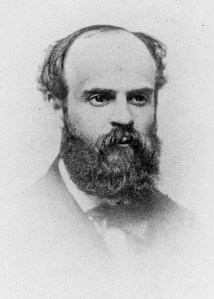
George William Warren

George William Warren

But we have recently found that there is more to this story. Warren responded the same month in a letter  to the Musical World’s editor published in the December 2, 1854  of the journal (page 166).  After describing  the European opera career of former St. Paul’s soloist Henry Squires, Warren reacted with good humor to Philomel’s characterization, and suggested why the reviewer might have found his performance comical:

One thing more and I am done. Your correspondent “Philomel” writes from Troy about the Organ exhibition at St Paul’s, and dubs me a Comic Organist; and as it is not so desirable to have that reputation, as some other, will you allow me to justify myself in the Musical World. When I played that evening it was a prima volta and in a certain passage when I used the CC pedal expecting that I had drawn the register “pedals and choir” lo! it was “pedals and great” and nothing out but “trumpet” which of course snarled astonishingly; as I was in for it, I proceeded up the scale and finally got out of the scrape. I explained this to Mr. Philomel who was in the Organ loft; but it is a very good joke and if he has said it, of course I am a Comic Organist and if Christy will get an organ to use at his concerts, maybe he will give me an engagement. Again I would say to you, how much I am charmed with your paper and I wish it was a dally instead of a weekly: and if I can be of use to it in any way command.

As Warren prepared to show off his footwork, he pulled the wrong coupler, and instead of bringing a pleasant mixture of sounds to the instrument’s pedals, he brought only a blaring trumpet. When he played the lowest note on the pedal board, the audience heard a loud, nasty blast. By moving up the pedals, the ugly effect was reduced, and Warren was able to continue. This, then, was Warren’s guess as to what Philomel found fanciful and comic.

The “Christy” from whom Warren jokingly suggests he might receive an engagement, was Edwin Pearce Christy, entertainer and producer, whose minstrels shows included an early version of vaudeville.

But this jovial conversation was not over!  In the December 23, 1854 issue of Musical World (page 206), Philomel replied to Warren’s explanation of his error in registration, and expresses affectionate regard for the young organist’s energetic style and character:

I regret that any remark of mine should cause even that degree of uneasiness in Mr. George Wm. Warren’s mind sufficient to call for a “comical” letter. Mr. Warren is, incontestably, a wit; and I do not desire, either by accident or design, to incur the consequences of his ridicule. Lest, however, he should deem the last observation more “comical” than true, I beg to state, that my remark “Mr. Warren extemporised in his usual fanciful and somewhat comic style” referred not to the mistake in the pedal playing, for this is common enough, and I did not notice it; but simply to his off-hand, dashing, sprightly, operatic, and in view of his unmistakably volatile temperament, occasionally comic style. Indeed a man cannot break away from the general current of his thoughts, and Mr. Warren’s musical expressions are the natural outbursts of a heart, (to all outward appearance at least) free from care, and overflowing in its excess of joy.


George Wm. Warren at Albany’s Second Presbyterian Church

In previous posts, we have outlined George William Warren’s engagements as St. Paul’s organist and choirmaster, showing from contemporary sources that he was at St. Paul’s from late 1848 until August 1, 1860, the “nearly thirteen years” at St. Paul’s that he mentions in his letter of resignation[i].

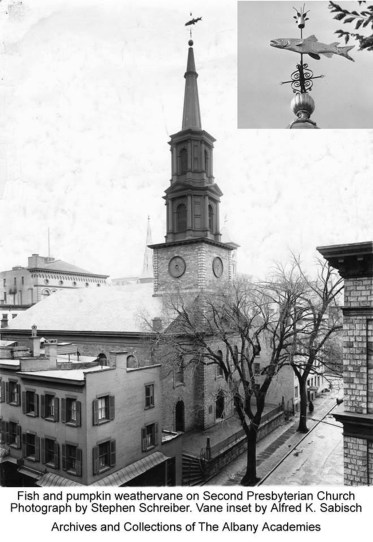
During this period, we know that Warren left St. Paul’s during late 1856 and some part of 1857 when he was organist and choirmaster at Albany’s Second Presbyterian Church. Until recently, however, it has not been possible to say exactly how long he was there. Our only source of this information that he had gone to Second Presbyterian was a November 1856 article in a Boston music journal,[ii] which does not tell us exactly when he left St. Paul’s, or when he returned.

Second Presbyterian Church (source: Albany Group archive)

Second Presbyterian Church (source: Albany Group archive)

The chronology is now provided by a May 1857 article in the Albany Morning Express which announces Warren’s departure from Second Presbyterian: “St. Paul’s Church has finally effected another engagement with George William Warren, who, until last October had been their organist for eight years.”[iii] This would mean that Warren left St. Paul’s in October 1856 and returned (as we know from his letter of resignation[iv]) effective August 1, 1857.

This period of a bit less than one year at Second Presbyterian is confirmed by an August 26, 1857 article about the gift of a silver goblet to “Mr. George William Warren, on retiring from the Second Presbyterian Church as organist, to resume his previous position at St. Paul’s.”[v] The article transcribes a letter, dated August 26, 1857, from the choir of Second Presbyterian to Warren, in which they thank him for his “instruction and direction as leader of the music in Second Presbyterian Church for one year.”[vi]

This allows us to construct a chronology of Warren’s activities during 1856 and 1857. In an April 1856 advertisement Warren identifies himself as “Organist and Musical Director at St. Paul’s Church (eight years)”.[vii] But sometime during the summer of 1856, Warren decided to leave St. Paul’s.

John Tweddle

John Tweddle

In September, according to St. Paul’s vestry minutes, “George W. Warren account for services as Organist & amounting to $698.77 was present and referred to Messrs. [Edward E.] Kendrick [, John] Tweddle & [Benjamin C.] Raymond with power & authority to adjust the same.”[viii] Almost $700 was a great deal of money in 1856, perhaps very close to a full year’s salary. Had Warren not been paid for some time? It seems likely, but we have no evidence.

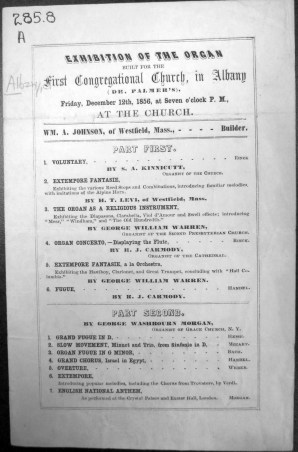
Whatever the cause, Warren left St. Paul’s during the month of October 1856, and settled into his new job at the church often called “Mr. Sprague’s Church,” in reference to its eminent minister, William Buell Sprague. We first hear of him in his role at the exhibition of a new organ at First Congregational Church in Albany.

Front, 1856 Organ Exhibition Program (Albany Public Library Pruyn Collection)

Front, 1856 Organ Exhibition Program (Albany Public Library Pruyn Collection)

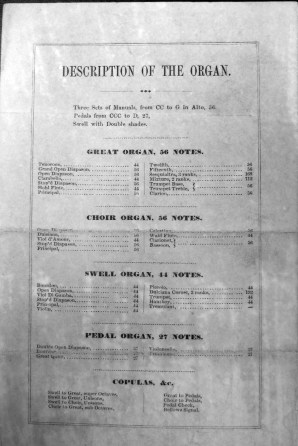
Reverse, 1856 Organ Exhibition Program (Albany Public Library Pruyn Collection)

Reverse, 1856 Organ Exhibition Program (Albany Public Library Pruyn Collection)

The program for a December 12, 1856 Organ Exhibition, celebrating the installation of a new William A. Johnson organ at First Congregational lists among the organists who played that day George William Warren, “organist of the Second Presbyterian Church.” Warren performed twice, first demonstrating the new instrument’s use in religious music, and then playing a set of extemporaneous improvisations titled “Extempore Fantasie, a la Orchestra.” We assume this was similar to the “Prelude in Organ Style concluding with an extempore Fantasio a l’Orchestre” that he performed in June the previous year at the exhibition of a new organ at Troy’s Park Presbyterian Church.[ix] We can hope that the audience that day was entertained by Warren. An 1854 review says that he “extemporised in his usual fanciful and somewhat comic style” at the exhibition of the new organ at St. Paul’s Church, Troy, New York in October of that year.[x]

First Congregational Church and its minister, Ray Palmer (Albany Public Library Pruyn Collection)

First Congregational Church and its minister, Ray Palmer (Albany Public Library Pruyn Collection)

A major change for Warren at Second Presbyterian was the type of choir. At St. Paul’s, Warren had conducted and composed for a quartet choir, four professional soloists, many of whom (including Lucy Eastcott, Henry Squires and Isabella Hinckley) went on to operatic careers. Second Presbyterian, on the other hand, had a chorus choir, a larger group primarily composed of amateurs.

During his year at Second Presbyterian, Warren continued his relationship with St. Paul’s and its choir. In January 1857, his Second Annual Concert for the Poor included Isabella Hinckley and Master Willie [William James] Gourlay, St. Paul’s former soprano and treble soloists[xi]. And the next month, Warren, “assisted by the choir-boys of St. Paul’s,” provided music for service at Grace Church to test improvements to its organ by an anonymous donor. This Festival Service also included St. Paul’s “Old Choir” (probably members of the former quartet choir) consisting of Miss [Isabella] Hinckley, Miss [Elizabeth M.] Atwood and Mr. [Stephen W.] Whitney.[xii]

George William Warren

George William Warren

We have only a few clues as to why Warren chose to return to St. Paul’s. He was a member of the congregation, and Mary Eliza Pease, whom he would marry at St. Paul’s in September 1858, was also a communicant. But as the Albany Morning Express suggested in May[xiii], St. Paul’s vestry must have made him an offer impossible to refuse.

The Albany Morning Express article mentions two elements in that offer: “The organ is to be entirely rebuilt at a cost of $1,200. The choir seats will be arranged for a “chorus,” and every plan of Mr. Warren’s which can advance true music will be fully carried out.”[xiv]

Cover, 1857 subscription to rebuild St. Paul’s organ

The offer’s first element had already been arranged on May 23,1857, when the wardens and vestry asked for donations. The first page of the subscription booklet reads:

The undersigned agree to pay to the Vestry of St. Paul’s Church Albany the sums set opposite their names for the purpose of repairing the organ in said church, said repairs to be made under the direction of Geo. W. Warren and the amount of the expense for the same to be $1200. “

Wardens and vestry signed on the first two pages, pledging more than one-half of the total. The remainder was given by members of the congregation, and the rebuilding by William A. Johnson was under way by early August 1857.

1857 subscription to rebuild St. Paul’s organ, page 1

The second element in St. Paul’s offering is significant: Warren was planning to replace St. Paul’s quartet choir with a chorus like Second Presbyterian’s. In a letter to Second Presbyterian’s choir, responding to their letter of thanks to him, Warren explains what he learned there:

Your hearty wishes for my future success takes away much of the sadness in parting from you as organist. Still I shall never forget the enjoyment of last year’s choir practice, which, thanks to your kind attention , was to me a period of great profit and pleasure; for it was my first experience in chorus choir training, and the good success that has marked our united efforts, will always convince me of the vast superiority of chorus and congregational effects in church service to the “quartette” arrangement now so popular in many churches. (Still, a change in the right direction is surely taking place, and this awakening interest for true church music is one of the good signs of the times.)[xv]

It is important to remember that, although George William Warren had been a church musician for thirteen years, he had very little formal training, and was not yet thirty years old. Clearly, the year’s experience at Second Presbyterian was an important step in his education.

By the spring of 1857, St. Paul’s terminated its contract with Albert H. Wood and the quartet choir effective 20 Apr 1857[xvi], and a month later George William Warren again offered his services to St. Paul’s[xvii]. But even before Warren resumed his duties at St. Paul’s on August 1, 1857[xviii], he made it clear what he learned at Dr. Sprague’s Church. In the classified section of the Albany Evening Journal for June 15, 1857, Warren advertised for “Ladies and Gentlemen with fine voices and fair musical abilities.” Clearly, “St. Paul’s New Choir” was to a be chorus choir.

Albany Evening Journal 15 Jun 1857

Albany Evening Journal 15 Jun 1857

The following year, we have evidence from St. Paul’s vestry minutes that rebuilding the organ and moving the choir chairs were not the only expenses necessary to bring George Wm. Warren back to St. Paul’s.

Edward E. Kendrick

Edward E. Kendrick

In May 1858, church treasurer Edward E. Kendrick reported a $680 shortfall in the church budget, consisting in large part of expenses related to Warren and choir, including “fitting up and arranging the organ loft and north room with carpets, gas, painting, gilding and decorating for the convenience of the musical director and the choir, and the salary of the organist increased from $850 to $1100.”[xix]

[i] Warren’s letter of 24 Apr 1860 is transcribed in the St. Paul’s vestry minutes of 4 May 1860

[ii] Dwight’s Journal of Music 15 Nov 1856, page 53.

[iii] “Local and Miscellaneous,” Albany Morning Express 30 May 1857.

[iv] Warren’s letter of 24 Apr 1860 is transcribed in the St. Paul’s vestry minutes of 4 May 1860

[v] “Musical Compliment,” Albany Evening Journal, 7 Sep 1857.

[vi] “Musical Compliment”.

[vii] Albany Evening Journal 7 Apr 1856, page 53

[viii] St. Paul’s vestry minutes for 6 September 1856

[ix] Troy Daily Whig 14 Jun 1855.

[x] Musical World, 28 Oct 1854, page 102.

[xi] Albany Evening Journal 22 Jan 1857.

[xii] Albany Evening Journal, 21 Feb 1857.

[xiii] “Local and Miscellaneous”.

[xiv] “Local and Miscellaneous”.

[xv] “Musical Compliment”.

[xvi] St. Paul’s vestry minutes. 17 Apr 1857.

[xvii] St. Paul’s vestry minutes. 26 May 1857.

[xviii] Warren’s letter of 24 Apr 1860 is transcribed in the St. Paul’s vestry minutes of 4 May 1860

[xix] St. Paul’s vestry minutes. 22 May 1858.

Mr. Starkey’s “high-church notions” divide St. Paul’s

William Ingraham Kip’s year-long medical leave (1844-1845) worked well for him and for the people of St. Paul’s: he returned in good health, and spent another eight years as our rector. Today’s post is the story of his successor’s medical leave, which ended badly and precipitated a crisis that almost destroyed the congregation.

When Kip resigned in December 1853, the vestry named as his successor Thomas Alfred Starkey, then the rector of Christ Church, in Troy, New York. Starkey arrived in February 1854. Fourteen months later, in April 1855, Starkey submitted his resignation because of ill health. He withdrew it “at the urgent request of the congregation.”[i] Then again, three years later, in April 1858, Starkey submitted his resignation because of ill health. This time, the vestry offered him a six-month leave of absence. Starkey accepted, and traveled to Europe.
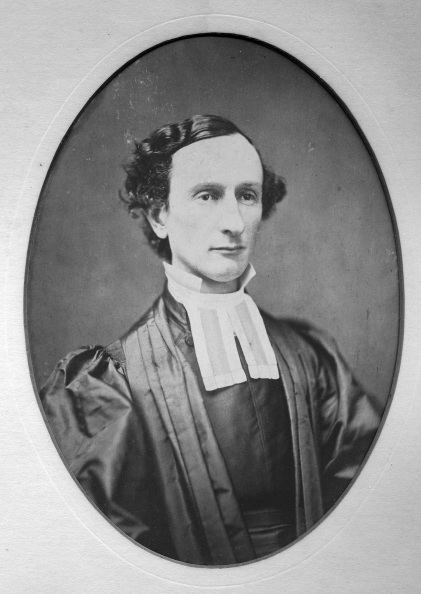
Thomas A. Starkey

Thomas A. Starkey

Previous histories end the narrative neatly, if not happily: Starkey returns from his leave in early October 1858, announces that his health is still fragile and again submits his resignation. The vestry reluctantly accepts the resignation, and a few months later announces the call of the new rector, William Rudder. This is the account given in a 1877 sketch of the congregation’s history[ii], and followed by all historical essays since that time. The vestry minutes support this version, containing only their offer of a leave of absence, followed by his resignation in November.

But this neat version is incomplete, and hides the story of a significant dispute within the congregation that tells us much about the church and the times. To understand it, we need to return to the long, successful tenure of William Ingraham Kip. In his farewell sermon at St. Paul’s, preached December 11, 1853, he said:

We have Brethern (sic) been at peace among ourselves. There has been no party strife within our borders, even among the exciting times which for some years marked our church; but Pastor and People have been in one mind in all that concerns the welfare and progress of the Church. It is to this that we owe our prosperity and Oh remember Brethern (sic) that so it must always be, if you would not decline and relapse into feebleness.

The “exciting times” to which he refers was the period of the 1830s and 1840s, when the English Oxford Movement’s “Tracts for the Times” were distributed in the United States. As the Episcopal Church sought to balance its theology in light of renewed interest in Catholic theology and liturgy, Kip wrote a series of lectures which he presented at St. Paul’s on Sunday evenings in the winter of 1843 and later published as The Double Witness of the Church. The lectures, relying on both scripture and tradition, distinguished the American Episcopal Church from the protestant denominations on one side and the Roman Catholic Church on the other. As Kip wrote in the Preface:

[The author] believes that this work will be found to differ somewhat in its plan, from most of those on the claims of our Church, which are intended for popular reading. They are generally written with reference merely to the Protestant denominations around us. The public mind, however, has lately taken a new direction, and the doctrines of the Church of Rome have again become a subject of discussion. The writer has therefore endeavored to draw the line between these two extremes – showing that the Church bears her DOUBLE WITNESS against them both – and points out a middle path as the one of truth and safety.[iii]
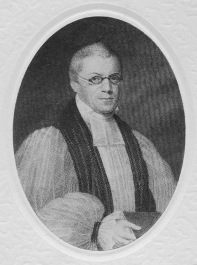
John Henry Hobart, Bishop of New York 1816-1830

John Henry Hobart, Bishop of New York 1816-1830

The Tractarians had little influence on Kip, who saw their works as supporting the high church theology to which he already subscribed. The Double Witness, while occasioned by the Tractarian controversy, restates the position of Kip’s mentor, Bishop John Henry Hobart, who summarized his theology when he wrote “My banner is, EVANGELICAL TRUTH, APOSTOLIC ORDER.”[iv]
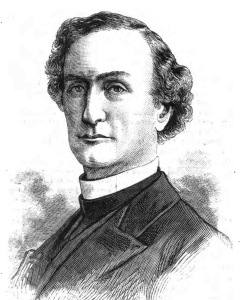
Thomas A. Starkey

Thomas A. Starkey

Thomas A. Starkey was also a high churchman, but one of a very different sort. While the press described him as moderate high churchman, that term had acquired a new meaning, one much affected by the distinctive theological, devotional and social views of the Oxford Movement. Starkey described the movement glowingly in his 1877 sermon at St. Paul’s:

The period of my rectorship of this parish which extended from February 1854, to the autumn of 1858, was embraced within a very interesting and exciting portion of our general Church History. The long-continued stagnation in English and American Church life had been disturbed twenty years before by what is known as the “Oxford tracts movement.” In the old diocese the controversies, growing out of local causes had terminated two years before in the election of Bishop Wainwright, whose bright but brief Episcopate cheered the hearts of Churchmen, only to deepen the disappointment at its premature close. In the autumn of 1854, the same year in which I became rector of St. Paul’s, Dr. Potter, of St. Peter’s church in this city, was consecrated for the vacant seat; and I believe that I only reflect the general judgment when I say, that rarely has a difficult choice been justified by a wiser administration. It was a day of controversy, and at times, of strong and even angry feeling; but it was also a day of generous self-devotion and of brave endeavor for the church’s sake. The old stagnation had been completely broken and a new life stirred throughout all her borders.[v]

The fuller story of Starkey’s resignation is omitted from all church sources, but it was considered newsworthy by the popular press, allowing us to piece it together from newspaper accounts. The first article comes from the Albany Morning Express of October 26, 1858.

In St. Paul’s Church Sunday morning [24 Oct 1858], immediately after the reading of the Ante-Communion service, the Rev. Mr. Starkey came before the chancel and addressed his congregation. He remarked that six months ago the Vestry kindly gave him leave of absence for a period of time to enable him to regain his health. He left his congregation harmonious in feeling and united in action. After an absence of six months, and a return to his labors, he found a great charge in his temporal charge – his congregation distracted, and a want of harmony existing in the Parish. In view of his state of health and the condition of his congregation, he felt it his duty to resign his charge, and as Pastor he bade them farewell. His remarks and his determination were evidently unexpected to a large majority of his congregation, and were received with manifest surprise and emotion.[vi]
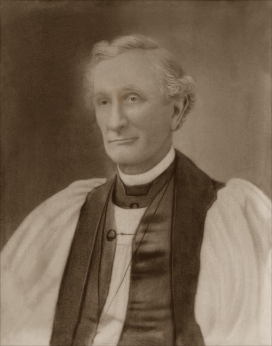
Thomas A. Starkey

Thomas A. Starkey

This news was so exciting that it was picked up by the New York City newspapers. The next day’s New York Evening Post gives a dramatic account of the previous Sunday’s events with the headline “Church Excitement in Albany: Dr. Starkie Declines to Preach,” quoting reports from the Albany Daily Knickerbocker of the previous day:

During Mr. Starkie’s absence his high-church notions have been so canvassed as to lead to some considerable feeling in the church, and he resolved to sever his connection with the church. This took place in a sudden manner on Sunday morning. “Without a moment’s notice to anybody, he walked into the church and informed the congregation that he could no longer act as their pastor. Having done this he retired and left the congregation to go home without a sermon. The reasons for resigning Mr. Starkie promises to lay before the senior warden –Mr. Tweddle—when the senior warden returns from Europe, which will be in a day or two.”[vii]

We may never know which “high church notions” were so vigorously debated (the now-archaic sense of canvassed.) The first option is that they refer to elaborate ritual practice, such as sung services, incense, sanctus bells and chasubles. In this period, however, the high church party was only beginning to be influenced by ritualism. Even twenty years later, when ritualism had spread widely, it was written that Starkey “is inclined to High Church views, but is not a ritualist in the broad sense of that term.”[viii] Starkey may however have been following ritual practices that would not surprise us at all, but that were then highly controversial. Many of these related to treating the communion table as an altar: by placing a cloth or flowers on it, or by using candles during daylight services. Another practice much debated was that of the celebrant turning to the communion table while reading the communion service, with his back to the congregation. The Book of Common Prayer directed that the minister stand at the liturgical north end of the altar (to the left, from the congregation’s point of view) during the service, as Kip is shown doing in the 1847 portrait by William Tolman Carlton.
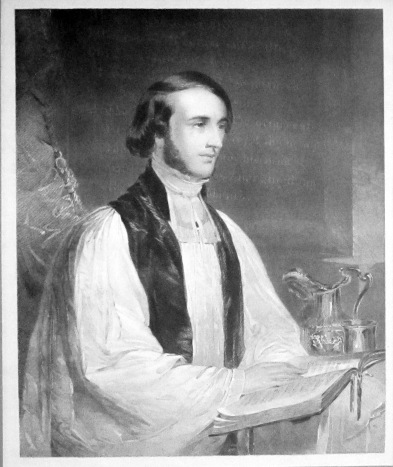
Wm. Ingraham Kip at St. Paul's altar (from an 1847 portrait by William Tolman Carlton)

Wm. Ingraham Kip at St. Paul’s altar (from an 1847 portrait by William Tolman Carlton)

A second possibility is that these notions were theological, and related to one of the most contentious disputes of the time: the relative weight to be given to justification by faith as contrasted with baptismal regeneration.

And a third possibility is the notions had to do with social outreach. The only activity during his rectorship that Starkey described in in his 1877 sermon was a social ministry, the establishment of St. Paul’s Church Home, a home for “homeless and aged women” [ix]. Social ministry was an interest of the high church faction in both England the United States, but not of the old-style Hobartian high churchman. Starkey tells us that the Home did not survive his departure, suggesting that the ministry was not supported by the congregation.

While the vestry minutes of November 1, 1858 record the vestry’s acceptance of Starkey’s formal resignation, they do not describe the issues that led to his resignation. What is clear is that Starkey’s resignation, did not end the dissension in the church. The Albany Daily Knickerbocker continues, accurately predicting the further problems to come:

The resignation of Mr. Starkie will, of course, increase the bad feeling existing at St. Paul’s. The result will be a grand division and a new church. Who will succeed Mr. Starkie at St. Paul’s remains to be seen. Some vote in favor of the Rev. Mr. Rudder. The friend of Mr. Starkie will be opposed to this – some of them looking upon Mr. Rudder as a sort of intruder, invited to Albany to make mischief. How the matter will finish up will be known when the senior warden arrives.[x]

William Rudder had been engaged as an interim in June to preach until August 1, 1858; in August, that contract was extended until December 1. During this period, Rudder was assisted by  Starkey’s curate, Frederick P. Winne.
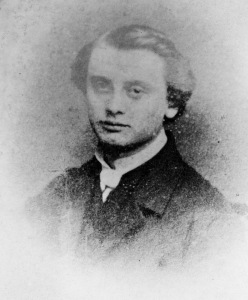
Frederick P. Winne

Frederick P. Winne

Rudder is vague about how he came to be called as interim from St. John’s Church, Quincy, Illinois, where he had been rector from 1857 until 1858. In his 1877 sermon he says that in 1858 he found himself in Albany as a result of “an accident on a western railroad,”[xi] was invited to preach at a friend’s church (presumably St. Peter’s, whose rector was Thomas Clapp Pitkin) where a member of St. Paul’s search committee heard his sermon, and invited him to fill St. Paul’s pulpit until Starkey returned.[xii]
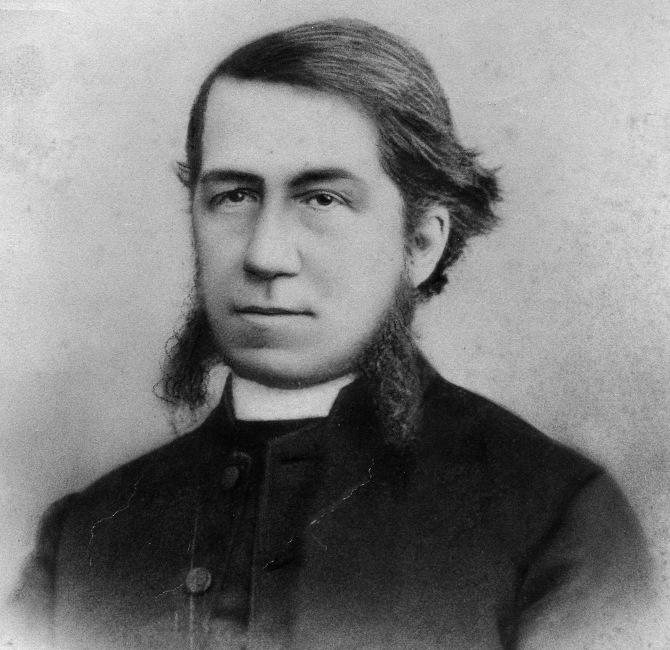
William Rudder

William Rudder

The Rudder faction made their feelings known publicly. An undated newspaper clipping reports the gift on November 10, 1858 of a portable communion set service by “some of the congregation, who had listened with pleasure and profit to his impressive discourse.” A letter from the fourteen men is quoted, as is Rudder’s response. The fourteen include only one vestryman, Edward E. Kendrick, the cashier of the Bank of Albany. Interestingly, they also include four employees of the Bank of Albany, two of them Kendrick’s sons.

By late December 1858, chaos reigned, as the Albany Morning Express reported:

For several months past the Vestry of St. Paul’s Church has been engaged in a most unpleasant controversy, and as a matter of course, the members of the congregation have become implicated in the difficulty, there being two factions or divisions in the Church, directly antagonistic to each other. Since the commencement of the troubles, we have purposely refrained from alluding to them, nor do we intend now to recapitulate them at length. The questions in dispute between the two parties having become matters of public interest, we have therefore concluded to refer thereto. The origin of the division we do not know with certainty, Of its existence there can be no doubt, in fact it is not disputed. The resignation of the Rev. Mr. Starkey, and the reason therefor, is not unknown to the public. From that time, the difficulties increased, one faction being very desirous of calling the Rev. Mr. Rudder, and the other as much opposed to it. The cause of this opposition we do not intend to discuss. It is sufficient to know it exists. Frequent meetings of the Vestry were held at some of which the belligerent manifestations were made by and between the members. If we are not misinformed – and our authority is undoubted – language was frequently used and epithets indulged in that were far from creditable to those having the temporal management of a Church of God. So bitter were, and arethe feelings between the parties, that charges of direct falsehood have been made, without the least hesitation, and complaints preferred that de do not feel at liberty to allude to. On Monday evening meeting of the Vestry was held to choose a Rector, and a motion to select the Rev. Mr. Rudder was negatived, four of the members being in favor of it and six opposed to it. So the Church remains without a head, and the warfare continues. The result will undoubtedly lead to the secession of one of the two factions from the Church, and perhaps may even result in its dissolution entirely. – Such a state of affairs is certainly to be regretted, and very discreditable.[xiii]

This impasse was resolved during April 1859. That month, there was a major turnover in St. Paul’s vestry, with only one warden and three vestrymen reelected. Among the three continuing vestrymen was Edward E. Kendrick (a member of the Rudder faction that gave the communion service), who was elected junior warden. It is likely that Kendrick and the other three who were returned were the four who had voted for Rudder in December. The congregation also elected six brand-new vestrymen. On April 30, 1859, William Rudder was called as rector; he accepted the call in May, and became rector on June 1, 1859.
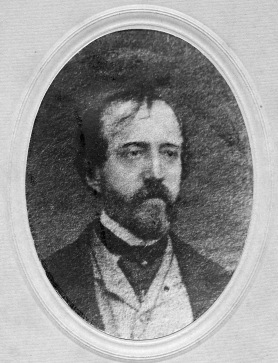
Edward E. Kendrick

Edward E. Kendrick

St. Paul’s had somehow been able to find a way through this crisis, with no sign of a major defection by the Starkey faction. Provided with a supportive vestry, Rudder was able to serve as rector until 1863. While Starkey’s Church Home for Women did not continue, Rudder did initiate a successful ministry to the deaf, and shepherded the congregation through the financial crisis of 1862 and the decision to move to Lancaster Street.

[i] “Our City Churches – IV. St. Paul’s (Episcopal) – J. Livingston Reese, Pastor,” Albany Evening Journal, January 28, 1871.

[ii] “Historical Sketch of St. Paul’s Parish: From a Sermon by the Rector,” pages 9-17 of The Semi-centennial Service of St. Paul’s Church (Albany: The Argus Press, 1877), 14.

[iii] William Ingraham Kip, The Double Witness of the Church (New York: D. Appleton, 1844), x.

[iv] John Henry Hobart, An Apology for Apostolic Order and Its Advocates (New York: T. and J. Swords, 1807), 272

[v] “Sermon of the Reverend Thomas A. Starkey, D.D.” pages 55-63 of The Semi-centennial Service of St. Paul’s Church (Albany: The Argus Press, 1877), 56-57

[vi] “Resignation of the Rev. Thomas A. Starkey,” Albany Morning Express, October 26, 1858.

[vii] “Church Excitement in Albany: Dr. Starkie Declines to Preach,” New York Evening Post, October 27, 1858.

[viii] “Rev. Thomas A. Starkey,” Frank Leslie’s Illustrated Newspaper, November 22, 1879, 204.

[ix] “Sermon of the Reverend Thomas A. Starkey, D.D.,” 61.

[x] “Church Excitement in Albany: Dr. Starkie Declines to Preach”

[xi] “The Sermon of the Reverend William Prall,” pages 32-42 of The Semi-centennial Service of St. Paul’s Church. (Albany: The Argus Press, 1877), 33.

[xii] “The Sermon of the Reverend William Prall,” 33-34.

[xiii] “St. Paul’s Church,” Albany Morning Express, December 29, 1858.

Daniel Manning’s Funeral

Daniel Manning

Daniel Manning

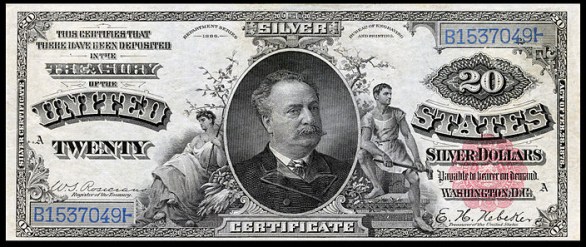
In its almost 190 years, St. Paul’s has had a number of distinguished members, men and women who have played important roles on a local, statewide or national stage. But we can claim only one member whose image appears on United State currency. As owner and editor of the Albany Argus, as president of Albany’s National Commercial Bank, as chairman of the New York State Democrat Committee, and as Secretary of the Treasury, Daniel Manning is among the most prominent who have sat in our pews.

Daniel Manning was born in Albany in 1831. He began work at age 11 as a “chore boy” at the Albany Atlas. The Atlas merged with the Albany Argus in 1856, and Manning rose through its ranks, first as a reporter, then editor, and finally owner in 1873. Through this period, he also made political contacts, and was a member of the New York delegation at the Democratic conventions of 1876 and 1880.

Daniel Manning

Daniel Manning

By the 1884 Democratic convention, Manning had become chairman of the New York delegation. He championed Grover Cleveland as a presidential candidate, and successfully fought for his nomination in the Democratic convention. During the election, as chairman of the New York State Democratic Committee, Manning made certain that ballots were properly counted, ensuring Cleveland’s victory in the State. His appointment as Secretary of the Treasury was not purely a political gift. As a board member of Albany’s National Commercial Bank beginning in 1873, and its president since 1882, Manning had become knowledgeable about fiscal policy, and had presented Cleveland with a plan for improving the Treasury Department. Contemporary reports suggest that he was among the most competent and intelligent of cabinet members during Cleveland’s first term. By 1886, there was even talk within the party of proposing Manning for nomination as president in 1888.

James Hilton Manning

Manning’s health had been poor for some time, and in early 1887 he resigned his position and returned to Albany. He died on Christmas Eve 1887 at the family home on Lancaster Street, just one block from the church. Daniel Manning had attended St. Paul’s for about thirty years, but had only been confirmed and become a communicant at Easter 1882. His son, James Hilton Manning was a St. Paul’s vestryman for twenty years, from 1883 until 1903.


St. Paul's Chancel, Late 19th century

St. Paul’s Chancel, Late 19th century

St. Paul's, Late 19th century

St. Paul’s, Late 19th century

St. Paul's Nave, Late 19th century

St. Paul’s Nave, Late 19th century

St. Paul's Nave, Late 19th century

St. Paul’s Nave, Late 19th century


Daniel Manning’s funeral, held the afternoon of December 27, 1887, was the grandest ever held in the Lancaster Street building. The New York Sun for

Charles S. Fairchild

Charles S. Fairchild

December 28, 1887 reported that “[I]t was the most distinguished gathering of men Albany has ever seen at a funeral of one of her sons. “ President Garfield and five of his cabinet arrived that morning in a special train car. A sixth cabinet member arrived separately; only one cabinet member missed the event.

Among the cabinet was Manning’s successor as Secretary of the Treasury, Charles S. Fairchild, who, in another St. Paul’s connection, was a vestryman here from 1873 to 1878. To date, Manning and Fairchild are the only two members of St. Paul’s who have served in a presidential cabinet.

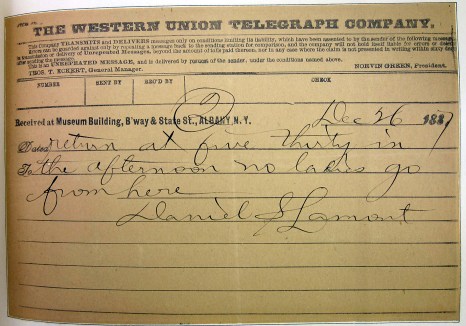
Here is the original telegram from Daniel S. Lamont (Cleveland’s private secretary and a Daniel Manning protégé) to James H. Manning describing the plans of the presidential party.
Daniel Lamont Telegram

Daniel Lamont Telegram

Daniel Lamont Telegram

Daniel Lamont Telegram

Delegations arrived from New York City, Brooklyn, Tammany Hall, the Democratic party, and the U.S. Treasury Department. Delegations from Albany included the Directors of the National Commercial Bank, the Typographical Union, the local Masonic lodge, and city and State officers.

Funeral Invitation

Funeral Invitation

Not just the prominent and politically connected came. People from the city and the region packed the streets, and made it difficult for sleighs carrying dignitaries and family to reach the church, as described in the New York Times for December 28, 1887:

The funeral of ex-secretary Manning to-day was the most notable, with the exception of that of Grant and Lincoln, ever seen in old Albany. Not only the citizens of this city filled the streets and packed those adjacent to the church, but people flocked in from the surrounding country in large numbers and added to the density of the throng… The crowd about the church was dense, and choked the entire street for more than a block. The police with difficulty kept passageways open to admit the various bodies.

The service was conducted by St. Paul’s rector, J. Livingston Reese, who also preached the sermon.

William Prall

William Prall

A dozen other Episcopal clergy were present, including St. Paul’s curate William Prall (who would later become St. Paul’s rector), Bishop William Croswell Doane, the rectors of all the Albany parishes, the president of Hobart College and a group of canons and honorary canons from the Cathedral of All Saints. Music was provided by St. Paul’s choir, led by choirmaster George Edgar Oliver, who had composed new music for the event.

William Croswell Doane, Bishop of Albany

The twelve pallbearers were men with national reputations, including a U.S. Senator, a former U.S. Senator, a Congressman (and former Speaker of the House), and a judge of the New York Court of Appeals. Six were bankers, two of whom had served at high levels in the U.S. Treasury; most held powerful positions in the Democratic Party.

The New York Times  for December 28, 1887 continues, “As the cortege left the church and the great crowd which had been held together broke away the ponderous City Hall pealed forth in faint refrain and the bells of other churches tolled in unison. Many, curiously inclined, followed the president’s sleigh, disregarding the solemnity of the occasion.”

Here is Manning’s tombstone in the Albany Rural Cemetery.

Manning Memorial, Albany Rural Cemetery

Manning Memorial, Albany Rural Cemetery

The Easter after his death, Daniel Manning’s widow presented a brass cross and two vases to St. Paul’s. “Mrs. Manning has many tender memories of St. Paul’s Church. Not only was the late Secretary one of its earnest memories for many years,

Manning Memorial Cross and Vases

Manning Memorial Cross and Vases

but she was married to Mr. Manning by the present rector, Dr. Reese, at its altar. When the Secretary lay upon his death-bed among the last sounds he heard on earth were the sacred chants of the choir of St. Paul’s wafted through the windows of the room in which he died, and was its rector who preached the funeral sermon.”


Here is a recent photograph of the cross and vases, still in use at St. Paul’s, and the resolution from St. Paul’s vestry, thanking Mrs. Manning for the gift in memory of “our beloved and distinguished brother in Christ.”

Vestry Resolution

Vestry Resolution

Manning Memorial Cross and Vases

Manning Memorial Cross and Vases

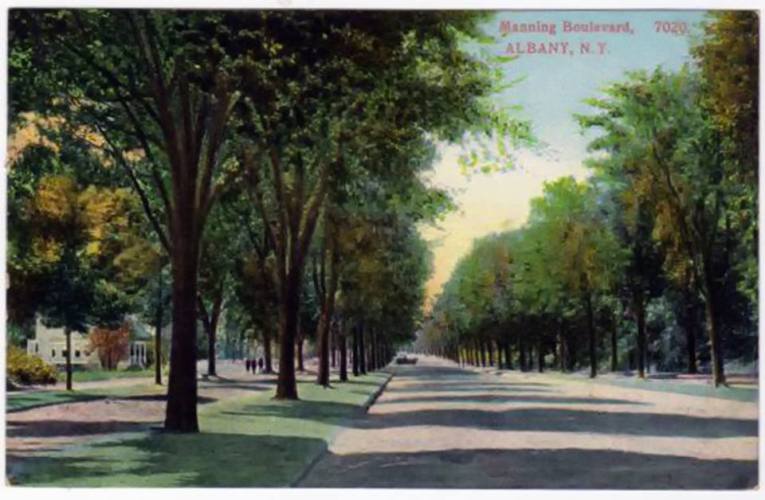
In other memorials, an engraving of Manning appeared on the U.S. silver certificate issued in 1886 and 1891. And closer to home, Daniel Manning may now be most remembered as the person for whom Manning Boulevard was named.

Manning Diamond Back $20 Silver Certificate

Manning Diamond Back $20 Silver Certificate

Manning Boulevard (courtesy Albany Group archive)

Manning Boulevard (courtesy Albany Group archive)

“Lest We Forget”

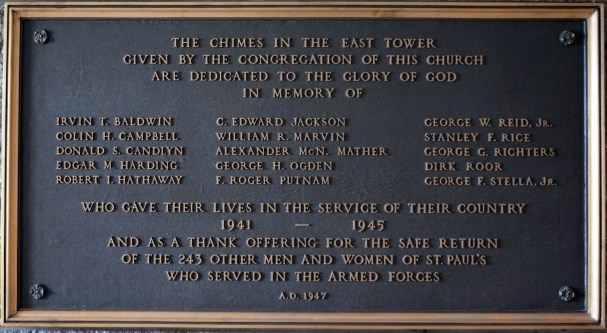
On June 8, 1947, St. Paul’s rector, George A. Taylor, dedicated a set of electronic chimes given by the congregation in honor of those from the parish who had died in military service during World War II.

Memorial plaque for World War II Dead

Memorial plaque for World War II Dead

The chimes, paid for by a special subscription from the congregation, had first been heard on Christmas Eve the previous year, when the organist, Raymond S. Halse, played carols before the service.

At the June dedication service, St. Paul’s choir sang Reginald De Koven’s setting of Kipling’s “Recessional.” Father Taylor took the title of his sermon from the the poem’s stirring line, repeated at the end of each of the first three stanzas: “Lest we forget!”

New York Times 6 Mar 1945

New York Times 6 Mar 1945

Among those listed is Donald Shore Candlyn, who was born in Albany in 1925 and graduated cum laude from the Albany Academy in 1943. He died 26 Dec 1944 in Luxembourg, during the Battle of the Bulge. The monument shown below is in the Memorial Grove in Van Cortlandt Park, the Bronx.

Donald Shore Candlyn memorial, Van Cortlandt Park, the Bronx

Donald Shore Candlyn memorial, Van Cortlandt Park, the Bronx

Candlyn’s parents. T. Frederick H. Candlyn and Dorothy Ridgway Candlyn, had moved to New York City in 1943 when his father, who had been the organist and choirmaster of St. Paul’s Church from 1915 until 1943, was named to the same position at St. Thomas Church, Manhattan.

As related in a November 12, 1945 New York Times article, “Sgt. Donald S. Candlyn was killed by a sniper’s bullet on Dec. 26, 1944 while on a mission above and beyond the call of duty. With the Germans on the offensive at the time, American communications had broken down and Sergeant Candlyn, in the face of heavy fire, had volunteered as a foot runner to obtain orders.” Candlyn was posthumously awarded the Silver Star and Purple Heart.

In a will signed just before leaving for war, Donald Candlyn made several bequests. We know that one provision was for his father’s new church: in April 1948 a  new principal four-foot stop on the St. Thomas organ was dedicated in his memory. But the 19-year-old also left a bequest to St. Paul’s Church. In our chapel is a window that was a gift of Donald Shore Candlyn.

Donald Shore Candlyn window, St. Paul's Chapel

Donald Shore Candlyn window, St. Paul’s Chapel

Detail, Donald Shore Candlyn window, St. Paul's Chapel

Detail, Donald Shore Candlyn window, St. Paul’s Chapel

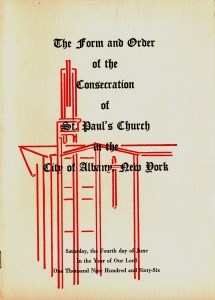
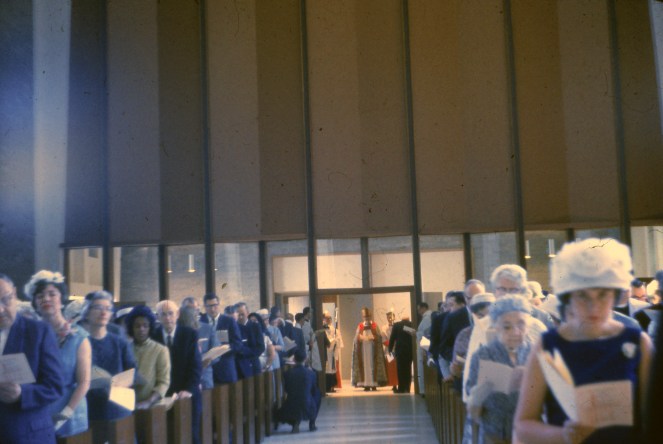
June 1966 — Consecration of “The New Modernistic St. Paul’s”

Consecration Bulletin 4 Jun 1966

Consecration Bulletin 4 Jun 1966

In posts over the past eighteen months, we’ve noted the progress in the construction of St. Paul’s new home on Hackett Boulevard, beginning with the groundbreaking in July 1964, following the stages of construction through 1965 and early 1966, and most recently the consecration of the high altar and the laying of the cornerstone. Today we celebrate the fiftieth anniversary of the building’s consecration on June 4, 1966.IMG_0012 v001

The preacher that day was Darwin Kirby, Jr., rector of St. George’s Church in Schenectady. Thanks to a Times-Union article describing the consecration of “the new modernistic St. Paul’s Church at 21 Hackett Boulevard,” we know some of the words he spoke that day, words that still resound half a century later. Kirby described the church as “the Bethel of Albany, its House of God, a meeting place of heaven and earth, Jacob’s ladder pitched there in Hackett Boulevard, in the midst of a great swirl of traffic and the hurrying life of a great capital.”

The Times-Union article continued:

Father Kirby paid tribute to the “vision and vigilance” of the people of St. Paul’s, saying “You and your distinguished rector are to be congratulated on what you have achieved.”

The new edifice replaces the former church in the South Mall.

Father Kirby warned that “splendidly-cared-for church buildings by themselves are not enough; that from the day of Pentecost until the day of Constantine, the Church owned not a single building it could call its own.Yet, he went on, “the church outlived, outfought and outdied a hostile, pagan Roman Empire.”

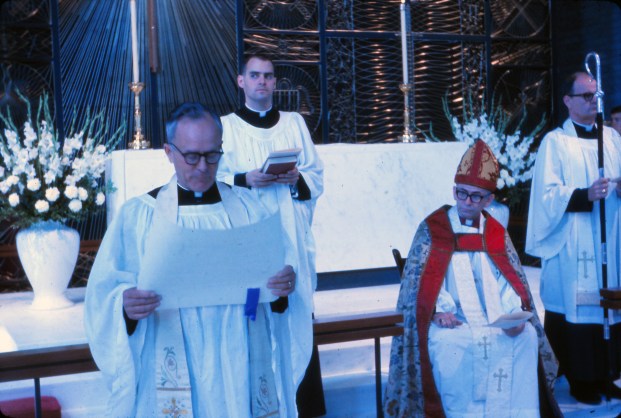
Presiding at the ceremony was Allen W. Brown, Bishop of the Diocese of Albany, with Suffragan Bishop Charles B. Persell, Jr. The Master of Ceremonies was Thomas T. Parke, curate of St. George’s Church, Schenectady and son of Nelson F. Parke, St. Paul’s rector from 1959 until 1962. Here we see Bishop Brown and the servers as the procession formed. The processional hmyns were Austria (“Glorious things of Thee are spoken,” and Regent Square (“Christ is made the sure foundation.”)

IMG_0001 v005

Following the prayer of consecration, Bishop Brown made a circuit of the church, praying at the font, the crossing, the midst, the pulpit, the crossing again, and the sanctuary. In the next photographs, we see the bishop at two of these stations.

The first photo shows Bishop Brown, with Father Parke holding the service book. In the background is St. Paul’s rector, J. Raymond McWilliam; the server with his back to the camera is Peter Eells.

Bishop Brown, with Father Thomas T. Parke 4 Jun 1966

Bishop Brown, with Father Thomas T. Parke 4 Jun 1966

The second photo shows Bishop Brown and Father Parke, with the same two servers.

Bishop Brown, with Father Thomas T. Parke 4 Jun 1966

Bishop Brown, with Father Thomas T. Parke 4 Jun 1966

After the circuit of the church, the Sentence of Consecration was read by George A. Taylor, St. Paul’s rector from 1932 until 1948.

IMG_0006 v001

Following the celebration of the eucharist, the bishop preceded by Father McWilliam processed from the church as the congregation sang Vigiles et Sancti (“Ye watchers and ye holy ones”).

Procession, St. Paul's Consecration 4 Jun 1966

Procession, St. Paul’s Consecration 4 Jun 1966

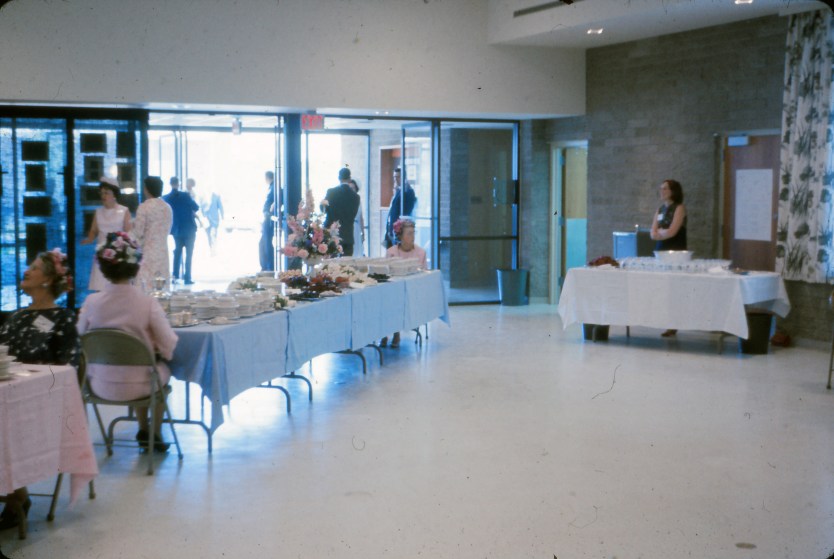
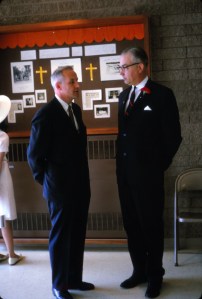
The reception after the service was the first to be held in the church hall, now known as McEwan Hall, in honor of William Starr McEwan, treasurer of the building committee. We see McEwan standing that day in the narthex with the building’s architect, Donald Stephens.

Reception 4 Jun 1966

Reception 4 Jun 1966

Donald Stephens (architect) and William S. McEwan (treasurer, building committee)

Donald Stephens (architect) and William S. McEwan (treasurer, building committee)

Finally, here are two photographs of clergy taken in the parking lot, probably immediately after the service.

Father George A. Taylor

Father George A. Taylor

Bishop Allen W. Brown and Father George A. Taylor

Bishop Allen W. Brown and Father George A. Taylor

May 1966 — “Women Prepare for St. Paul’s Consecration”

Knickerbocker News 18 May 1966

Knickerbocker News 18 May 1966

In today’s world, women’s roles in an Episcopal congregation include ordained ministry, election as wardens or members of the vestry and many other kinds of service.  While this headline, from an article in the Knickerbocker News of May 18, 1966, is only fifty years old, it describes a St. Paul’s that is some way familiar, yet foreign, one in which women’s part in the new building’s consecration on June 4  consisted of cleaning, decorating, and pouring tea. As was then the custom, the newspaper gives only their husbands’ names; their first names (in brackets) were obtain from other sources.

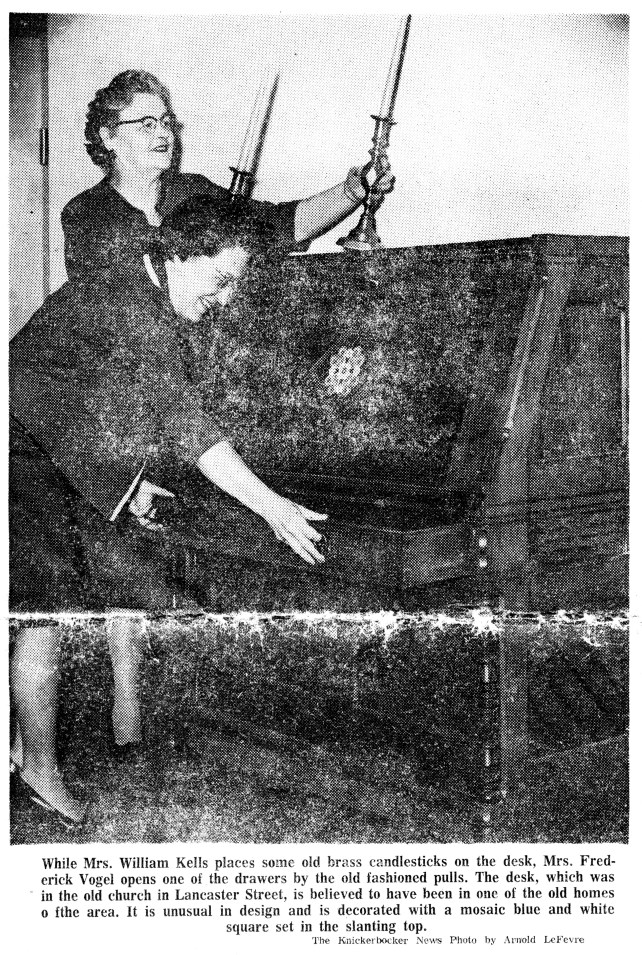
The entire effort was organized by Mrs. Frederick [Betty Jeanne] Vogel. We see her here with Mrs. William E. [Josephine] Kells arranging furniture and candlesticks.

Knickerbocker News 18 May 1966

Knickerbocker News 18 May 1966

Decoration of the new building was organized by Mrs. Arthur C. [Ruth] McDowell, the President of Women of St. Paul’s, assisted by Mrs. Roger [Ruth] Aiken, who had the distinction of being the only woman on the building committee. We have seen Mrs. Aiken before, as co-chair of the 1961 Christmas Bazaar and the 1981 Christmas Holiday Festival and Bazaar.

Painting of Lancaster Street Building signed "J. Lyons"

Painting of Lancaster Street Building signed “J. Lyons”

The article particularly mentions two objects that were to be placed in the Fellowship Hall: the grandfather clock and a painting of the Lancaster Street building, donated by Dr. Susan Seabury Smith, associate professor of library science at the State Teachers’ College. We will have more to say about these objects in a later post.

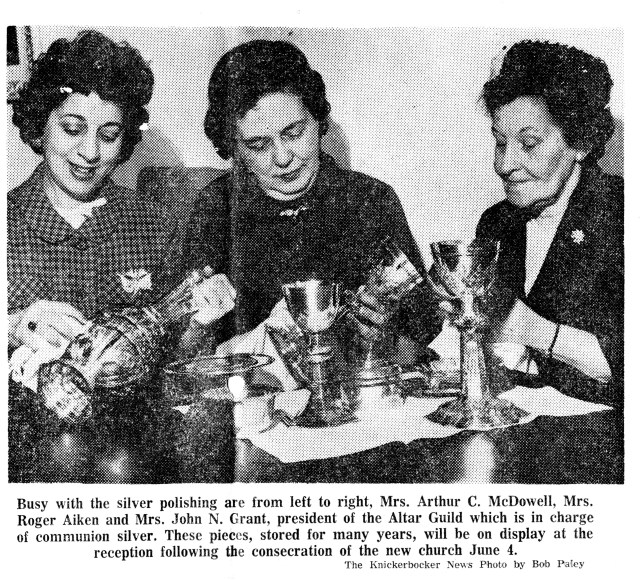
Cleaning and polishing of the church silver were organized by Mrs. John N. [Ismena] Grant, longtime president of the Altar Guild, who also had roles in the 1961 and 1981 Christmas Bazaars. We learn that much of the old silver had been stored for years or decades in the tower of the Lancaster Street building was “pretty black.”  Here is the photograph of Mrs. Grant, assisted by Mrs. McDowell and Mrs. Aiken.

Knickerbocker News 18 May 1966

Knickerbocker News 18 May 1966

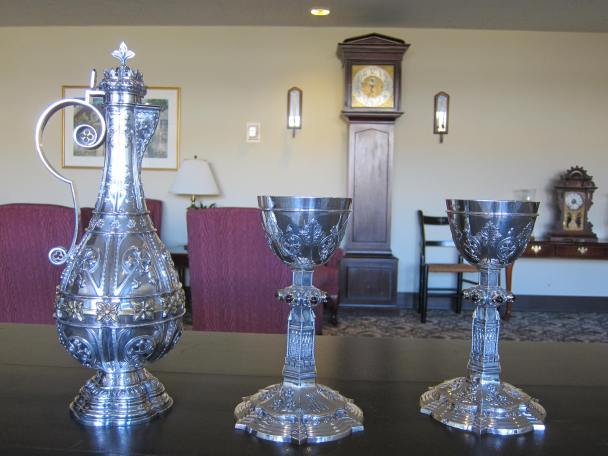
For comparison, here is a more recent picture of the flagon and chalices, with the grandfather clock in the background. The silver pieces were donated in 1886 in memory of parishioner Adam Van Allen (1813-1884).

Flagon and Chalices given in memory of Adam Van Allen (1813-1884)

Flagon and Chalices given in memory of Adam Van Allen (1813-1884)


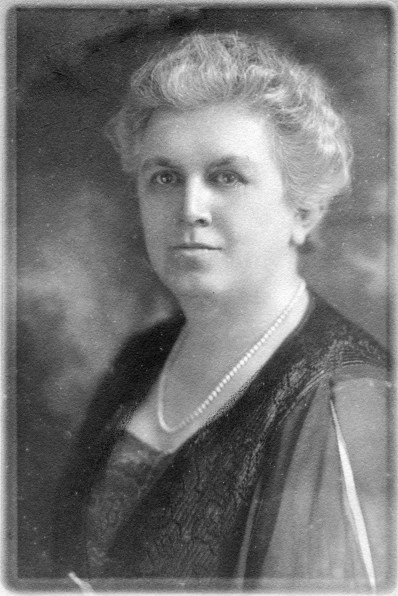
So that everyone would be able to enjoy the event, the dinner after the consecration was to be catered, but the women were to be active as pourers and hostesses. The article mentions a tea set and tea urn that are still used for formal occasions. The tea set was donated by Mrs. William G. Burrill, the tea urn by Pauline Hewson Wilson, who had also given the Wilson Memorial Parish Hall on Jay Street.

Pauline Hewson Wilson

Pauline Hewson Wilson