You’re Invited!

Yes, here is your formal invitation, to the consecration of St. Paul’s new Hackett Boulevard building on June 4, 1966. As we have seen, the nave had been in use since April 7, but work on the chapel and Sunday School rooms would continue into the summer.

Invitation to consecration of St. Paul's Church

Invitation to consecration of St. Paul’s Church

As we prepare to note the fiftieth anniversary of the building’s consecration, it is interesting to look back at what was being said about the new building when it was new. We don’t have records of discussions within the St. Paul’s family about the design of the new church,  but we do have two slides of an architect’s model that was shown to the congregation before construction began.

Architect's model, Hackett Blvd Church from the southeast

Architect’s model, Hackett Blvd Church from the northeast

Architect's model, Hackett Blvd Church from the northeast

Architect’s model, Hackett Blvd Church from the southeast


We also have newspaper reports of the design, with some interesting details on how and why it was chosen.

A Knickerbocker News article from shortly before the consecration declares that “[t]he new St. Paul’s Church on Hackett Boulevard is a contemporary church that hasn’t forgotten man has a history.”

As to the general design, it quotes Father McWilliam: “We wanted a church that was contemporary but not extreme, a church that expressed the social concerns of the day”

The article continues

Architect Donald J. Stephens of Loudonville explained the building committee wanted a church that was different from the typical A-frame used in most modern churches. The result of visits to new churches throughout New York and New England was a building ‘traditional in plan and form, contemporary in structure and materials.’

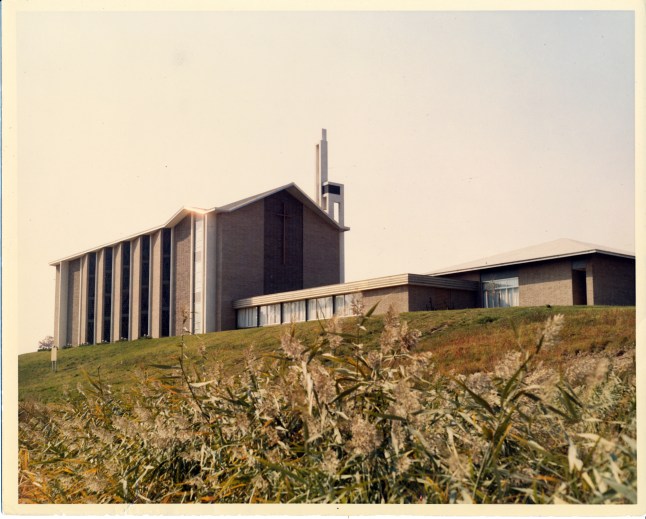
Outside, the church gives the impression of slenderness and height, with a white bell tower in the forms of an abstract cross soaring skyward….

Inside, the nave is designed to focus everything on the plain, marble free-standing altar.  The sawtooth construction of the side walls, patterned after the new cathedral in Coventry, England, helps create this focus. The zigzag causes the light from the narrow stained glass windows to be reflected on the gray, rough-textured bricks that make up the walls. Because of the construction, a member of the congregation facing the altar cannot see the stained glass windows, which, according to Father McWilliams, minimized distractions and keep attention focused on the altar.

IMG_8241 v001The comparison to  the window design to that of  Coventry Cathedral is one that is often still made. What has been forgotten over the years is the building committee’s survey of new church in New York and New England. It would be interesting to know where they visited. We know of one for certain, because an April 2, 1966 Times Union article specifically mentions it.

The congregation drew inspiration from a similar project in the Church of Saint Mark in New Canaan, Conn., with adaptations executed by St. Paul’s architect, Donald J. Stephens of Loudonville.

Donald Stephens (architect) and William S. McEwan (treasurer, building committee)

Donald Stephens (architect) and William S. McEwan (treasurer, building committee)

Hackett Nave_0008


While the exterior of St. Mark’s Church is certainly reminiscent of St. Paul’s (if a bit more elaborate), the interior is even more so, with its free-standing altar and an elaborate reredos screening the choir and organ from the rest of the nave.

Both of these articles also explain how carefully the building committee attempted to incorporate elements of the old building into the new. Prominently mentioned are the ten J. and R. Lamb windows in the narthex, the Tiffany Good Shepherd window in the sacristy and the almost complete preservation of elements in the chapel.

“Christ the Good Shepherd” was given in 1899 in memory of J. Livingston Reese, rector of St. Paul’s from 1864 until 1891. It was designed and executed by the Tiffany Studios, after a painting by Bernhard Plockhorst.

"Christ the Good Shepherd" window

“Christ the Good Shepherd” window


July 1964 — Another Photo of the Hackett Boulevard Groundbreaking

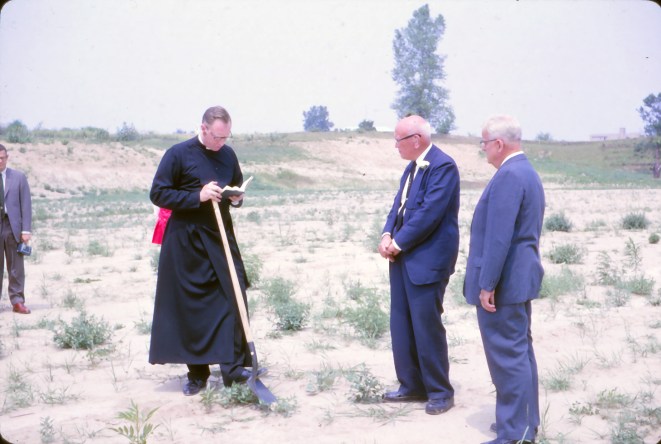
Last year, we shared a snapshot of the groundbreaking for St. Paul’s new Hackett Boulevard building on July 26, 1964.

Father J. Raymond McWilliam and wardens Frederick Eckel and Raymond E. Foskett

Father J. Raymond McWilliam and wardens Frederick Eckel and Raymond E. Foskett

Thanks to the late Mildred Lentz (and to Pam Love, who has preserved her files) we now have another photograph taken that day.

Groundbreaking at Hackett Boulevard, 26 July 1964

Groundbreaking at Hackett Boulevard, 26 July 1964

The photographer was facing west, and in the background we can see the tower of the Albany Academy, and the Child’s Hospital and St. Margaret’s Home buildings. Fr. J. Raymond McWilliam and wardens Frederick Eckel and Raymond E. Foskett are in the foreground, with the congregation forming an arc around them. Thanks to Dave Van Hattum, Betty Peters Bertrand and Gertrude (Trudy) Van Hattum, we can identify a few faces in the congregation. To the right of the rector and wardens, the woman in the striped dress is Gertrude Van Hattum, with her sons Dave and Steve to her right and left respectively. To the left of the rector and wardens, the woman in the flowered dress is Erma Peters; to her right, in a white dress, is her daughter Betty Peters. The man second from right holding flowers is Dave Powers. On the left side, the man standing next to man with suspenders is William S. McEwan.

From a Knickerbocker News article printed on the previous day, we know that the congregation held its last service in the Lancaster Street building at 11:00 AM on Sunday, July 26, 1964, and then proceeded directly to the Hackett Boulevard site.

The Knickerbocker News article said that the new building was to be completed by September 1, 1965.  Because of a strike by masons, the building was not ready until spring 1966, and the first service was held April 7 of that year. For that period, more than twenty months, the congregation held its services at Trinity Episcopal Church.

In recognition of that last service at Lancaster Street, here, also from Mildred Lentz’s files, is an undated photograph of a service in the church. Can we identify any of the people shown, or guess approximately when it was taken?

Service in the Lancaster Street church

Service in the Lancaster Street church

Bouillon Cubes and Saltine Crackers at the Governor’s Mansion

Today’s post brings a story from the memoirs of Arthur R. McKinstry (St. Paul’s rector from 1927 until 1931), with an amusing anecdote about Eleanor Roosevelt’s preference for simple food during Franklin’s term as New York governor (1929-1932).

Arthur R. McKinstry

Arthur R. McKinstry

Albany society, which had felt particularly cheated during the Smith regime, rejoiced that aristocracy had returned to the Governor’s Mansion. They waited hopefully for the first high tea to be given by Mrs. Roosevelt. But Mrs. Roosevelt, not sensing this, and being interested in a school and a furniture factory in New York City would be absent from Albany virtually the whole week, returning only for the weekends.

Soon Albany society became very discouraged about the prospects of any activity in the Mansion House. A good friend went to Mrs. Roosevelt and explained the situation to her, whereupon the Governor’s wife sent out engraved invitations, with one going to the rector of St. Paul’s Church and his wife. We all gathered expectantly at the Mansion. I remember how Mr. Roosevelt, came in – how gracefully he moved among the guests on his crutches. But what almost ruined relations between the Mansion and the society of Albany was the fact that on that occasion Mrs. Roosevelt served only bouillon cubes and saltine crackers. Albany society felt cheated again.[1]

Governor's Mansion 1925 [Photo credit: Albany... the way it was Archive]

Governor’s Mansion 1925 [Photo credit: Albany… the way it was Archive]

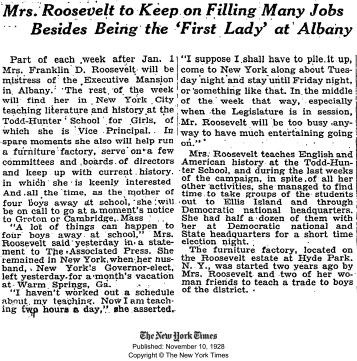
Albany society need not have been surprised that the new governor’s wife would have little time for entertaining. Mrs. Roosevelt had announced before Franklin’s inauguration that she would be busy from Tuesday through Friday each week, teaching American history, literature and serving as Vice-Principal at the Todhunter School for Girls in New York City, and overseeing the furniture factory at Val-kill in Westchester County.[2]

New York Times Times November 10, 1928

New York Times Times November 10, 1928

Albany society’s values were shallow indeed: despite the warmth of the Roosevelts’ greeting, they thought the event “almost ruined” because of the simplicity of the refreshments. No disrespect was intended: the food served was a matter of principle for Eleanor Roosevelt. Starting during the early 1920’s, Eleanor was much influenced by the Cornell University Home Economics program. She had a close relationship with its founders, Martha Van Rensselaer and Flora Rose, and advocated their simple and frugal recipes.[3]

This commitment to simple food extended to Eleanor Roosevelt’s years as First Lady (1933 – 1945). Contemporary accounts of the food served at the White House during the Roosevelt administration are harsh: guests routinely reported dull, unimaginative food. No wonder that many in Washington knew that it was advisable to eat before dining at the White House. It was not only guests that were dissatisfied: Franklin Roosevelt often complained about the quality of the food.[4] The food Eleanor chose was certainly plain, “especially at lunchtime. Broiled kidneys on toast, chipped beef on toast, shrimp wiggle on toast, curried eggs on toast…”[5] The president once complained about being served “liver and beans three days in a row.”[6]

Many of these dishes were influenced by the menus recommended by Cornell’s Home Economics Department. During the Depression, Eleanor wanted White House food to represent the kind of cooking that America’s distressed citizens could afford and cook. The emphasis was on low cost, efficient cooking, and nutrition, not on the pleasures of the table.[7] This view certainly made sense to a person like Eleanor, of whom her son James Roosevelt said “… she has no appreciation of fine food. Victuals to her are something to inject into the body as fuel to keep it going, much as a motorist pours gasoline into an auto tank.”[8]

While commentators agree that the Cornell program influenced Eleanor Roosevelt, there are two related theories about underlying factors, the type and quality of food served during the White House years.

As a practical matter, Henrietta Nesbitt, the head housekeeper that Eleanor employed during the entire time she lived in the White House, was unprepared for her role as supervisor of a staff of thirty-two, both maintaining the mansion and organizing meals from state dinners to family suppers. She seems also to have been willfully incompetent, ignoring advice from professional chefs and restaurants.[9] Roosevelt’s biographer, Blanche Wiesen Cook, in a chapter titled “ER’s Revenge: Henrietta Nesbitt, Head Housekeeper”[10] argues that Eleanor Roosevelt’s hiring of Nesbitt and her refusal, despite many provocations on Nesbitt’s part, to dismiss her, is an element in the First Lady’s passive-aggressive style in a troubled marriage. In partial defense of Mrs. Nesbitt, Barbara Haber points out that Nesbitt was above all loyal to her employer and benefactor, and was carrying out Mrs. Roosevelt’s instructions.[11]

This psychologizing on party food, however, seems petty and even mean-spirited. Eleanor Roosevelt, as First Lady of New York State, then as First Lady of the nation, and finally (in Harry S. Truman’s phrase) as First Lady of the World, lived a busy and noteworthy life, contributing much to our nation and our world. As a woman with many interests and causes, as her husband’s legs during Franklin’s governorship, as one of the most active and effective First Ladies in our history, Eleanor Roosevelt had far more important things on her mind than canapés.

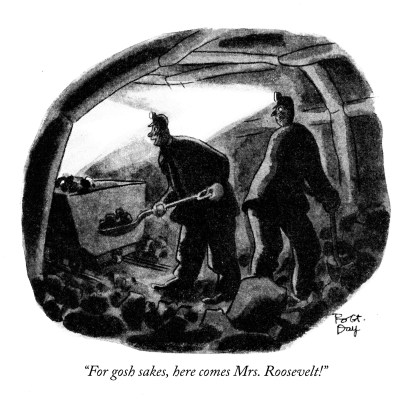
New Yorker cartoon, 1932

New Yorker cartoon, 1932

Returning to St. Paul’s connection to this story, our rector Arthur R. McKinstry wrote that Governor Roosevelt knew him “quite well” when they were both in Albany, and we suspect this was not the only time McKinstry visited the Governor’s Mansion. Roosevelt and McKinstry kept in touch after Roosevelt was elected president, and in 1935 Roosevelt pressed his church, St. Thomas, Du Pont Circle, Washington, D.C. to call McKinstry as rector, a call that he declined.[12] McKinstry went on to be named bishop of Delaware.

[1] Arthur McKinstry, All I Remember…: The McKinstry Memoirs by the Fifth Bishop of Delaware 1939 – 1954 (Wilmington: Serendipity Press, 1975), 40.

[2] “Mrs. Roosevelt to Keep on Filling Many Jobs Besides Being the ‘First Lady’ at Albany,” New York Times, 10 Jan 1928.

[3] H. Roger Segelken, “Affectionately, Eleanor,” New York Archives 15, no. 4 (Spring 2016), 12 – 17.

[4] Laura Shapiro, “The First Kitchen: Eleanor Roosevelt’s austerity drive,” New Yorker (November 22, 2010).

[5] Shapiro.

[6] Henrietta Nesbitt, White House Diary (Garden City: Country Life Press, 1948), 185.

[7] Barbara Haber, “Home Cooking in the FDR White House: the Indomitable Mrs. Nesbitt,” in From Hardtack to Homefries: An Uncommon History of American Cooks and Meals (New York: The Free Press, 2002), 118-119.

[8] Haber, 123.

[9] Cook, 55.

[10] Blanche Wiesen Cook, Eleanor Roosevelt, Volume 2, 1933 – 1938, (New York: Viking, 1999), 52-59.

[11] Haber 121-124.

[12] McKinstry, 49-50.

May 1966 — the Hackett Boulevard Cornerstone

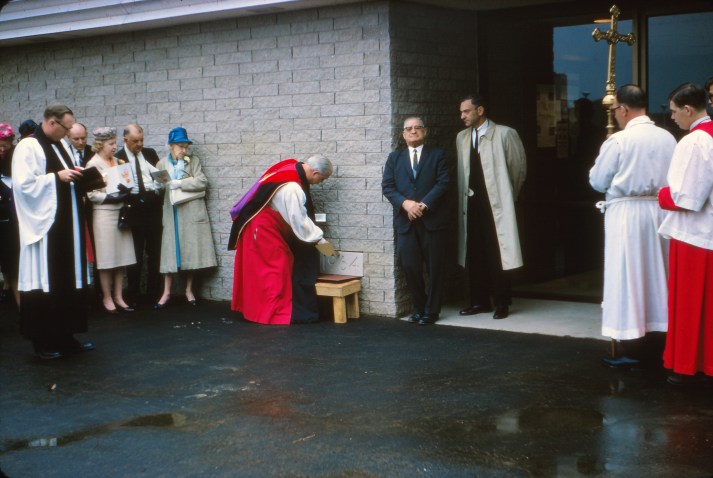
Today we continue our celebration of the fiftieth anniversary of St. Paul’s move to its new home on Hackett Boulevard with two photographs from the ceremonies at the laying of the new building’s cornerstone on May 8, 1966. The first photo shows Suffragan Bishop Charles B. Persell, Jr. laying the cornerstone.

Bishop Persell laying cornerstone 8 May 1966

Bishop Persell laying cornerstone 8 May 1966

The second photo is of Bishop Persell preaching in the church.

Bishop Persell preaching 8 May 1966

Bishop Persell preaching 8 May 1966


Easter 1966

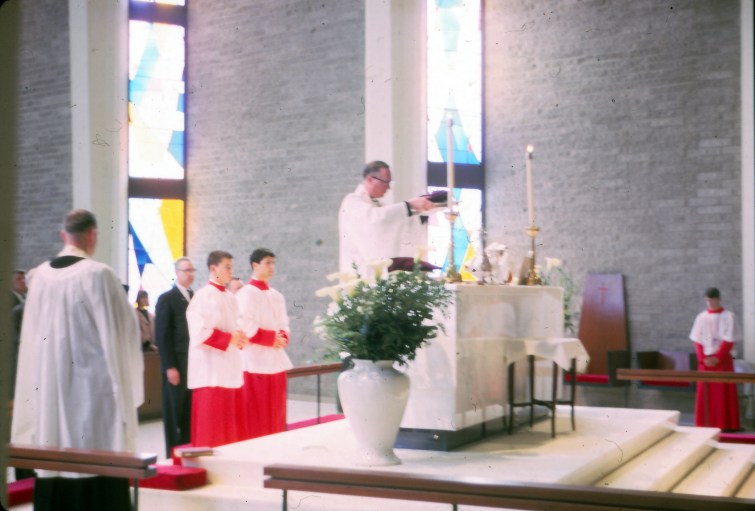
It’s Easter, and fifty years ago St. Paul’s celebrated its first Easter in the Hackett Boulevard building. This was only the second service  in the church: the high altar had been consecrated on Maundy Thursday, and there were no services on Good Friday and Holy Saturday.

All three photographs show the rector, J. Raymond McWilliam, at the altar. Notice that he stood with his back to the congregation. In the third photo, David Van Hattum is the crucifer. Can anyone identify the others in these snapshots?

Easter 1966

Easter 1966

Easter 1966

Easter 1966

Easter 1966

Easter 1966

Maundy Thursday 1966 — Consecration of the High Altar

It’s Maundy Thursday, and fifty years ago today on the liturgical calendar St. Paul’s held its first service in the Hackett Boulevard church: the consecration of the high altar. In this photograph we see the altar, and behind it, “the massive, shimmering bronze reredos,”  as it was described in a contemporary  Knickerbocker News article.

Altar and Reredos, Hackett Boulevard

Altar and Reredos, Hackett Boulevard

The free-standing altar, of Vermont marble, was donated by the treasurer of the building fund, William Starr McEwan, and dedicated to his maternal grandparents, Samuel Starr Peck (1852-1934) and Susan Marsh Peck (1860-1942).

Bulletin cover, Consecration of Altar, Maundy Thursday 1966

Bulletin cover, Consecration of Altar, Maundy Thursday 1966

Bulletin, Consecration of Altar, Maundy Thursday 1966

Bulletin, Consecration of Altar, Maundy Thursday 1966

The only photograph that we know was taken that day shows Bishop Allen W. Brown at the altar, partially obscured by our rector, J. Raymond McWilliam.

Consecration of the High Altar, Maundy Thursday 1966

Consecration of the High Altar, Maundy Thursday 1966


April 1966 — “The New St. Paul’s Ready Next Week”

Kenneth Eels (chair, building committee) and J. Raymond McWilliam (rector)

Kenneth Eells (chair, building committee) and J. Raymond McWilliam (rector)

Fifty years ago today by the liturgical calendar, St. Paul’s was preparing to move into its new home at 21 Hackett Boulevard. In “The New St. Paul’s Ready Next Week” published in the Albany Times-Union for Saturday, 2 April 1966 (the day before Palm Sunday that year), we read:

After almost two years of worshipping in another congregation’s church, the people of St. Paul’s Episcopal Parish will be moving back into their own religious home next week.  The striking new building at 21 Hackett Boulevard, just beyond Holland Avenue, replaces St. Paul’s that stood as a landmark in downtown Albany until it was demolished for the South Mall. Services will begin in the new church Maundy Thursday at 8 p.m. The Rt. Rev. Allen W. Brown, Bishop of the Albany Episcopal Diocese, will bless the high altar. Holy Communion and a brief sermon will be offered by the Rev. John Raymond McWilliam, rector of St. Paul’s.

St. Paul's, Hackett Boulevard, about 1966

St. Paul’s, Hackett Boulevard, about 1966

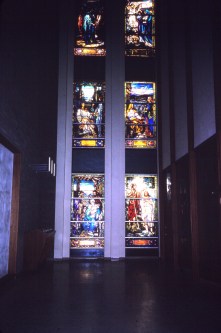
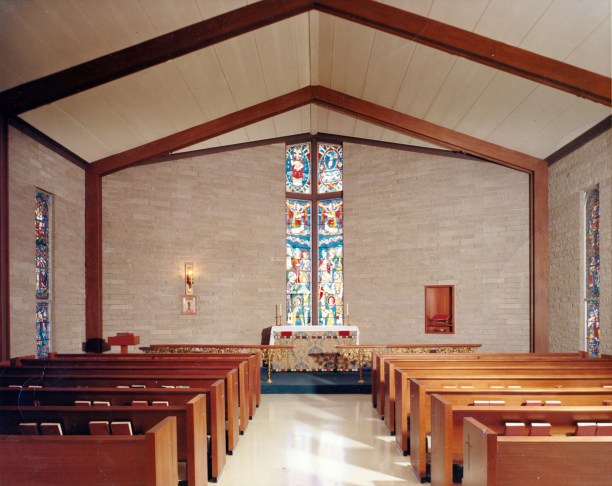
The article mentions the incorporation of the Tiffany Good Shepherd Window, as well as the ten J. and R. Lamb windows in the narthex, as well as the “almost completely preserved” 1940 Memorial Chapel.

J. and R. Lamb windows, Hackett Boulevard Narthex

J. and R. Lamb windows, Hackett Boulevard Narthex

J. and R. Lamb windows, Hackett Boulevard Narthex

J. and R. Lamb windows, Hackett Boulevard Narthex

Chapel, Hackett Boulevard

Chapel, Hackett Boulevard

Finally, the article reveals an aspect of the new building’s design which is not widely known:

The congregation drew inspiration from a similar project in the Church of Saint Mark in New Canaan, Conn., with adaptations executed by St. Paul’s architect, Donald J. Stephens of Loudonville.

St. Paul’s design was certainly influenced by that of Coventry Cathedral, particularly the angled windows in the nave. But the Times-Union article gives us a further clue to influences on the design, a clue that we will pursue in a later post.

Nave, Hackett Boulevard

Nave, Hackett Boulevard

Holy Cross Farm

Rambles in local history frequently lead to surprises: we go looking for some piece of information, and stumble across something far more interesting. Serendipity struck again last month, when, purely by chance, I learned about an Episcopal orphanage for African-American children in Albany County. And the story was not new to just me: there were no references in either the diocesan history or the history of All Saints Cathedral.

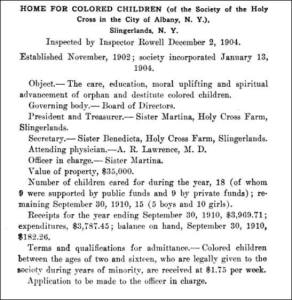
Annual Report of the New York State Board of Charities, 1910

Annual Report of the New York State Board of Charities, 1910

The orphanage’s legal name was The Home for Colored Children, but it was more commonly referred to as Holy Cross Farm. It was located just outside the then city limits on New Scotland Avenue, in the hamlet of Hurstville.

The one full listing we have (from the 1910 Federal census for the town of Bethlehem) shows fifteen African-American children between the ages of two and seventeen. We know from a contemporary newspaper account[1] that it accepted children from across the State of New York. That year, there was a staff of six: a Mother Superior and her assistant, a teacher, cook, and a handyman.

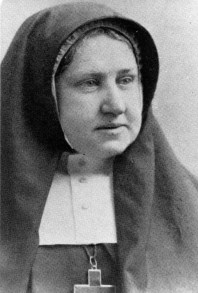
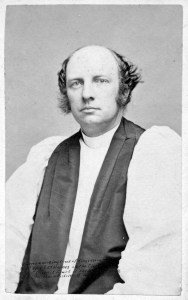
According to a city directory of the period, the Mother Superior, Stella Runyon Martin, was called Sister Martina. Sister Martina was a member of the Sisterhood of the Holy Child Jesus, an order of Episcopal nuns organized by Bishop William Croswell Doane and Mother Helen Dunham in 1873. Sister Martina’s assistant, Winifred Clare Benedict, was known as Sister Benedicta, and likely belonged to the same order.

Mother Helen Dunham, Mother Superior of the Sisterhood of the Holy Child Jesus

Mother Helen Dunham, Mother Superior of the Sisterhood of the Holy Child Jesus

William Croswell Doane, Bishop of Albany

The orphanage was opened in 1902 and closed in 1914. For all but its first two years, Holy Cross Farm was directed by the Society of the Holy Cross in the City of Albany.

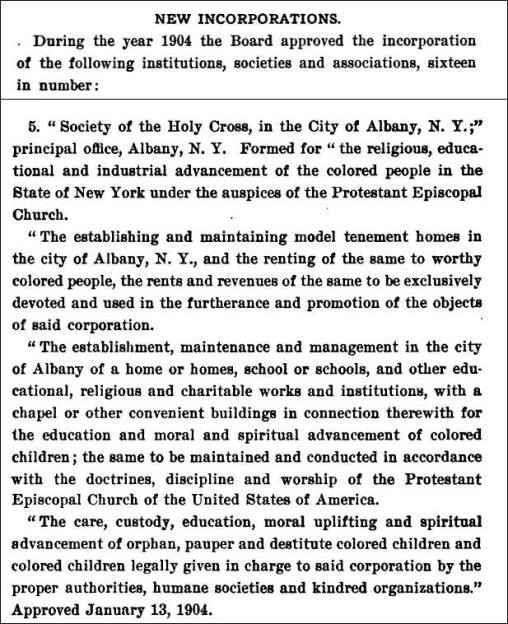
Annual Report of the New York State Board of Charities, 1904

Annual Report of the New York State Board of Charities, 1904

The Society of the Holy Cross was incorporated in 1904. Its officers consisted entirely of Cathedral staff and members: the president was the cathedral’s long-time Canon Precentor, Thomas B. Fulcher, the treasurer a long-time member of the Cathedral congregation, and the secretary was the assistant Cathedral organist. The Society was formed for “the religious educational and industrial advancement of the colored people in the State of New York under the auspices of the Protestant Episcopal Church.” Three activities were planned:

  • Rental housing in the city of Albany
  • Homes, schools or other institutions in the city of Albany
  • Care and custody of orphaned and neglected children

The first of these projects was already under way. According to the history of All Saints Cathedral[2], Sister Martina had inherited houses in Sheridan Hollow and, as a landlord, found a need among African-Americans for suitable rental housing.

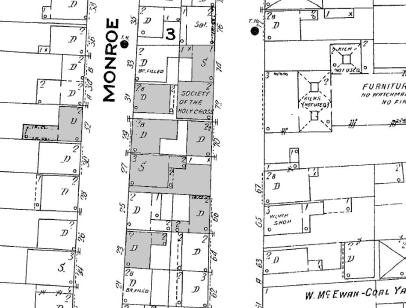
Society of the Holy Cross housing (Sanborn map, 1908)

Society of the Holy Cross housing (Sanborn map, 1908)

The deeds for the properties tell a slightly different story. Sister Martina bought the houses from four different owners in October and November 1903 and assumed two mortgages; she sold the property to the Society of the Holy Cross in March 1904 and they assumed the mortgages. In 1910, the Society mortgaged the houses a second time to provide income for Holy Cross Farm[3]. Sister Martina also encouraged her tenants to join the Cathedral congregation[4]. Among these were two sisters, Georgine and Harriette Lewis.

Georgine Sheldon Lewis (University Archives, University at Albany, SUNY)

Georgine Sheldon Lewis (University Archives, University at Albany, SUNY)

In a 1910 newspaper article[5], Georgine Lewis is described as a director of the Society, whose offices were located with the rental properties at 27 Monroe Street. Georgine was then a student at the New York State Teachers’ College in Albany; she graduated in 1911 with a B.S., and later earned a master’s degree at the same institution. She was a long-time faculty member of the Washington D.C. Teachers’ College[6]. According to the University at Albany web site, “She was the first African-American to earn a graduate degree from the University and is believed to be the University’s first African-American graduate to become a college faculty member.”[7] Georgine’s younger sister, was no less impressive. Harriette Lewis graduated from the Teachers’ Training School at Albany in 1911[8], and was the first African-American to teach in the Albany Public Schools[9]. Both sisters were members of the Cathedral congregation; Georgine was married there by Canon Fulcher, the president of the Society of the Holy Cross[10].

The Society sold the houses on Orange and Monroe Streets in January 1914 to businessman William J. Stoneman. The houses were demolished in 1924 to build a warehouse which still stands on the site.

The Society’s second project seems never to have been begun. I have been unable to find any reference to any institution other than Holy Cross Farm.

The third project refers to Holy Cross Farm and the work done there. The fact that the houses were mortgaged a second time in 1910 may indicate financial pressure on the small institution. It closed in 1914 for reasons we may never know.

Richard Henry Nelson as bishop coadjutor of Albany

Richard Henry Nelson as bishop coadjutor of Albany

We do know that Bishop Richard Henry Nelson (who succeeded Bishop Doane in 1913) did some pruning of diocesan missions early in his term. It is possible that Holy Cross Farm was one of these. The Farm continues to be mentioned in classified advertisement for a few years, but only as a farm, offering pasturage for horses. The property was sold in three separate lots between 1914 and 1916.

While the orphanage was no more, Sister Martina continued her good works. According to her obituary, she ran a home known as Mission of the Cross on Staten Island for a dozen years, and also worked in Florida. She died at the Convent of St. Anne in Kingston in 1946.[11]

[1] “Local Officials Are Pleased With Holy Cross Home,” The Binghamton Press, 23 March 1912.

[2] George E. DeMille, Pioneer Cathedral: A Brief History of the Cathedral of All Saints, Albany. (Albany: no publisher, 1967), 159.

[3] “Mortgages Its Property: Society of the Holy Cross to Improve Farm for Colored Children,”Albany Evening Journal, 8 Aug 1910.

[4] DeMille, 159.

[5] “Mortgages Its Property: Society of the Holy Cross to Improve Farm for Colored Children,”Albany Evening Journal, 8 Aug 1910

[6] “Mrs. Wilkins Dies; College Teacher,” Albany Times Union, 1 Feb 1970.

[7] “African-Americans at the University at Albany and its Predecessor Institutions – 1858-present” http://www.albany.edu/news/uablackhistory.php retrieved 5 Mar 2016.

[8] Marian I. Hughes, Refusing Ignorance: The Struggle to Educate Black Children in Albany, New York, 1816-1873. (Albany: Mount Ida Press, 1998), 80-81.

[9] “The African Voice in Albany, New York: Harriette Bowie Lewis Van Vranken Remembers” in A.J. Williams-Myers (ed.) On the Morning Tide: African Americans, History and Methodology in the Historical Ebb and Flow of Hudson River Society. (Trenton: Africa World Press, 2003), 119-139.

[10] “Wilkins-Lewis,” Albany Times Union, 24 Aug 1914.

[11] “Sister Martina, 89, Dies in Kingston,” Albany Times Union, 16 Jan 1946.

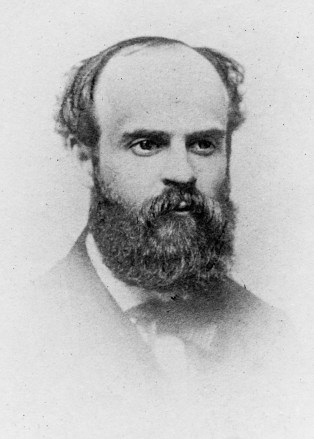
George William Warren at St. Paul’s — Part 3, 1857-1860

George William Warren

George William Warren

As we saw in an earlier post, George William Warren resigned as St. Paul’s organist and choirmaster sometime in the fall of 1856. At that point, he had been at St. Paul’s since 1848, other than (perhaps) ten months in 1852 — 1853 when he had been in business with Richard H. Pease at the Temple of Fancy. During the fall and winter of 1856 – 1857, Warren probably served as organist at the Second Presbyterian church, but the only evidence we have for that is the article cited in the previous post.

Albany Evening Journal 20 Jan 1857

Albany Evening Journal 20 Jan 1857

He was certainly busy that winter with the second Concert for the Poor, which again featured Isabella Hinckley and William Gourlay of St. Paul’s. That spring, Warren organized a farewell concert for Isabella Hinckley, raising funds so that she could  begin her operatic career in Europe. For information on Isabella’s brilliant career and her untimely death, see Don Rittner’s post. Isabella Hinckley’s funeral was conducted by our rector, William Rudder, at St. Paul’s , in whose choir “her extraordinary musical talent first attracted attention”.

Warren’s position at Second Presbyterian may not have lasted long. Already in February of 1857, Warren was performing with St. Paul’s boy choir in a service at Grace Church. By the spring of 1857, St. Paul’s terminated its contract with Albert H. Wood and the quartet choir, and a month later George William Warren again offered his services to St. Paul’s. Warren resumed his duties at St. Paul’s on August 1, 1857.

Even before his term officially began, Warren advertised to fill vacancies in the St. Paul’s choir.

Albany Evening Journal 15 Jun 1857

Albany Evening Journal 15 Jun 1857

Advertisements for boy choir vacancies also start at this time and continue for the next few years, including this from January 1858 “None need apply except those with good voices, gentlemanly manners and under 13 years of age.” Could this have been a reference to the horseplay mentioned by Charles M. Nickerson, who sang with the boy choir in this period?

Worshippers afflicted with nerves are sometimes heard to complain of the restlessness of the boys in the chancel, especially during the sermon, but choirmasters nowadays certainly maintain a stricter discipline than their predecessors of the time of which I write thought necessary. When the sermon began, it was our wont to draw the curtain that hung over the front of the organ gallery and then slip out one by one through the door behind the organ into the Sunday School room, there to regale ourselves on candy and peanuts and enjoy general conversation until a signal from the choirmaster called us back for the offertory hymn. This was in the old Saint Paul’s, the one time theatre on South Pearl St. The Sunday School room in the rear of the organ loft had no doubt served as the lobby or bar of the theatre. Strange, as it may seem, our way of passing the time during the sermon was winked at alike by rector and choirmaster as long as we kept reasonably still. But it being a physical impossibility for a dozen boys to be in a room by themselves for half an hour and not become exhuberantly (sic) active, the inevitable happened. When the noise we made penetrated to the Church and even to the pulpit, the decree went forth that we must remain in our seats during the sermon, which we thought rather hard lines.

Bishop Horatio Potter

Bishop Horatio Potter

When Bishop Horatio Potter made his annual visit to St. Paul’s in May 1858, the choir sang the canticles Cantata Domino and Deus Misereatur from a service setting from St. Paul’s Cathedral in London. “The first of these, as rendered by the choir, with the organ accompaniment of Mr. Warren, exceeds anything in church service we have ever heard.” The reporter was equally impressed that nine of the choir were confirmed by Bishop Potter that day.

We do not know the conditions under which Warren returned to St. Paul’s, but it seems that he had been granted a raise in salary and improvements in the organ and in choir facilities. Four months after his return, the church organ, a three-manual instrument built in 1840 by Thomas Robjohn in a contract with Firth & Hall, was rebuilt by the firm of William A. Johnson. And in May 1858 the church treasurer, E.E. Kendrick, announced a $680 budget shortfall consisting in large part of expenses related to Warren and the choir, including: “fitting up and arranging the organ loft and north room with carpets, gas, painting, gilding and decorating for the convenience of the musical director and the choir, and the salary of the organist increased from $850 to $1100.”

Warren’s personal life also saw a major transition at this time. On September 16, 1858 he was married to Mary Eliza Pease at St. Paul’s. Mary Eliza was also a member of the congregation, and the daughter of Warren’s former business partner, Richard H. Pease.

That same month, a reviewer gave a mixed assessment of Warren’s work at St. Paul’s:

He has one of the best organs in the city, which he handles with much skill in the lighter style of music, which no doubt gives delight to admiring friends, but your correspondent would like to see it changed to a style more adapted to the church and to the organ. The choir, comprising several good voices, sing the musical compositions of Mr. Warren very well, but it would be to the advantage of all concerned, if more prominence were given to other church compositions of established merit. Miss C[arrie] Ross, the leading soprano, is quite a treasure to the choir…

Miss Ross was later to marry James Mason Sayles, composer of “Star of the Evening.”

As we have seen, Warren submitted his resignation to St. Paul’s vestry in April 1860, “to take effect the first of August ensuing, which time terminates the third year of my present engagement with you.” We can now see that the “nearly thirteen years … devoted to the musical interests of St. Paul’s” consisted of the period from 1848 until 1860, broken briefly only during parts of 1852-1853 and again in 1856-1857. The young man’s concern for the good opinion of St. Paul’s vestry is evident in his statement “It has always been my willing duty to try to please you; if I have not always succeeded, the cause has been something else than lack of desire on my part.” Warren was only thirty-years old, and had played at St. Paul’s since he was barely out of his teens. The vestry responded affectionately with three resolutions:

The following resolutions in answer thereto were unanimously adopted and a copy ordered transmitted to Mr. Warren.

Resolved, that we have heard with regret the communication of Mr. Geo. Wm. Warren announcing his determination to leave this City and resign his position as Organist and Musical Director of this Church, a determination which leaves a void in the musical portion of the service of our Church and inflicts a loss on those who appreciate and enjoy excellence in church music.

Resolved, that in view of the long connection of Mr. Warren with the Choir of St. Paul’s extending over a period of thirteen years, we cannot allow the occasion of separation to pass without expressing the satisfaction which his services have given during the whole of that period.

Resolved, that we tender to Mr. Warren our best wishes for his prosperity and his success in his new home and that we warmly commend him as a Gentleman whose moral character, professional ability and industry entitle him to abundant reward.


January 1966 — Construction Complete on Hackett Boulevard

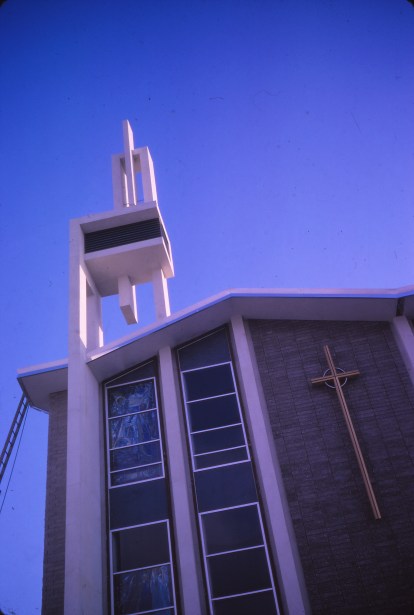
Hackett Blvd Building, 8 Jan 1966

Hackett Blvd Building, 8 Jan 1966

When these slides were taken on January 8, 1966, the new church was almost complete, with the consecration scheduled for the following April . The first slide shows the tower, with a ladder propped against the roof next to it. They may have been working on the wiring for the electric chimes, which had originally been installed in 1947 in the east tower of the Lancaster Street church as a memorial to members of the congregation who died in World War II.

The photograph also allows us to see progress on the installation the stained glass windows from the Lancaster Street building in the new narthex.

The second slide shows the Hackett Boulevard facade of the building, looking much as it does today, except for the bare soil and missing landscaping.

Hackett Blvd Building, 8 Jan 1966

Hackett Blvd Building, 8 Jan 1966