Mrs. Hawley’s Legacy — Emma Starr Montgomery Mosher

In a previous post, we began looking at the legacy of Elizabeth Maria Starr Hawley, who became a member of St. Paul’s Church in 1831. She and and all four of her children were active members of the young congregation.

This time, we follow her descendants to the next generation: the children of her daughters Lydia Amelia Hawley and Mary Ann Hawley , both of whom, as we have seen, were communicants of St. Paul’s.

Mary Ann Hawley (1817 — 1911) married William Janes (born 1906) in St. Paul’s Church on April 5, 1843. Of their three children, Julia Maria Janes (1848 — 1933), who joined the Sisterhood of the Holy Child Jesus as Sister Julia  will became important to our story in relation to one of her younger cousins.

Our main story, however, follows the descendants of Lydia Amelia Hawley (1814 — 1880), who married Jesse H. Montgomery (1810 — 1840).  The couple  had two children, Emma Starr and Lydia Amelia. Both daughter were communicants of St. Paul’s by 1858 and both were married at St. Paul’s in the mid-1860’s.

Emma married a young physician from Coeymans, Jacob Simmons Mosher, and it is their descendants who will fill much of the rest of our story. When the young couple was married at St. Paul’s in December 1863, Emma might have hoped for the quiet life of a physician’s and academic’s wife in Albany, but, with the Civil War still raging, this was not to be. The next year, Jack was appointed volunteer surgeon in the Army of the Potomac and sent to Virginia. In June 1865, Emma and their first child were living with her mother.

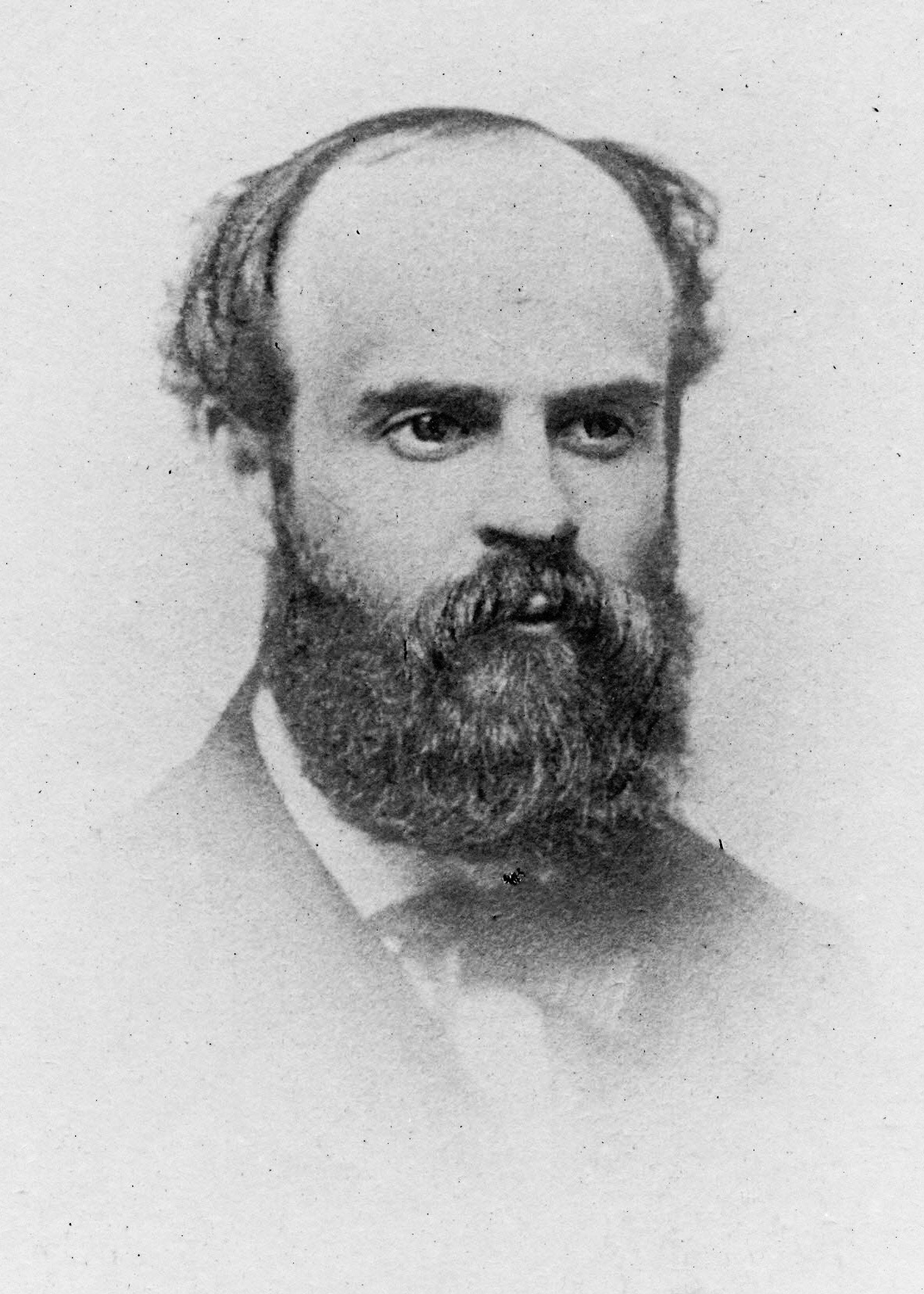
Jacob Simmons Mosher

Jacob Simmons Mosher

Even the end of the war did not make things easier. Jack was appointed Assistant Medical Director of New York, and assigned to Washington, D.C. The family’s longest stay in Albany was from 1869 until 1873, when Jack served as Superintendent of a hospital for disabled soldiers here. During this period, Mosher was also a vestryman of St. Paul’s Church. This respite ended when he was named Deputy Health and Executive Officer for the Port of New York. The family lived in New York City from 1873 until they returned to Albany for good in 1876.

Through all these moves, Emma retained her connection to St. Paul’s: three of her four children were baptized at St. Paul’s . But the constant moves and child-bearing took their toll; the next entry in our records is that of the death of Emma Starr Montgomery Mosher on June 28, 1879, when she and her newborn infant were buried from St. Paul’s.

Jacob Simmons Mosher finished a distinguished career as physician, teacher and administrator in Albany. He was among the earliest faculty of the Albany Medical College and  one of the founders of the Albany School of Pharmacy, where he was also professor. He died in 1883 and was buried from St. Paul’s.

Albany Medical College 1897 (credit: Albany Group Archive)

In the next posts, we will follow the lives of three of Emma and Jack’s children, each of whom made important contributions locally, nationally and internationally, extending the legacy of our Mrs. Betsy Hawley.


St. Paul’s Lancaster Building On Postcards!

In the early twentieth century, postcards were a popular way for families and friends to keep in touch. The variety of subjects is immense; cards show not just natural sights, or impressive buildings, but more humble streets scenes, and even churches.

Today we share three postcards printed in the first decade of the last century, all showing St. Paul’s Church on Lancaster Street. The first image should be familiar, because we use it here frequently. It appears on a card mailed from Albany to Brooklyn, New York in December 1911. During this period, the card reverse could be used only for the address, so you see the message on the face of card below the photograph.

Postcard of St. Paul's Church (1911)

Postcard of St. Paul’s Church (1911)

The next card is slightly earlier, but uses the same image, along with pictures of other Albany church and public buildings. It was mailed in December 1906, also to Brooklyn, New York.

St. Paul's Postcard (1906)

St. Paul’s Postcard (1906)

Finally, with many thanks to the good people at the Albany Postcard Project, we are able to share another card, mailed to Schenectady in August 1906. Can you find St. Paul’s? It peeking out from behind the beautiful young woman in the last letter of “Albany.”

Greetings from Albany (1906),  by permission of the Albany Postcard Project

Greetings from Albany (1906), by permission of the Albany Postcard Project


May 1915 — The Arrival of T.F.H. Candlyn as St. Paul’s Organist and Choirmaster

Last month marked the centennial of T. Frederick H. Candlyn‘s arrival at St. Paul’s.  Among musicians at St. Paul’s Church during the twentieth century, Candlyn stands preeminent. Not only did he serve as our organist and choirmaster for an unprecedented 28 years (from 1915 until 1943), he was also an internationally respected composer of works for organ and for choir. I will have much else to say about Dr. Candlyn at another time, but didn’t want to let the anniversary pass without this brief reminder, and without sharing this portrait of him, taken at St. Paul’s organ.

T. Frederick H. Candlyn at St. Paul's organ.

T. Frederick H. Candlyn at St. Paul’s organ.

January 29, 1947 — St. Paul’s Parish Aid Society

In a recent post, I mentioned the difficulty of tracing women’s involvement in St. Paul’s church in the earliest period. By the mid-twentieth century, women’s organizations are more often recognized. We are lucky to have these two snapshots taken during World War II, showing the women of  St. Paul’s Parish Aid Society sewing for the Red Cross. The photographs are unusual in including identification for each person. Do some of our current members remember any of these ladies?

Rector, assistant rector and two members of the Parish Aid Society. Note the parish photo gallery on the wall behind them, with portraits of some of the congregation’s wardens and vestrymen.  George Taylor was our rector from 1932 until 1948; Rollin S. Polk was curate from 1945 until 1947.  Pictured left to right are: Mrs. Wm. H. Verch (treasurer), the Rev. Rollin S. Polk (Assistant Minister), Mrs. George S. Jacobsen (worker), the Rev. George A. Taylor (Rector).

Parish Aid Society January 1947

Parish Aid Society January 1947


Women at work. Part of the photo gallery is also visible here; we can see the  section with portraits of major donors and men who had entered the ministry from St. Paul’s.  The large portrait at rear left is of Thomas A. Starkey, St. Paul’s rector from 1854 until 1858 and later bishop of Northern New Jersey. Gwenola Smith Jones (fourth from right) was the wife of Sydney T. Jones (senior warden from 1922 until 1943 or later) and mother-in-law of the rector. The women are (L-R): Mrs. Marion Larwood, Mrs. George Jacobsen, Mrs. Margaret Weaver, Mrs. Edward McCammon, Mrs. Fred Eckel, Jr., Mrs. William J. McKown, Mrs. W. Phinn, Mrs. Sydney T. Jones,  Mrs. Augustus Bender, Mrs. W.J. Fernette, Mrs. W.S. McDowell

Parish Aid Society Ladies January 1947

Parish Aid Society Ladies January 1947

How Long Was George Wm. Warren Organist at St. Peter’s, Albany?

As mentioned in a previous post, the often-cited chronology in which George William Warren was organist and choirmaster at St. Peter’s Church, Albany from 1846 – 1858 and at St. Paul’s Church, Albany from 1858 – 1860 cannot be correct. In Warren’s 1860 letter of resignation to St. Paul’s vestry he wrote:

It has been my privilege to be a Church Organist in this, the City of my birth, seventeen years; and the best part of that time (nearly thirteen years) has been devoted to the musical interests of St. Paul’s.

George William Warren

George William Warren

In this post, we will discuss the likely cause of this error, and determine the date he actually left St. Peter’s, supported by primary sources.

The first reference work to give specific dates for Warren’s employment at St. Peter’s is Cyclopedia of Music and Musicians (John Denison Champlin, Jr., ed. New York: Charles Scribner’s Sons, 1890. Volume 3, page 566). Champlin gives the 1846 – 1858 period, and he may be the source of this information.

The first work to mention Warren being at St. Paul’s is Who’s Who in  America 1899-1900 (John W. Leonard , ed. Chicago: A.N. Marquis & Company, 1899. page 768) which says Warren “became organist St Peter’s Ch., also St Paul’s Ch., Albany until 1860; organist Ch. of the Holy Trinity, Brooklyn, 1860-70.” As we will see, this is the correct sequence.

It is not until 1919 (seventeen years after Warren’s death) that we find the first reference to the mistaken chronology. Baker’s Biographical Dictionary of Musicians (Alfred Remy, ed. New York: G. Schirmer, 1919. page 1013) conflates  Champlin’s erroneous 1846-58 time period with Leonard’s correct sequence and says that Warren held “positions at St. Peters (1846-58) and St. Paul’s (1858-60), Albany; 1860-70, at Holy Trinity, Brooklyn.”

What, then, is the cause of Champlin’s error in Warren’s term at St. Peter’s? While 1846 is the correct beginning date, 1858  is a typographical error (whether his own, or copied from another source) for 1848, as can be determined from St. Peter’s vestry minutes (New York State Library Manuscripts SC19680, Box 4, Volume 2) and St. Peter’s choir vouchers (New York State Library Manuscripts SC19680, Box 13, Folder 9).

Without question, George Warren became St. Peter’s organist in 1846. His letter offering his services without pay (dated 20 June 1846) is transcribed in the vestry minutes for 6 July 1846; on the same date, the vestry accepted his offer for a period of six months [St. Peter’s vestry minutes 8 July 1846].

Geo. W. Warren's offer to serve as St. Peter's organist without pay (Vestry Minutes 20 Jun 1846)

Geo. W. Warren’s offer to serve as St. Peter’s organist without pay (Vestry Minutes 20 Jun 1846)

The position is confirmed by an 1847 St. Peter’s choir list  which includes G.W. Warren as “Organist and Conductor” [St. Peter’s choir vouchers, sheet reverse dated 1847 without month or day].

St. Peter's 1847 Choir List

St. Peter’s 1847 Choir List

Then on 26 April 1848, St. Peter’s vestry authorized its Music Committee to negotiate a salary no greater than $200 with Mr. George Warren to serve as organist “for the year ending in May next,” implying May 1849. [St. Peter’s vestry minutes 26 Apr 1848 ]

Approval for extension of Warren's service as St. Peter's organist until May 1849

Approval for extension of Warren’s service as St. Peter’s organist until May 1849


If Warren accepted this offer, he changed his mind within six months. On 17 October 1848, his resignation was presented to St. Peter’s vestry, and accepted. [St. Peter’s vestry minutes 17 Oct 1848] The last reference to Warren in St. Peter’s records is the listing of a payment due to him in January 1849 as “late organist.” [Joseph Hooper. A History of St. Peter’s Church in the City of Albany. Albany: Fort Orange Press, 1900. page 294]

As confirmation that George William Warren could not have remained as St. Peter’s organist for much of the 1850’s, an apparently complete set of choir vouchers in that period contains no reference to him after 1847. Between 1852 and 1856, all payments to an organist are made to Albert H. Wood. [St. Peter’s choir vouchers]

By the third quarter of 1849, Warren was organist and choirmaster at St. Paul’s Church. In our next post, we will follow the course of his first term as our organist.


The Legacy of Elizabeth Maria Starr Hawley

St. Paul’s archives are rich source for the early history of our congregation: vestry minutes, portraits, financial documents, correspondence. But particularly in the early years, they give a view that is largely male. All the rectors were men of course, as were all of the vestry until the mid-twentieth century. Most of the pew holders are men.

St. Paul's Ferry Street Building as it looked in the early 20th century

St. Paul’s Ferry Street Building as it looked in the early 20th century

It is only when we turn to the list of communicants that we see women’s names. And not just a few women: of communicants in our first three years (1827-1830), slightly more than two-thirds (67.6%) are women. Extending the range from 1827 to 1832, the percentage is just a bit lower, 64%. Even odder, many of the men we know were active in the period (pew holders and vestrymen) are not listed among communicants. The women listed are mostly married women, but, on the whole, they are not the spouses of vestrymen or of pew holders.

This sex distribution was not atypical in the first half of the nineteenth century. Women were the majority of communicants (and likely of regular attenders) in Episcopal churches. A study of church membership in Albany in the period shows that the same was true of Presbyterian and Methodist congregations. As one example, of new members in one Albany Presbyterian congregations in 1831, two-thirds were women entering alone or with another woman.

In a period when women’s activities outside the home were circumscribed, church membership was an important activity for the women of St. Paul’s. And we know that women were not only sitting in the pews; through the congregation’s difficult early years, the women of the church frequently held fairs or soirees to raise funds.

Announcement of St. Paul's Ladies Fair at Stanwix Hall; Albany Evening Journal 14 Dec 1836

Announcement of St. Paul’s Ladies Fair at Stanwix Hall; Albany Evening Journal 14 Dec 1836

These early members of our congregation were an important part of our founding, and a history of St. Paul’s Church must tell their story. But they are not easy to describe. Most are listed only with their first name and husband’s last name. As women, they do not appear in city directories, they are not listed in Federal censuses before 1850, they are rarely mentioned in newspaper articles. Sometimes, even a woman’s first name is missing; we may, for example, never be able to identify “Mrs. Brown,” who became a member in February 1831.

Occasionally, however, we can put together clues and gather enough information to draw a clear picture of one of these early members. Such a person is Elizabeth Maria Starr Hawley. She is certainly not typical. As you will see in a series of posts, she was the matriarch of a family of broad accomplishments. But she can stand in place for the many women central to our history whom we will never be able to honor.

Elizabeth Maria Starr was born in Connecticut in 1794, and married Joseph Hawley in 1812. We do not know when they moved to Albany, as part of what has been called the “New England Invasion”, but it was probably between 1814 and 1817. The couple had four children: three daughters, Lydia, Julia and Mary Ann (who may have been twins) and one son, Shaw. We first meet Betsy in St. Paul’s records when the young congregation was only three years old: she became a communicant in June of 1830, listed only as “Mrs. Betsy Hawley”. Her youngest child, Shaw, was baptized at St. Paul’s two years later; Julia and Mary Ann were confirmed on the same day in 1837. By February 1840, all the female family members are listed in our records: “Mrs Betsy Hawley with Mrs. Montgomery” (Lydia had recently married Jesse H. Montgomery), Mary Ann and Julia were all members.

Section of 1830's Ferry Street Pew Map -- Front Center Section

Section of 1830’s Ferry Street Pew Map — Front Center Section

The extended family sat in pew 81 on Ferry Street; an early pew map shows “Montgom” in the fourth row, center, of the church and Jesse H. Montgomery paid a pew rent in 1839. The family then made the transition to the church’s new home on South Pearl Street: Julia and Mary Ann were both married there (in 1841 and 1843, respectively), and Shaw became a communicant in 1847.

While there are many other families with participation over two generations, it is difficult to identify them in this early period. By chance, we have been able to trace these relationships this far. But this is only the beginning of the story of Betsy Hawley’s legacy. In the next post, we will discuss Betsy’s grandchildren, their connection to St. Paul’s and their accomplishments.

October 1964 — Demolition of the Lancaster Street Building, After and Before

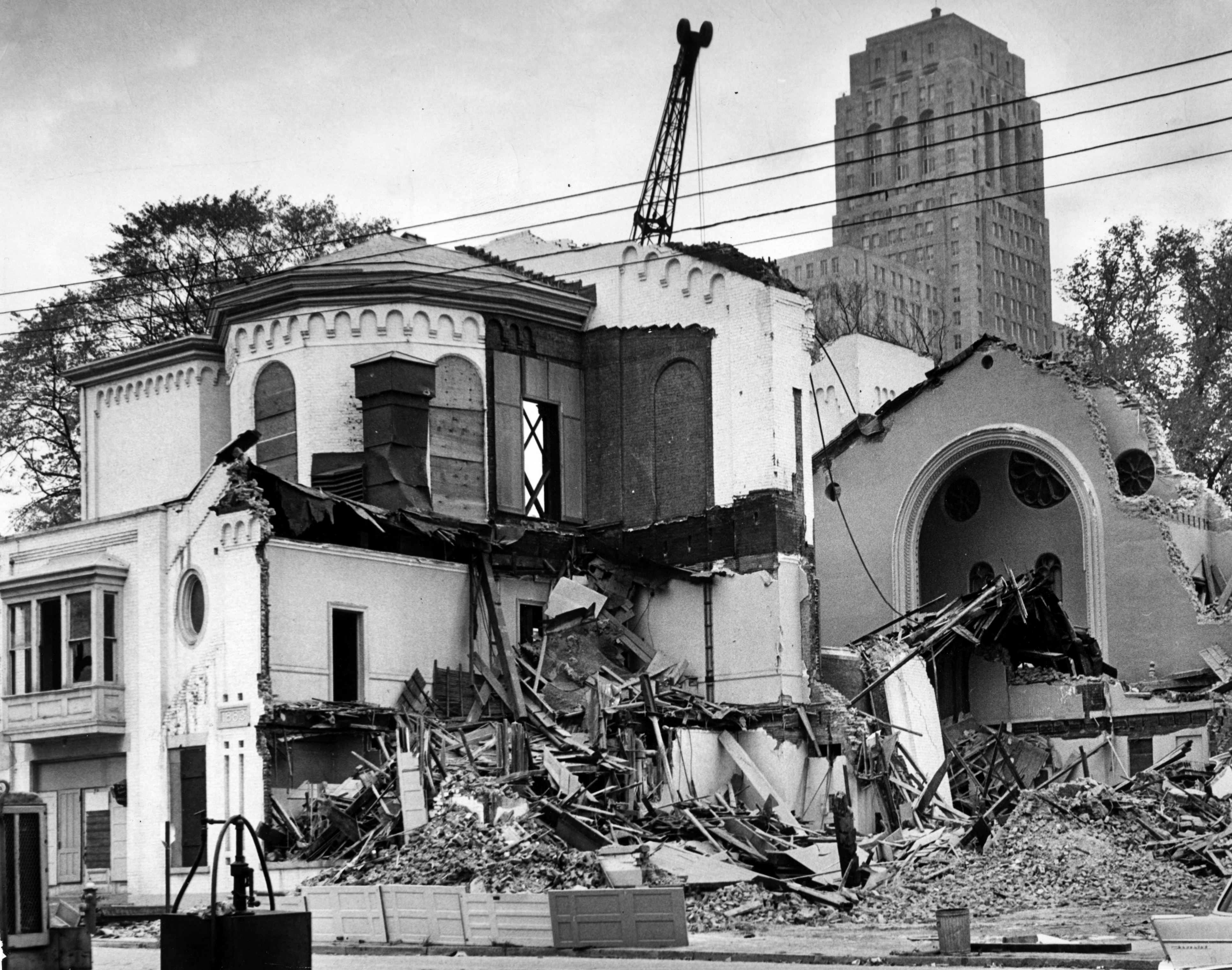
Did you see Chris Churchill’s excellent article “Empire State Plaza isn’t worth celebrating” in the Sunday, May 24, 2015 issue of the Times-Union? One of the illustrations is a photograph taken on October 19, 1964, showing the Jay Street facade of St. Paul’s Lancaster Street building, including the chancel and parish hall, just as demolition began. This is an image we’ve never seen, and we’d like to thank Chris for providing a high-definition copy for our records.

St. Paul's Episcopal Church is demolished to make way the South Mall Oct. 19, 1964, in Albany, N.Y. Historic buildings and streets 1960s, Empire State Plaza. (Times Union archive)

St. Paul’s Episcopal Church is demolished to make way the South Mall Oct. 19, 1964, in Albany, N.Y. Historic buildings and streets 1960s, Empire State Plaza. (Times Union archive)

For comparison, our archives has two color slides taken just before the Times-Union image. The first, a closeup of the parish hall, was taken in spring 1964, while the building was still in use.

Jay Street Facade May 1964

Jay Street Facade May 1964

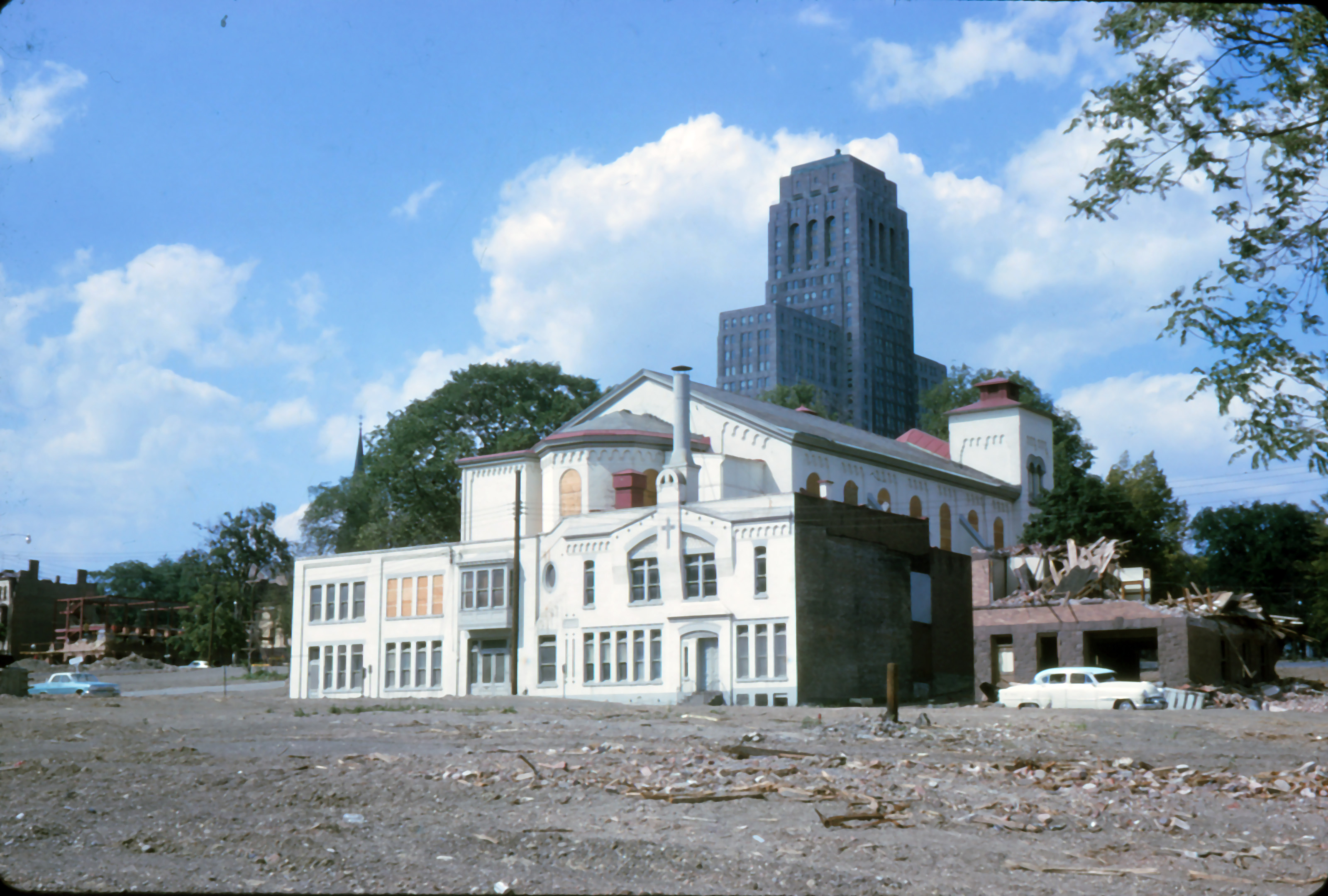
The other shows the buildings immediately before demolition began. Notice that the church and parish hall appear to have been the last structures standing in this part of the South Mall “catchment area”.

St. Paul's Jay Street Facade October 1964

St. Paul’s Jay Street Facade October 1964

Finally, here is another “after” photograph from our archives. This November 1964 slide shows the Lancaster Street facade after demolition. The frame of the nave rose window can be seen leaning against the rubble.

Lancaster Street facade after demolition

St. Paul’s Lancaster Street facade immediately after demolition in October 1964

Early Spring 1965 — Continued Construction Progress on Hackett Boulevard

Here is another set of unlabeled slides from the St. Paul’s archives, with nice views of the progress of construction. The slides were processed in April 1965, but there are no leaves on the trees and there may be a touch of snow on the nave roof, so the photographs may have bee taken a bit earlier.

First a good shot of most of the site, though only a bit of the chapel shows on the left side. This was taken from what is now the parking lot of Albany Medical Center’s South Clinical Campus, then Child’s Hospital. Was this still open land at that time? It seems not to have been paved.

Hackett Blvd April 1965, showing entire construction site

Hackett Blvd April 1965, showing entire construction site

Next, two dramatic shots of the west end of the nave, almost complete.

Hackett Blvd April 1965, exterior west end of nave

Hackett Blvd April 1965, exterior west end of nave

Hackett Blvd April 1965, exterior west end of nave

Hackett Blvd April 1965, exterior west end of nave

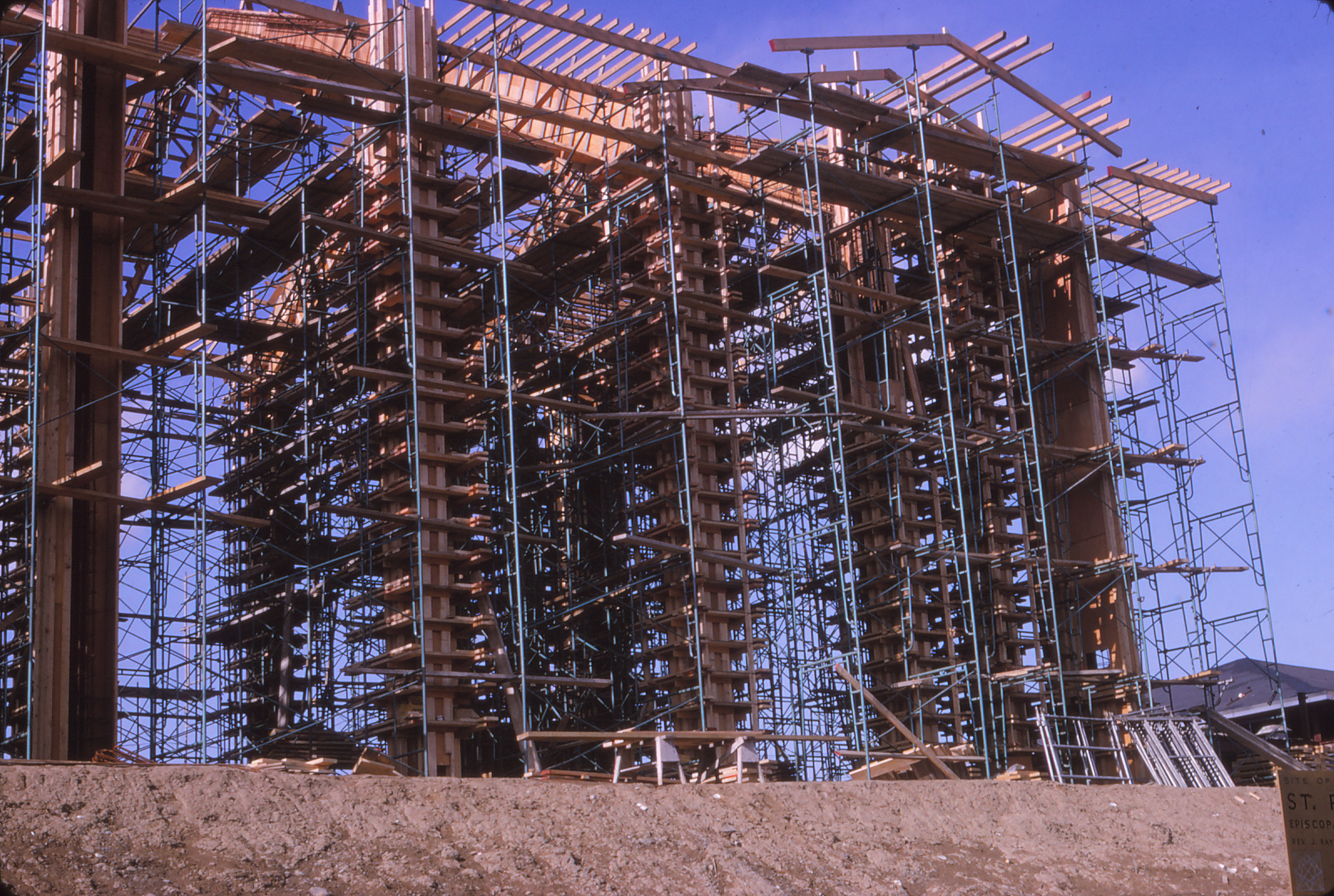
And finally, more detail of the nave construction, with all of the temporary supports still in place.

Hackett Blvd April 1965, construction of nave

Hackett Blvd April 1965, construction of nave

April 1860 — George William Warren Resigns as Organist and Choirmaster

Last month marked the 165th anniversary of George William Warren’s resignation as St. Paul’s organist and choirmaster. Well-known as an organist and composer in the nineteenth century and still remembered today as the composer of “National Hymn” (the tune to which “God of Our Father’s is usually sung), Warren was certainly the most illustrious of St. Paul’s organists and choirmasters until the arrival of T. Frederick H. Candlyn in 1915.

George William Warren

George William Warren

As you can see from his letter of resignation below, Warren served at St. Paul’s for a little less than thirteen years in the period between 1843 (when he was only fifteen years old) and 1860, with his final engagement at St. Paul’s lasting from August 1857 until August 1, 1860. Warren does not mention the dates of his earlier engagements, but the general picture is very clear from his own words: three-quarters of his professional life in Albany were spent at St. Paul’s.

Why, then, does The Hymnal Companion: Service Music and Biographies (Raymond F. Glover, ed.  Church Hymnal Corporation, 1994, page 651)  say that “at the age of eighteen Warren became organist of St. Peter’s, Albany, where he served from 1846 to 1858, then for two years at St. Paul’s, Albany.”? In future posts, I will explain the likely origin of this error, and show the correct chronology from contemporary records.

George William Warren’s letter of resignation as organist and musical director of St. Paul’s Church, Albany, is transcribed in St. Paul’s Vestry minutes, volume 3, dated 4 May 1860:

To the Rector, Warden and Vestrymen of St. Paul’s Church

Gentlemen:
About two weeks since, I was waited upon by a Committee from the Vestry of the Church of the Holy Trinity Brooklyn, N.Y. asking upon what terms I would remove my residence to that City, and take charge of the Music of their Church.  I was invited to visit them, inspect the Organ, and present my contract to the Vestry at their meeting of last Thursday. All this I did, and as my terms in every particular were instantly and unanimously accepted, I must necessarily beg leave to submit my resignation as Organist & Musical Director of St. Paul’s Church, to take effect the first of August ensuing, which time terminates the third year of my present engagement with you.

It has been my privilege to be a Church Organist in this, the City of my birth, seventeen years; and the best part of that time (nearly thirteen years) has been devoted to the musical interests of St. Paul’s. It has always been my willing duty to try to please you; if I have not always succeeded, the cause has been something else than lack of desire on my part.

From my heart I thank you, for the confidence and kindness I have always received from you, and now that I am soon to remove to another City to leave old and tried friends, and make every honest effort to win new ones, I am most anxious to carry with me the esteem of all those with whom I have been connected. May I not hope for a continuance of your friendship, and good wishes?

I am most respectfully
Your friend

George William Warren
Albany, April 24, 1860


November 1964 — Progress on Construction of the Hackett Boulevard Church

Our first post featured a snapshot of the July 1964 groundbreaking for St. Paul’s new building on Hackett Boulevard. Today, we have a gallery of images showing the progress of construction, from a set of slides in the church archives. The slides are all labeled November 1964, but they seem to represent several months of early construction.

The first three show early clearing and excavation of the site, with much of the original landscape is still visible.

Hackett Blvd site cleared for construction

Hackett Blvd site cleared for construction

Hackett Blvd site excavation

Hackett Blvd site excavation

Hacket Blvd site excavation

Hacket Blvd site excavation


Hackett Blvd site early construction of McEwan Hall

Hackett Blvd site early construction of McEwan Hall


The remainder seem to have been taken several months later, with construction well begun. It’s hard to orient oneself, but the roof-line of McEwan Hall is clear. Can the girdered structure be the choir room?


Hacket Blvd site. Early construction of choir room and McEwan Hall (to left)

Hacket Blvd site. Early construction of choir room and McEwan Hall (to left)